Showing posts with label L.A. Los Angeles. Show all posts

Monday, April 30, 2012

Coordinates: 3819 and 2827 Dunn Drive Culver City


THE LAWRENCE and Martha Joseph Residence and Apartments, also known as the ‘Hobbit Houses’ located right around the corner from Sony Studios at 3819 and 3827 Dunn Drive in Culver City looks more like a scene from a storybook than the average apartment building.
Lawrence Joseph, a former Walt Disney artist, brought a fairytale to life between 1946 and 1970 with these residencies in Culver City. Behind trees and tall blades of grass lies the cottage built in the Storybook Style. Pillars and garage doors made out of tree trunks, cobblestone exterior, and a wood shingled roof sits behind the green swamp inhabited by turtles.
A Conservancy's page on the complex said, "Joseph redesigned an existing single-family residence and added two two-story buildings with multiple units. He also created nautically themed interiors for the three buildings. The apartments feature galley kitchens, vertical-grain boat plank flooring, and built-in furniture with hardware made from boat latches. The interior looks like you are in a combination of a boat and tree house."
Los Angeles is a city built on fantasy, and this becomes even more evident when looking at the Lawrence and Martha Joseph Residence and Apartments. As I stood in front of the buildings I forgot I was in the middle of the city until I turned around and saw the normal street and the normal houses surrounding the fairytale apartments.


-Nastassja Habers
-Photo Credit: Nastassja Habers

Friday, April 27, 2012

Los Angeles Through its People: Descriptions from Christopher Isherwood

(Left to right) Gerald Heard, Christopher Isherwood, Julian Huxley, Aldous Huxley and Linus Pauling, Los Angeles 1960 -by Ralph Crane Image via Life magazine's Tumblr 

IN THE beginning of the semester I was wowed by Christopher Isherwood’s piece “Diaries.” His incredible descriptions and attention to detail made me see the beauty of LA.  Because this was one of the first pieces we read, as well as my favorite piece, it only seems right that it is my last blog post. 

One thing I found during my time in this class is that Los Angeles is defined by its people. While I was reading the piece, I noticed that the descriptions of the people he recalled in his journal described and defined the city.  For my final post, I wanted to take his words, his descriptions of the people he met, and use them to define the city of Los Angeles.

LA is a “universal figure.  She is the woman whose life everyone wants to interfere with” (234). 

LA’s “general untidiness was obviously calculated” and there was “a tiny plaster between her eyebrows, to prevent wrinkles from forming”(232-233).

“With bloodshot eyes,” LA yearns “to be told the secret of eternal youth, the meaning of life” (233). 

LA has “faint traces of extraordinary beauty,” and “showed little sign of inward calm” (233). 

LA is “both a parent and a child” (234). 

LA has “done what no other man alive today has done; he refused to become a god” (233).  Instead, he is who he is and makes no excuses.

LA is make believe and says, “‘Let’s pretend we are two other people—quite, quite different,’” (234).

LA “pays no attention to the scenery” (234). 

“If you watch her for a quarter of an hour, you see every one of her famous expressions” (237).  “She is so amazingly beautiful, so noble, so naturally compelling and commanding, that her ridiculous artificiality, her downright silliness can’t spoil the effect” (237). 

LA is an extra in a film.  A copy “of famous filmstars—literal copies, made without the least imagination or individuality," in which there was "not the slightest interest in Chaplain’s instructions—but, when the shooting began, they put up a surprisingly convincing performance” (240).

LA teaches. But, “‘the only thing we learn in life is waiting’” (236).

LA “works til he’s tired, eats when he feels like it, sleeps when he feels inclined” (247).

LA is a “character from a Scott Fitzgerald novel who’d passed out during a wild party and slept for twenty years.  Now she’s just woken up and thought this was all a horrible dream” (246).

LA makes you feel “a terrible, shameful, almost insane attack of self-pity and despair” because you “can’t turn her into a stage for [your] own private drama” (240-241).

LA “chain-smokes nervously.  But, as always, there is something very attractive and even stimulating about him” (242).

LA “glanced at herself in the mirror without enthusiasm: she was no longer quite fresh” (245).

LA "accepts the will of the majority as long as its his will" (249).

LA knows that “‘we can’t really stop your hair from falling out.  We know it doesn’t really matter about being well-groomed, or attracting girls, or making the grade, or selling your personality. We know you’ll grow old and die, and others will be born, and new tonics will supersede us, with new slogans and old lies on the label” (244-245).  And this is LA’s secret.  LA's tragedy.

LA makes you say, “Goodbye.  Goodbye. I shall see you often—but differently I suppose” (246).

-- Elise Fornaca

Monday, March 5, 2012

Getting Lost in the Santa Monica Mountains


TUCKED AWAY in the Santa Monica Mountains, off the Murphy Ranch hiking trail, are the remains of an unsuspected history from the 1930’s, a Nazi sympathizer campground. In 1933, Winona and Norman Stephens built the fifty-acre compound to be a self-sustaining Nazi community and a safe haven once America fell to Hitler. The Stephens and their followers believed Los Angeles would be where Hitler would rule the United States and restore order from anarchy. The Stephens and 15,000 other Californians believed in and supported Hitler, and thus there is a piece of deeply disturbing Nazi history attached to the city of Los Angeles, according to historian Randy Young in an article on Huffington Post.

 What seems like a never-ending staircase in between trees and shrubs leads down into the beautiful canyon with an ugly history. Once at the bottom the trail leads to a large building that was once used as a secret base for German spy, Herr Schmidt. The peaceful and tranquil atmosphere of the Santa Monica Mountains is replaced with an eerie feeling once the building comes into focus through the oak and sycamore trees, and Los Angeles’ startling Nazi past becomes real.


Today the base is covered with graffiti inside and out with empty beer cans and trash on the floor as Angeleno youth began using the secret Nazi base as a secret party base. Continuing along the trail there is a rusty red steel structure that has collapsed in several places. This structure too has been spray painted with a mixture of artwork and vulgar phrases across the standing sections of the steel structure.


To leave you have to go to back to the secret base to hike up more stairs. These stairs not only lead you back to your car, it also leads you to the large crumbling stone gate, which was the entrance to the ranch. Ironically, the Nazi sympathizer had the gate designed by prominent African-American architect Paul Revere Williams, also according to Young. The ruins of the Nazi campground are a piece of history hidden in the Santa Monica Mountains that is typically unknown to both Angelenos and tourists.
--Nastassja Habers
--Photo Credit: J.Jakobson, MagicRedShoes (Flickr)

Sunday, March 4, 2012

A City of Palm Trees


SINCE THE beginnings of Los Angeles’ history, L.A. was said to be the American Mediterranean, the new Latin shore, a paradise. However, it would have been a tough sell for the original L.A. boosters to advertise Los Angeles as the new Mediterranean paradise with the lack of palm trees, even with the consistently 'perfect' and warm weather.
Although nearly every street in Los Angeles is lined with palm trees, only one species of palm tree, the Washingtonia filifera, is native to California. All other types of palm trees that can be seen lining the L.A. streets are imported, and even the Washingtonia filifera is not native to Los Angeles.
Los Angeles didn’t become a palm tree guarded city until the turn of the twentieth century, with most of the palm tree planting taking place in the 1930’s. On Colorado Boulevard in Pasadena palm trees were planted every hundred feet, and was almost renamed "Street of a Thousand Palms." In Venice, two hundred Washingtonia Robusta palms, or Mexican fan palms, were planted along Washington Boulevard.
In 1931, thousands of palm trees were planted in Los Angeles by the forestry division, which also helped the unemployed find work. The planting project cost $100,000, put around 400 unemployed men to work, and 40,000 palm trees were planted alongside 150 miles of city boulevards spaced forty to fifty feet apart, and many still line the streets of L.A. today.
The iconic palm trees in Los Angeles serve no purpose other than to confirm the original L.A. booster’s claim that L.A. is in fact the new Latin shore and to provide a picturesque paradise of a city. They provide no shade from the constant L.A. sun and provide and no fruit. The imported palm trees serve as a mask for Los Angeles to wear to hide her reality and promote fantasy that can be seen on nearly every street of Los Angeles.
-Nastassja Habers
-Photo Credit: SuperStock

Monday, February 27, 2012

Untangling L.A.

I KNOW you're all blissfully decompressing on Spring Break, but I wanted to let you know that your blog got a mention on the KCET blog by writer D. J. Waldie (about whom I've spoken about  in class).

Here's a little snip:

Whatever the reasons, Los Angeles has resisted embracing its "vast accumulation of individual stories" in favor of a small store of familiar tropes: noir city, La La Land, fifty suburbs in search of a city, city of broken dreams, and the best worst place in the world.

These pages - UpDaily, 1st and Spring, Departures, SoCal, and The Back Forty among them - have been finding and telling other stories of Los Angeles since 2008. And their "vast accumulation" is only a part of what a lengthening roll of online storytellers bring to readers every day. So many storytellers, that it would be an almost impossible task even to survey them all.


And here's your closeup:

But I'd like to offer you one more - the students in Loyola Marymount University's journalism course, Telling L.A.'s Story.

Their encounters with Los Angeles (and the problems of story telling here) have the uneasy shock of first discovery. Their stories also have some of the rough edges expected of student writers. Their sympathies are not yet fully given, as they and the city continue a romance that could end badly.

A blog of million stories - including theirs - is not a mere accumulation, however.

Stories are the measure of a city's grandeur, the nerve fibers of its being, and its memories. The more stories we have and from as many tellers as can be recruited, the more we will redress this city's greatest lack: its failure to know itself.
 Keep digging, keep looking, keep thinking, keep writing.

Kudos to you all!
Onward.

-- L.G. 

photos: Union Station Passenger Terminal, Downtown
credit: L.G.

Saturday, February 18, 2012

L.A. "Protects and Preserves" Peace on the Beach


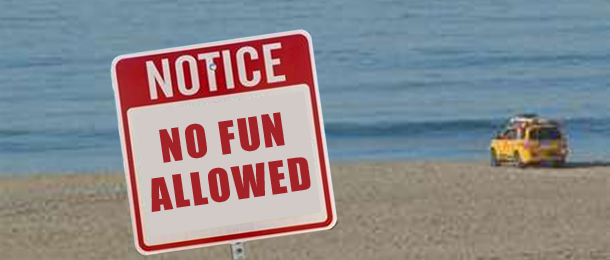
CALIFORNIA HAS been bankrupt for some time now; luckily Los Angeles is here to save the day. As of February 9, 2012 throwing a Frisbee, a football, or even digging a hole deeper than eighteen inches on an L.A. beach could end up costing you up a pretty penny, but thankfully it won’t be a $1000 fine as reported by every news coverage of the new laws. This law is intended to “protect and preserve the peace on public beaches,” as stated in the thirty six page fun killing document.


Throwing a ball of any kind, digging a hole deeper than eighteen inches, disturbing a rock, cussing, producing loud or odd noises, using a tent or structure larger than ten feet by ten feet, holding any group event with more than 50 people without a permit, including a yoga class, and operating a model airplane are all considered a crime on L.A beaches. Luckily these are only considered infractions instead of a misdemeanor. According to the California law, the fine for a first-time infraction will be $100. The second time, it will be $200. And each time after that, the crime of throwing a ball will cost you $500.


Fining people on Los Angeles’ beaches will only be enforced by lifeguards or The Department of Beaches and Harbors’ "peace or code enforcement officers" during the summer season between Memorial Day and Labor Day and will prohibit beach balls, volleyballs, Frisbees, footballs, or in-ocean water polo balls. Only during the off-season are people free to toss, throw, and dig as they please. There is some good news for those who come to the beach looking to do more than just soak up the sun, The Department of Beaches and Harbors will designate special ball-throwing areas or grant permits for a ball game.


This law seems to be a quick and easy way to a lot of money since throwing balls and digging holes are a given at the beach. L.A will make plenty of money from the law, especially when it comes to tourist who may not be aware of the anti-ball throwing and sand digging laws.


This new law is ridiculous. I have been to the beach almost every day for the past twenty years and not once has a football, Frisbee, or a hole deeper than eighteen inches disturbed my time at the beach. This law will change the atmosphere of L.A. beaches from one that is fun, free, and lively. Kids wont be able to try to dig a hole to China or dig a pool big enough for two like I did when I was a kid and adults wont be allowed to do anything other than lay out, swim in the waves, or go surfing or paddle boarding. Adults will however still be allowed to come to the beaches drunk, since that wasn’t added to the list of activities that will disturb the peace on the beach, which makes plenty of sense right? But whatever you do, don't pick up a ball or a shovel on an L.A. beach, or you will not only be committing a crime, you will also apparently disturb the peace.


-Nastassja Habers

Photo Credit: TK

Wednesday, January 18, 2012

Welcome to Our Island . . .

LOS ANGELES has struggled to just simply "be."

The "Arcadian Myth" --  that the city was a lush, verdant paradise, an untouched Eden -- wasn't quite accurate.   As well, that modern Utopian ideal that hopeful outsiders sought to build on what was essentially a desert floor didn't quite take root either.

So what are we left with?

If you've lived in Los Angeles for any little bit of time, you see how it is often "written over," broken down" like a set and re-built again and again --  in search of some different, elusive perfection.

That's the way it seems to exist both in our day-to-day lives as well as  in our imagination: What will I find today? What will tomorrow bring?

Here is the place for you all to explore the L.A. that you actually see day-in, day-out -- it's innate beauty, frustrations, blemishes, contradictions, possibilities.

Write deeply, write passionately, write honestly. Look. Listen. Feel. Smell. Touch it.
Remember, you're journalists writing the Los Angeles you experience not simply into view but into focus.

Welcome to our Island!

-- L.G.