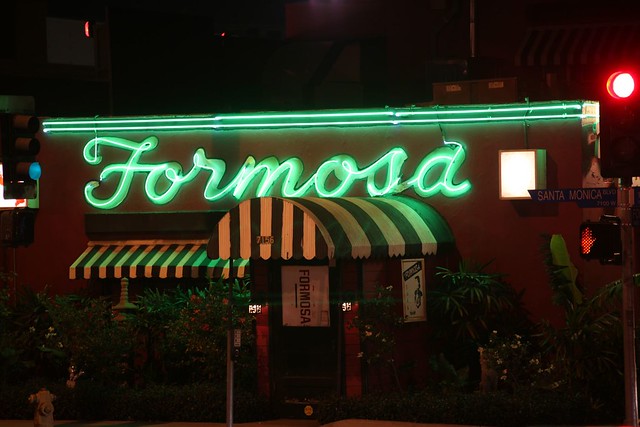
ON THE southeast corner of Santa Monica Boulevard and Formosa Ave there a neon green sign glows out of the darkness that surrounds. This intersection is unusually dark for a Hollywood intersection, unusually vacant. Quiet, even. Or maybe I am just too fixated on the neon cursive the sad-looking reddish lobster painted awkwardly at it's side. The nights is cold. I am wearing a vintage coat by Dolce and Gabana and feeling very Los Angeles.
Underneath the Fromosa Café there is--very luckily--a vast parking lot, flourecently lit, mostly empty. There are so many parking spots to choose from, it is almost eerie... like a mouth smiling without teeth.
At the front entrance, beneath a brown and white striped awning, I expect to be met my a door man, I expect a guest list or a reservation requirement or a secret password that I don't know. But there are none of these barriers--I walk right in, unnoticed, and join the already-tipsy crowd beneath dim, rust-colored light.
The walls are painted a rich, maraschino red, and on them hang rows upon rows of black and white photographs--photographs of old Hollywood stars who once drank and dined within these very walls. The whole place is a shrine for the creatures of talent who once roamed the streets, a nostalgic trip to a place of long lost charm. There is almost a sadness about the cafe, as if mourning the loss of something remarkable that cannot be retrieved. It makes me think of Joni Mitchel's lyric: "We can't return, we can only look behind from where we came and go round and round and round in the circle game." The Formosa Cafe seems to acknowledge this reality, taking great advantage of the fact that we CAN look back to where we came from (i.e the past) by showing us joy and melancholy in the black eyes of Marilyn Monroe...hoping that maybe her presence will stay with us if we plaster her photo enough places.
The original owner, Jimmy Bernstein, originally operated the Formosa Cafe out of a red car trolley in 1925! Because Jimmy originally set up shop directly next to the Samuel Goldwyn Studio, Hollywood's elite quickly took to it as a nightly hangout. For generations, movie stars have been drawn to the Formosa Cafe despite its quirky, unremarkable set-up. Although the Formosa does not look like it is bursting with money and fame, there is an inherent sense of glamour built into the walls, stitched into the setting...it is almost as if the essence of it's classy guests has lingered. Either that or it was built already having a beacon of decadence and wonder.
The Formosa Cafe is filled with legends. Humphrey Bogart and Clark Gable were known to dine and drink there on a regular basis. Frank Sinatra hung around in the 1950s, supposedly watching Ava Gardner from afar, longing to have her.
Inside the cafe, as well as all over the internet, one can find a list of over 50 celebrity patrons ranging from the 1920s to 2012, that include everyone from Marlon Brando to Britney Spears. What people do not talk about, however, is the equally strong history of drug dealing and prostitution, as the corner of Santa Monica and Formosa is not a particularly fancy one. In fact, prostitutes could be seen even during the day until 2004 when the West Hollywood Gateway shopping complex opened on the same block, ushering away the lower class.
Interesting, though, that for so long movie stars, drug dealers and prostitutes could coexist at the same corner bar. For this reason, the Formosa Cafe is the ultimate Los Angeles spot, bringing all that is glittery and all that is filthy together in one city, all that is fortunate and all that is downtrodden, constantly blurring the lines between the two.
-- Zahra Lipson
photo via flickr creative commons
Showing posts with label hollywood. Show all posts
Thursday, May 3, 2012
Wednesday, May 2, 2012
Coordinates: 6671 Sunset Boulevard
LOCATED ON Sunset Boulevard and Las Palmas in Los Angeles, Cross Roads of the World is considered America's first outdoor shopping mall. The mall features a central building designed to resemble an ocean liner surrounded
by a small village of cottage style bungalows. According to the Cross Roads of the World website, it was designed by Robert V. Derrah and
built in 1936.
It was once a busy shopping center, the Crossroads now hosts
private offices, primarily for the entertainment industry. It has been used for
location shooting in many films, T.V. shows, and commercials. According to the official website, a reproduction of Crossroads' iconic tower and
spinning globe can be seen just inside the entrance to Disney's Hollywood Studios at Walt Disney
World in Florida!
Today, Cross Roads of the World is the creative home of a variety of "unique offices" and Eckankar, a new church that "promises a personal experience with God every day". Some of the "unique offices" that I saw while exploring the Cross Roads were offices for music publishers and producers, television and film script writers, film and recording companies, novelists, costume designers, publicists and casting agencies.
While the monument still stands the same as it did 76 years ago, everything else has changed around it. The fact that it stood the test of time and has been preserved shows that not all aspects of Hollywood are easy to paint over and use as movie sets. That there are certains things, perhaps "firsts" in Hollywood, that are seemingly off limits in terms of tearing down. The pictures below demonstrate the contrast from 76 years ago to today. If you look at the bottom layer of the original building it still is exactly the same, only a difference in the inhabitants and businesses, perhaps acting as a microcosm for Hollywood and its movie sets: the sets remain the same, but the movies and actors are constantly changing, trying to stay fresh and relevant.
--Julian
Photo Credit: Present day ones are mine
Old photo is from the official website
Hollywood and Back
LAST WEEKEND I was doing my best to fulfill any clichéd adventures I could think of in Los Angeles. I began by seeing a movie at the Disney El Capitan Theatre. The film was Chimpanzee, and it featured a live animal show prior to starting. The drive to the theatre featured a twenty-minute commute down Santa Monica Boulevard, which featured a very different L.A. than the one I am used to. The scenic Beverly Hills neighborhoods immediately brought me back to the idea that West L.A. is a state of mind. When we finally got to the El Capitan half of the boulevard was under construction and it instantly reminded me that we were still in L.A.
The next day I made my way toward Beverly Hills via my
intuition. The progression of
scenery from Washington Boulevard and Centinela Avenue to Beverly Glen was
captivating. When I finally made
it to Frida’s Mexican Restaurant it was clear that I was in Beverly Hills. Luckily, the menu’s prices were not as
Beverly Hills as I thought they might be. During my meal a stray dog walked up to me, and was a lot
cleaner than my family’s dogs.
After lunch, I ventured toward Rodeo Drive to check out the tourist attractions
and shops. Unlike lunch, the
prices at these stores were very Beverly Hills. I only went in one store, and the prices of men’s ties were
the reason--$230 plus.
Lastly, I followed my intuition toward the Hollywood
Hills. The roads were windy and treacherous. I would drive miles without any stop
signs or streetlights, and the speed of cars behind me were dangerously
fast. I ventured through East Mulholland
Drive and stopped along all of the scenic viewpoints. Tour vans, with convertible tops, would frequent the street,
and I wonder what details the drivers knew that I did not. My stop before heading home was above
the Hollywood Bowl. I have never
attended a concert there, but the view of the Bowl and of the city, despite the
smog, was still amazing. While my
roundabout tour of West L.A. was long-winded and carried many identities, it
was well worth it.
Photo: Art Flores
--Art Flores
Labels:
april,
Art Flores,
Griffith Park,
hollywood,
tourist
Wednesday, April 25, 2012
Genius Loci: The "Spirit" of LA
A famous comedian's house with a scary secret...
A murder-suicide with many unanswered questions
A movie theater with a not so silent history
Celebrating 40 years of laughter... and terror
Surprisingly, many celebrities are still spotted here...
Monday, April 23, 2012
Coordinates: 1416 La Brea
PULLING UP to 1416 La Brea in Hollywood is not an easy task when you aren’t exactly sure where you are going - so after making U-turns from all four angles at the intersection of La Brea and Sunset, I finally spotted the location. The building has a charming exterior with what appears to be a brick house on the outside with a towering archway overhead that reads “The Jim Henson Company.” I tried to enter the gates beneath the archway, but a security guard kindly informed me that if I wasn’t there to see anyone in particular, I would not be allowed entrance. As I was backing my car back out onto the extremely busy intersection I had been frequenting for the past twenty minutes, I asked him “what is this place, exactly?” He responded like he was talking to someone who was a little looney, and said, “just a bunch of offices, ma’am.”
I took a glance at the plaque on the brick house-looking building before I left, and it read “Historic Charlie Chaplin Studio. Build 1917 Declared 1969.” Immediately I understood what was so charming about the place - it was a cozy studio, the type of establishment that characterizes Hollywood and what it stands for, but tucked away like a delicate gem on the side of one of the busiest intersections in the city. Chaplin, the first actor to appear on the cover of Time Magazine (1925), must have seen the allure as well, because in his autobiography, he described his decision to purchase the studio space by saying, “I decided to buy land in Hollywood and build [a studio]. The site was the corner of Sunset and La Brea and had a very fine ten-room house and five acres of lemon, orange and peach trees. We built a perfect unit, complete with developing plant, cutting room, and offices." No wonder it was so quaint; it had originally been a farmer’s home!
Chaplin purchased the land from a man who had been living on the lot for several years and decided that he would reside there as well in order to be as close to the studio as possible. The creative genius that he was, he had distinct a visual plan for the land. He wanted the six buildings on the property to be “arranged as to give the effect of a picturesque English village street,” which was definitely accomplished and can still be seen today. The cost of carrying out the studio was estimated at nearly $100,000, but when all was said and done Chaplin managed to create the lot he wanted for only $35,000 in just under three years. When it was finished, it was described by one writer as “eccentric Peter Pan architecture.”
There was a bit of trouble getting everything squared with the nearby residents, who complained that the studios were too close to Hollywood High School, but in the end the city was on Chaplin’s side and signed his permit almost unanimously. Not only were his living quarters and studio space incorporated on the property, but there were “stables, a swimming pool and tennis courts” (Wikipedia). The orange orchard that had existed when Chaplin bought the studios became the backlot for filming, where classics like “Modern Times” (1936), “The Great Dictator” (1940) and “Limelight” (1952) were shot.
Chaplin placed his footprints in wet cement outside of the studio, which was perhaps an inspiration for the Chinese Theatre. The studio underwent several changes during Chaplin’s reign, and one particularly notable change on one of the stages because of a fire during the production of the film “The Circus” in 1827. Chaplin enjoyed great company at the studio, including people from Winston Churchill to Helen Keller to Henry Lauder. By 1942, Chaplin sold part of the property (including his persnal residence, the tennis courts, and most of the backlot) to the company Safeway, where they wiped it all out to build a shopping center.
Greta Garbo had her last screen test there in 1949, and by 1953 Chaplin sold the rest of the studio to a real estate agent from New York for $650,000, gaining a hefty profit. Even though the investor was not planning on keeping it as a studio, a television company leased it from him and named itself Kling Studios. Several television series were shot at the studio, and in 1953 the “Adventures of Superman” were shot there was purchased by Red Skleton in 1960. Skelton bought $3.5 million worth of equipment for color television taping, and had a “Skelton Studios” sign put up on La Brea. But his ownership didn’t last long, and he sold the studio to CBS in 1962 where the “Perry Mason” television series was filmed for the next four years.
CBS sold the studio in 1966 to Herb Alpert and Jerry Moss where it then became the headquarters of A&M records. The stages and the swimming pool were transformed into a recording studio, and Alpert and Moss described their transformation by saying, "The old sound stages are in the process of being completely rebuilt into what must be the most luxurious and pleasant recording studios in the world. Chaplin's cement footprints are one of the few reminders of the past." Incredibly successful artists like Michael Jackson, Bob Dylan, Bruce Springsteen and Van Morrison recorded there.
Chaplin returned to the studio in 1972 after 30 years away from it when he came to America to receive an Academy Award, but instead of accepting an event that A&M wanted to throw him, he simply drove by the studio on a weekend day.
Then, in the year 2000, Jim Henson’s children bought the studio for a whopping $12.5 million in order for it to serve as “The Jim Henson Company.” Henson’s daughter Lisa has said that, “The buildings are a lovable hodge-podge of quirky, unusual spaces. There are unexpected elements in some of the offices like original vaults and fish tank-like bathrooms. It's not your typical corporate space, but it's ideal for the Muppets.” Henson’s son Brian said, “When we heard that the Chaplin lot was for sale, we had to have it. It's the perfect home for the Muppets and our particular brand of classy, but eccentric entertainment. When people walk onto our lot, they fall in love with Hollywood again."
And lastly, the designation of the lot as a Los Angeles Historic-Cultural Monument was certainly an important touch. In February 1969, the President of the Los Angeles Vulturual Heritage Board, Carl Dentzel, said that "His studio was one of the first to be established here and by some quirk of fate continuity from the movies' earliest times to today's television and recordings demands has persevered.”
Although the studio is no longer a sprawling 5 acres but rather 2.2, and it is not used for anything as glamorous as Chaplin’s movies or A&M’s “We are the World” recording, it is still a standing piece of Los Angeles history with a great backstory.
-- Jordan Younger
Labels:
Charlie Chaplin,
Coordinates,
hollywood,
Jordan Younger
Tuesday, April 3, 2012
Stan the Man
SUPERHEROES DON'T often reveal their true identity, but in Hollywood, it's hard to stay hidden. I met the man, the myth, the legend, Mr. Stan Lee. For those that don't know him, Mr. Lee is the creator of Spiderman, The Hulk, X-Men, and Iron Man to name a few.
I met him on the set of my internship a couple weeks ago; he was promoting his new comic book, "The Mighty 7", the world's first reality comic book — it stars fictional superpowered characters, of course, but also Archie head Jon Goldwater and "Stan the Man" himself. As I was anxiously watching his interview in the reception room I was running through all the questions I wanted to ask him: "How did you start writing?", "Who was your biggest inspiration?" "What drives you to keep writing?"
As I saw more and more "fans"(my coworkers) trickle in to the small reception room I came to the realization that I'd probably have to cut it down to one question and quick pic. So as he came out of his interview, I mustered up the courage to ask a lifelong hero for a picture, and he happily agreed. As we were posing for the photo, I asked him, "Any advice for an aspiring writer?" He grabbed my shoulder, looked me square in the eye, and chuckled, "Write my boy!"
--Julian
Photo Credit: Heidi (Coworker)
Labels:
hollywood,
Julian Portera,
March,
Stan Lee,
Superhero
Sunday, April 1, 2012
KTLA 5
KTLA 5, the number one morning news station in Southern California, at least that's what we've been promoting this fiscal quarter. I used to drive by the news station all the time as a kid, right off Sunset and the 101 freeway, little did I know I'd be interning there one day.
I wake up at around 2:45 a.m., get ready and must be in the newsroom at 3:40 a.m. to edit scripts for the 4:00 a.m. anchors in the studio. After editing scripts and making sure there are no errors, I print out 4 copies (2 for the anchors and 2 for the spanish translators) and literally run them over to the studio before we go live at the top of every hour. The fun doesn't stop there.
After coming back from running the scripts there are still developing stories that are being written as the newscast is going on, and guess who gets to run them throughout the hour? Me. As I'm editing scripts for the next newscast at the top of the hour, I also have to make sure that if a writer needs help on writing a story or adding photos I'm there to do it. It's controlled chaos.
There's never a dull moment in the newsroom, and rightfully so, we're in Los Angeles. There's always news to cover, celebrities to interview, and SIG alerts to report. So tune in, to KTLA morning news with Chris Schauble and Megan Henderson. KTLA news: Get Connected. Oh yeah, and you can catch a glimpse of me on dance party Friday at 8:50 a.m. on that big yellow number up there.
Here's yesterday's (Warning: "The Robot" was utilized for maximum partying):
--JP
Photo Credit: Me
Labels:
hollywood,
Internship,
journalism,
Julian Portera,
KTLA,
March,
television
Blue Collar Hollywood
AS YOU sit in the movie theatre, the lights go down and the movie begins, butterflies begin to fly with excitement because you will soon find out if they really end up together, who cheated, who is going to die, if the house is really haunted or if demons exist. You escape your life for a moment and enter into another. But what you many not realize is the life you are entering into is that of the men, in jeans and backwards caps who has made this their life and have literally created the world you are about to enter. Behind the plot, the costumes, the special effects, the elements that come together to magically take you out of your seat and away from the everyday there is the most basic element; the blue-collared workers that make this journey possible.Green, red, grey, black, brown plaid flannel, blue jeans with an accidental hole or two, tennis shoes or Timberlands, T-shirts hanging with yellow pit stains and baseball caps dyed pale from the sun and sweat. Yellow construction trucks and ladders. Sawdust and smog filter through the air. Bikes, pick up trucks and golf carts zoom by in a hurry.
A man in a blue T-shirt, thinned from being overwarn, slides the giant metal door of Sound Stage 17 open to assist his colleague with scraggly brown hair and a five o’clock shadow forming across his face life a large wooden sign reading “East India Trading Co” in gold calligraphy and place it strategically within the set. They turn, laugh and wipe the sweat from their brow as they turn on their heals to build the next part of the set actors will call their home.
Although they are forgotten, they are the one who make memories possible. The Titanic, a film that won eleven out of fourteen Academy Awards and grossed over $1.8 billion, would have been a lost memory and never have gotten to the big screen if it were not for the workers. Rose would have never been able to stand on the edge of the mast, spread her arms and fall in love with Jack, if the mast didn’t exist.
-- Elise Fornaca
photo via russellbobbitt.com
Labels:
behind-the-scenes,
Elise Fornaca,
hollywood,
March
Tuesday, March 27, 2012
Hollywood and Highland: Footage from the Fifities
THIS WAS up on Vintage L.A.'s Facebook page yesterday and made me very jealous. Boy did Hollywood look like a place you might want to visit because it had character and a certain elegance. The palm trees are pretty lovely too.
-- L.G.
Tuesday, March 6, 2012
Coordinates: Unearthing Vanished L.A.
SURFING THE internet a couple weeks back, I happened upon a website selling handmade trinkets -- mostly charms for bracelets, unusual earrings or cufflinks. They were conversation pieces; items that commemorated buildings, streetcars, supermarkets, bakeries and beer-brands that hailed from New Orleans, Louisiana yet were physically no longer in existence. The webmaster had titled the page -- "Ain't There No More" -- and I could hear that sentence delivered rapid-fire in one of my friend's or relative's idiosyncratic Louisiana Creole accents.
I have to say though, I thought, immediately, that the other L.A. -- our Los Angeles -- could have not occupied just a page, but an entire other city dedicated to what isn't here any longer.
Often, you'll hear Angelenos dolling out directions by referencing markers that were once in its place. It's a strange way to live in the present. Our memories are cluttered with such locations. Some addresses have had multiple identities and lives within one building -- like a brick-and-mortar nesting doll; others sites continue to be razed entirely and built up over and over again and so often, Angelenos really have to force the recollection, because even the landmarks nearby have been "updated," "renovated," "retrofitted."
We live in a place filled with the promise of new beginnings and the impatient expectation of them. We want Los Angeles to be "the fix," the geographical solution to our problems. That's a lot to heap on a city's shoulders.
Above, you'll see a charming building, one that when I look at it conjures F. Scott Fitzgerald short stories or the beautiful black-and-white movies I would stay up at night to bathe in the blue glow of on the old Channel 11-KTTV (decades before it was known as Fox). This was once the old Hollywood Hotel and it stood at the corner of Hollywood and Highland, which many of you know now looks - sigh -- like this below.
As if we needed another mall, really.
In the next few weeks under the tag "Coordinates" you'll be reading posts from a couple of guest bloggers weighing in on various spots on L.A.'s vast grid -- former empty lots, college hangouts, late-night watering holes, down-at-the-heels hotels -- now turned into McMansions or coffee chains or any number of mixed-use playgrounds. What sort of memories and histories do these re-imagined spots hold or trigger? What old boundary lines did they once draw? What community did they once host?
The above images come from the wonderful Facebook page, Vintage Los Angeles. Check it out for a mind-blowing compare and contrast of then-and-now L.A.
And below, check out the trailer for the film "Hollywood Hotel" in its black and white glory.
-- L.G.
Labels:
Coordinates,
hollywood,
L.G.,
movies,
Vanished L.A.
Monday, March 5, 2012
"Anchor's Aweigh"--Exposing the Boosters
YELLOWS, REDS, blues and oranges lit up against the neon
pink sunset. Street carts selling
fruits, handmade dolls, trinkets, skirts, hats lined the cobblestone streets as
the scent of tamales wafted through the air. Dark-haired men wearing sombreros and women wearing big
flowing skirts are playing instruments and waiting for the occasional passerby
to buy an item from their cart. Gene Kelly, followed by Frank Sinatra, dressed
in a blue Navy uniform, walks up to one of these carts and to ask the vendor a
question. Although it may seem
like these two famous actors from the 40’s are taking a vacation in Mexico,
they are actually just outside of the MGM Studios lot in, none other than, Los
Angeles.
LA was founded upon this false identity forged by its founding
boosters. I never realized how prevalent it was until I watched a one of the
classics from its time that replicated all these ideals that the boosters
promoted. “Anchors Aweigh,” a 1945 movie starring Frank Sinatra and Gene Kelly tells
the story of two sailors that are on leave in Hollywood, Los Angeles. The scenes switch between what was
then, the MGM studio lot and this little two that was previously
described. This is what the
boosters promoted, the mending together of the dreams of fame and the promise
of warm weather, in a beautiful town surrounded by Hispanic influence.
At the end of the film, we meet Frank Sinatra’s love match
and the illusion of the boosters is broken through. She is a beautiful blonde from Brooklyn, New York, who, like
many, came to Los Angeles because her “nose and the rest of her body were
blue.” The allure of the LA weather and the utopian world was the true pull on
her to come to the “magical land.” However, as she finds herself working in a
Mexican restaurant as a waitress, a true oxymoron of the utopian ideal and
truth behind its mask, tells Sinatra’s character, “My nose isn’t blue anymore,
but the rest of me is.” It is
still interesting to me that even in a lighthearted film of that time,
filmmakers can find the cracks behind the façade.
Labels:
boosters,
Elise Fornaca,
February,
hollywood,
movies
Subscribe to:
Posts (Atom)