Showing posts with label Santa Monica. Show all posts

Wednesday, May 2, 2012

Visiting LA


EARLIER THIS month one of my best friends from high school, Mariah, unexpectedly called me up to tell me “Hey, I’m in LA, when can I see you?” I was quite excited, but I am also not the most spontaneous person - my days that week were precisely planned with exactly what I needed to get done in order to prevent procrastination and excessive stress. So her and her friend, who had driven the entire way here, crashed on my couch for a few days. They had a car and everything, but they waited until Friday night to go out. They just hung out in my apartment, both when I was there and when I was in class. If I had driven so far, I would for sure be maximizing my time wherever I was. They had no idea how lucky they were! A free night on a weekday to explore? I would kill for that, and not just because Thursday night is the night all the celebrities come out - according to the paparazzi my friend Lauren and I had befriended one random Saturday night. 
When they did go out, they wanted to go to Hollywood and Highland. That’s the same place my other friend Lyndsay wanted to go when she visited. And then they wanted to eat at Saddle Ranch. They went to Venice, and the Santa Monica Pier. I’ve been to all these places - except Saddle Ranch - but I kept trying to tell her that there are so many other places in Los Angeles that are much cooler and more interesting. But they insisted, because it was Mariah’s first time here. Are we only allowed to find that out after we’ve visited all the touristy places? They’re not all LA has to offer, but maybe you come to the city and think you’re missing out if you don’t see all the stereotypical places for yourself. What they didn’t know was that, by only going to those places, they actually ended up missing out on a lot. But then again, maybe you have to experience the stereotype in order to be able to move beyond it. 
-- Allie Flinn
Photo Credit: from Flickr, taken by Shawn S. ParkVi

Sunday, April 22, 2012

From Shepherd's Pie to "Sexy Tuesdays" and Back Again: Life at the Cock n' Bull Pub


WHEN DRIVING  by the Cock n’ Bull pub, the only thing that makes it stand out from the many other businesses on that stretch of Lincoln Boulevard is the big red British phone booth. The building is a bit old and faded, the door is wide open allowing you a glimpse of the patrons inside, and occasionally a person or two stand outside with plumes of smoke trailing out of their cigarettes. You might pass it by. Los Angeles is a made place furthered by establishments that run on gimmicks instead of authenticity. The Cock n Bull, a rare unpretentious establishment, could have been one of those places.
Julie Bray, who moved to Los Angeles 20 years ago, remembers a time when the only patrons at the Cock n Bull pub were elderly British gentlemen. Bray and her friends had a penchant for dive bars, and when they found the pub in 2001 it seemed like perfection - authentic, with excellent Shepherd’s Pie, and decidedly not crowded. “The average number of patrons even on a Friday or Saturday night was about 10,” says Bray, a welcome escape from the popular sweaty crowded dive bars or, perhaps worse, the uncrowded dive bars that were that way for a reason. The Cock n Bull had no reason not to be crowded, and Bray and her friends were not going to be the only ones to discover that.  
In the four years they frequented the pub, at any given time, Bray and her friends were the only women in the pub. This earned them the nickname “the girls” from the bartender. “We’d walk in and Dave, one of the bartenders and half owner of the bar, would call out ‘the girls are here,’” Bray says, though the only people there to hear him were the 70-80 year old men who, no matter the time of day, had been drinking for hours.
Given the limited conversation options, Bray spent a lot of time talking to Dave. “He even gave me a ton of barware to use on the tiki bar at my apartment,” says Bray. For her, with its dim lights and unique clientele, it was a haven away from the busy city.
That all changed the day the Cock n Bull was listed on one of the local TV stations as the best sport’s bar in LA, because it would open up at two in the morning every Saturday and Sunday to televise soccer games live from the UK. 
“After the television story it became really popular,” recalls Bray, “and it was crowded every night with up and coming hipsters.” Aside from the change in population, the bar’s appearance also took on a new vibe. The beloved Shepherd’s Pie was taken off the menu because it required so much time to prepare, and the bar, once lovingly dim, became more heavily lit. “No dive bar looks better with the lights on,” says Bray. Even the die hard, elderly British men were driven out of their spots. 
Before then, the only time the faded walls of the bar had been filled side-to-side was on the night of the Australian Rules Grand Final, an event Bray describes as “the Australian version of the Super Bowl.” Bray only attended one more Grand Final after the television story ran, because though she was used to the crowd on game night, that time she recalls, “The crowd was much different than before. A little edgier, a little angrier. So it was hot, annoying, and a little scary.”
As far as entertainment goes, Bray and her friends did just fine with the televisions, dartboards, and ratty pool tables. Now the pub offers theme nights like Thursday night trivia and “sexy” Tuesday salsa lessons. 
Sexy is the last word that comes to mind when picturing the pub. The lights are far too harsh and flickering to be sexy, and so are the clientele. On a recent Friday night, on the far side of the bar, tucked away in a corner a little darker than the rest of the room, are the remnants of the hipsters who came because of the television show. They sit and watch the door, looking each person who comes in up and down, as if they were the ones who discovered the place. Tight pants and beanies, with dyed hair and too cool glances, they thrive in the dark corner like unwelcoming moss.
Another group sits near the door and the dartboard, laughing and talking in voices tinged with British accents. They sit as if they are regulars, and unlike the posing group in the corner, greet visitors with friendly looks. The long bar with it’s tall seats, at first only punctuated with the occasional person, begins to fill up and fill in as the night goes on. Only one bartender works this Friday night. He is Dave, and he recommends the Carlsberg beer and speaks in a soft voice with a heavy accent.
It is the kind of place where you fear to use the ketchup bottles. A modern jukebox, mounted on the wall, is a jarring juxtaposition from the clear, shiny, faded, old beer signs that hang framed on the walls, along with a dartboard and a row of old guns that are lined up on a rafter near the ceiling. Behind that rafter are the pool tables, and a game is going on between a group of men who look like they go to a lot of dive bars. Though more people come in the later it gets, it only hints at the fickle crowds that used to come. Perhaps on game days it picks up. 
A mural of John Lennon provides a backdrop for a small raised platform that functions as a stage on live music nights.
The lights are too bright. An elderly British man sits at the bar, eyes glued to the TV, speaking only to dispute football (English, not American) with Dave. He stays there through all of the comings and goings that Friday night, on a stool that wasn’t chosen at random.
And the Shepherd’s Pie is back on the menu.

Photo via Cock n' Bull's Facebook page

Sunday, April 1, 2012

Penthouse View

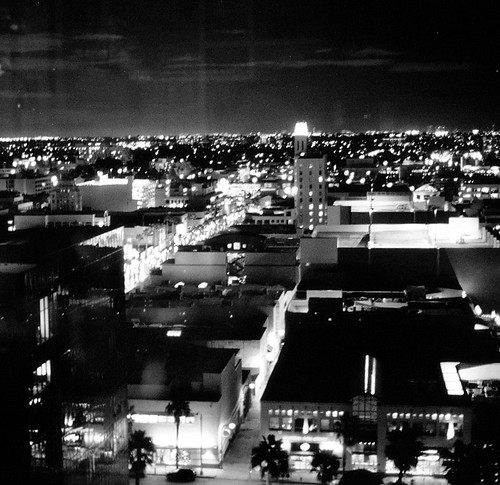
Santa Monica as seen from The Huntley
THE PENTHOUSE restaurant and bar, perched on the top floor of the Huntley Hotel in Santa Monica, is known for its panoramic views of that city and the ocean. Great windows line every wall continuously, even in the bathroom, which makes the place even more specifically known for its view of the ocean from the last stall in the ladies room.


The view inside is also something to be remembered. So many of the stereotypes of LA come alive there. I went there a couple weekends ago with my friends, and we were the youngest people there, but luckily only by a few years. The entire floor was packed, and though the room was lined with luxe cabanas, no one was sitting at them. That’s because the minimum price for a table was $350, and everyone was dancing to the mixture of pop songs coming from the DJ’s table anyway.

You had the businessmen in suits. The hipsters. The dyed blonde, stick thin, middle-aged woman who was tottering about in high heels with an unnaturally large chest. The young women clad in super expensive clothing. Ousiders, insiders, people on the cusp. Everyone was there. It really makes you wonder where you fit in in all of this, and what all those people think when they are looking at you.

It was a great place. Fun, and trendy, and excellent people-watching. Given all the spectacles to be seen (or looked away from, I didn’t realize I was going to have to relive parts of my high school dances), it is relatively surprising that one person stood out from all the rest.

Let’s call him the “sensitive artist.”

A section of the floor deigned a few couches and some comfy looking chairs, all of which were filled by the time we got there, so he must have staked his claim quite early. He sat there, in the back of the room, reading a book. This, I thought, was a little odd. When someone got up and my friends and I pounced on their seats, I was able to get a little closer and see which book he was reading. It was “A Midsummer Night’s Dream.” No joke. This guy was reading Shakespeare at 12:30 a.m. in a hip, crowded bar. Even I, and English major who happens to love Shakespeare, would never fall for that. I wanted to ask him why. It seems so odd. I have to believe it was to pick up girls. I can’t think of another reason. So I guess it kind of worked, because I was quite curious about him. Eventually, he moved closer to the dancing and then he left. I went to the bathroom with my friend and waited for the last stall so I could check out the ocean.

It was a great view.


-- Allie Flinn

Photo from Flickr, taken by kristi.nicole

Tuesday, March 13, 2012

Lords of Dogtown: "Poetic License"


JUST A QUICK riff on Caroline's post about Dogtown and Z-Boys.

Not too long after the documentary about the Westside skate tribes made its rounds, a feature film based on their story premiered on the big screen in 2005. The film,  Lords of Dogtown, is the dramatized retelling of the story of skaters Jay Adams, Stacy Peralta and Tony Alva. 
Jay, Stacy and Tony -- the "Hollywood Version" in  Lords of Dogtown
Directed by Stacy Peralta, (who was part of the scene and also prominently featured in the doc) Lords of Dogtown explores the same ground yet via a different prism.  It's a clarifying compliment to watch the two side by side. While 2001's Z-Boys was frank, edgy and gloriously frayed at the edges in a realistic way,  the Lords of Dogtown is all mood,  evoking a re-enacted of-the-moment "sense of place." It speaks to some elements we have been discussing in class -- voice, point of view and how memories of places and scenes now gone -- unfold differently in various hands.

Jay Adams, for one, pretty much thought the film was in a way, Dogtown Lite.That, however, he suggests, was largely the problem with the Hollywood version of gritty subcultures:

 "Movies about surfing and skateboarding have always turned out to be pretty bad. Usually they're pretty corny. The only one that I ever really liked was “Big Wednesday.” Movies like “Thrashin” made me want to hide. I think “Lords of Dogtown” was kind of like “Blue Crush” but for little boys instead of girls. “Blue Crush” was a little girl movie. I thought they did a good job on it. I thought the same for ours. I mean, it was PG-13. How real can it be?
First of all, Stacy Peralta never hung out with us. He was a Z boy, but he wasn't a Dogtowner. I have to give Stacy a lot of credit. Think of how hard it would be to write a movie about yourself and not come across as being big-headed. Stacy was a really great skateboarder. He did good in contests and was smart as far as making money is concerned. Some of the things in the movie were true, but a lot were made up just to make the story better."

Adams has photographed and written extensively about the scene himself.  You might want to check this out too. 


Here's a couple of windows in on that moment in L.A via Stacy Peralta's POV.:

Lords of Dogtown: The Trailer: 


 Pool Skating: Let's turn "the dream" inside out . . .


-- L.G.


Monday, March 12, 2012

Dogtown and Z-Boys: L.A. Then and Now


"There is a place where American manifest destiny collides into the Pacific Ocean. This is Dogtown"
--Dogtown and Z-Boys

DURING class last week, I jotted down some ideas for blog inspiration while our speaker, Mike the Poet,  recited his poems by heart while occasionally inserting Los Angeles tidbits and suggestions for our reading and viewing. Among these ideas were the words and phrases, "Venice," "Cold cases/unsolved mysteries," "The Black Dahlia," "Noir," "Gary Phillips," "Dave Eggers," and "Dogtown and Z-Boys." Inspired by my list, I decided to watch Dogtown and Z-Boys, a documentary about skateboarding and surfing in Los Angeles in the 1970s. Although, as a native Texan, I have never surfed or skateboarded, I found the documentary very interesting, especially because of the illustrations and images it provided of old Los Angeles. I have always thought that in order to understand a place better, you must first understand it's history, and Z-Boys offered a glimpse of what Los Angeles was like back in the 1970s through telling the story of the Zephyr skate team and how they helped shape modern skateboarding into what it is today.

I find it hard to summarize the documentary because it presented so many personal stories and interviews from the Zephyr skate team, but in a nutshell, it discussed how skateboarding and surfing have come to be what they are today through the influence of a group of Angeleno kids who simply loved to surf, skate, and have fun doing so, yet accidentally and inadvertently created a cultural phenomenon, transforming skateboarding to something that was considered an insignificant hobby to a sport, lifestyle, and attitude.

One of the most surprising aspects of the documentary was the discussion of the image surfing used to have. Now, especially in California, surfing is a popular and arguably "cool" thing to do. It requires talent, money, and often a proximity to the beach. Most kids who live near the beach are often skilled in surfing or have at least tried it. The kids I babysit, who live in Manhattan Beach, often go to the beach to surf on weekday mornings for school, as it is considered a sport for Physical Education class. However, surfing in 1971-72 was completely different and was considered an outcast sport. Surfing was not something you did to build your self-esteem or gain popularity, but was rather an antisocial activity done by kids who were considered drop outs. From surfing, skateboarding became popular because when the waves died down by 10am, Angeleno kids needed another hobby, and so they glued wheels from hand-me-down roller skates to pieces of plywood and practiced the surfing tricks they learned in the water on land, using empty swimming pools as their creative canvases.

The most astonishing and inspiring aspect of the documentary was the general message that these kids weren't trying to create a phenomenon through their skating--they just wanted to be kids, having fun and doing what they loved, and this genuine passion and talent for the sport manifested itself into an entire movement, as skateboarding became so popular that skateboarding magazines were the best sellers at gas stations. The kids who decided to take advantage of their new found fame and market themselves traveled across the country and became famous everywhere, even abroad.

As for what I learned about California, I jotted down and copied below some notable quotes that reflect how Los Angeles used to be. The vintage black and white pictures and videos of the Zephyr team skateboarding in empty pools, (drained due to a serious drought at the time), and surfing on crowded beaches offered a view into Los Angeles circa 1970.

A quote from the film on the striking differences between parts of Los Angeles that we have talked about in class and that still exists today:

"There is an invisible line of demarcation from the North side of Santa Monica and the South side. On one side, there are trophy houses with a lot of money, and the other side isn't like that at all. There is a visible financial line: If you lived above Wilshire you had money, if you lived below Wilshire, you wanted their money."

I am not sure where exactly these visible financial lines exist today, but judging from what I have seen of Los Angeles and how it can go from astonishingly wealthy to extremely run-down in a matter of minutes, I have no doubt that many of these lines are still present today. There isn't just one line of demarcation, but multiple lines, and through my adventures exploring new parts of L.A., I hope to find them.

Link to watch the entire documentary (in 8 parts) online: http://www.ovguide.com/dogtown-and-z-boys-9202a8c04000641f80000000002fc241

--Caroline Queen
--Photo Credit: Amazon.com

Thursday, March 1, 2012

Let's Get Lost - Corner of 2nd & Wilshire

Fig Tree at the Fairmont Miramar Hotel
photo credit: Google Images

AMIDST THE chaos that is the city of Los Angeles, there is a place that radiates warmth to me - the corner of 2nd and Wilshire. Standing on the busy sidewalk you will encounter people bustling to work, sauntering back from the beach, strolling with an armful of shopping bags, or, of course, begging for change. This corner is a place I have spent quite a bit of time at over the past two and a half years I have lived in Los Angeles, but I am referring back to it for the idea of getting lost in L.A. because it was the first place I wound up in when I moved to L.A. and I was lost; albeit a sixty foot radius from the sun-spotted beach.

As I sit here today and take in the beach covered in mid afternoon mist, I can't help but smile. My brother once deemed Santa Monica a magical place in that "people are fun enough to party all night but active enough to be up for their morning jog," which is a description that rings true in this moment. There is always activity in Santa Monica, and from my perch on 2nd and Wilshire I can observe that activity and relish it for what it is - the type of area people dream about when they envision Los Angeles.

The corner has a neon brightness from the white light of the sun compared to the dimmer streets perpendicular to it, and maintains a peaceful air while it's 3rd street counterpart is packed with shops and popular eateries. This corner is quiet, boasting a hair salon and a dog groomer as well as smaller cafes and doctors' offices.

The aspect of this corner that makes it feel like a slice of home to me is the Fairmont Miramar hotel that spans the area between the corner and the beach. It is the hotel I stayed at with my parents the night before I started college, and it is the place that they stay each time they come and visit - which is twice as often as most of my classmates' parents! Any time I have taken a friend to the hotel to hang out with my parents, they comment on the gargantuan fig tree that sits in the middle of the sprawling entrance. Someone once told me that they purposely built around it to garner a homey feel.

And, at the end of the day, of course there is the beach. If you walk less than a mile into the bright sun you will reach Santa Monica Pier, with its gorgeous view and infamous rides.

Santa Monica is one of my favorite places to explore in Los Angeles, and the corner of 2nd and Wilshire is just one of the many spots I hope to find during my time living here.

-- Jordan Younger


Wednesday, February 15, 2012

My LA: Eclectic Avenues

 WALKING THROUGH downtown Santa Monica this past weekend was a stark reminder of the eclecticism that is Los Angeles. A man with no shoes, dressed in rags, sits on the floor alongside a couple of businessmen, sitting at a patio table of an upscale restaurant.  The pattern continued as the journey progressed, outdoor patios with carefree patrons, and the homeless, sitting on the floor next to them, with signs of desperation.
            Street performers and nonprofit workers filled the sidewalks.  Attempting to get donations and per chance get their name out there, or the organization they represent, these people put passion into their work, hoping that people would contribute to their cause.  I decided to stop and ask one person in particular about her situation, as she was asking for donations for her cats.  It turns out she was a part of a non-profit organization that helped rescue stray cats, and she herself had adopted all of the cats that she had with her, which amounted to about 15.  When I asked her why she decided to adopt all of these cats, instead of just drop them off at an animal shelter, she looked me directly in the eyes and passionately said, “Because if I wanted them to die, I would have left them where they were”. I felt embarrassed for asking and decided to donate to her cause, realizing that she was doing what she felt was the right thing.
            Most believe in the myth of Santa Monica. They see Santa Monica as a predominately upper- class area, with upscale shopping malls and five star restaurants to boot.  Most come to shop and perhaps visit the pier, and enjoy the beautiful ocean and view that it encompasses. The truth is there’s much more than that.  There are the people that inhabit it that make it a truly diverse community.  Whether it’s a beachfront property, or a park bench with nothing to comfort you but your guitar, these people are simply looking to make it in this city, no matter the age.
            I saw a little boy, no older than ten, walking by himself down the promenade, sporting bright red DJ style headphones covering his ears and bopping to the music. He was dressed in a plain black tee and brown skinny jeans, looking like the direct descendent of a “hipster” family, with high top Chuck Taylors to match.  This image made me realize just how eclectic this city is, and how my interpretation of reality and what is supposed to happen and how people are supposed to act, is really something only I’ve created.

--Julian Portera
Photo Credit: Myself