Showing posts with label February. Show all posts

Wednesday, March 7, 2012

Hollywood Cake


AT THE Chateau Marmont on Sunset Boulevard, you can order the "Hollywood Cake".  The cake, as presented above, is chocolate and comes with lines of powdered sugar, arranged to resemble lines of cocaine.  The cake is placed on a circular mirror and accompanied by a candied, edible dollar bill. What is trying to be said with this cake? It is simultaneously a celebration of and a playfully mocking critique on a favorite, deadly Hollywood habit.  It comments lightly on the subject of this drug as if it is something humorous, completely overlooking it's life-ruining qualities.  Ultimately, shockingly, the Hollywood Cake ACCEPTS cocaine, admits somewhat proudly to the Ziploc bags and tiny vials of powder hidden in wallets and pockets all around the room.  Think of the gradual melting of the frontal lobe, think of the cardiac arrest, the emaciated frames and corroded noses, the thin streams of blood that drip, the pale eyes that roll back... none of that is acknowledged in the Hollywood Cake.

 As everybody gathers around the cake, prodding hesitantly with forks, nobody is thinking about John Belushi who died of a drug overdose in one of the rooms upstairs, nobody is thinking about Lindsay Lohan who lives here now, scolded again and again for her use of this very drug.  Is it okay to celebrate Cocaine but not okay to snort it? What then are we celebrating? The high? The escape? Escape is the mantra of Los Angeles, the city whose name even nods at imaginary, idealized creatures.  What, here, are we trying to hard to escape from? Why is escape so valued in LA that it gets its own cake despite dark, destructive associations? The powdered lines become an escalator away from the mundane, away from the pain of being average.

Los Angeles feeds us a lie, an illusion that something heavenly, something divine lies just on the other side of the wall. That lie is sweet and seductive, that lie is toxic, that lie is Hollywood Cake.

In the bathroom, powder residue lingers on the sink. This is real: Cocaine isn't a dream or a nightmare, it is a reality that goes on enhancing brief, flickering moments while destroying lives. Cocaine is still a tool for the unhappy, condemning spirits to emptiness, sealing despair with despair.

As we can see by this cake, cocaine in Hollywood is looked upon with ease and humor, as if it were pixie dust, something airy and light we inhale simply to feel better.

-- Zahra Lipson
Photo: Zahra Lipson

Tuesday, March 6, 2012

In Los Angeles, You Can Reach for the Moon


 HOT AIR ballooning in Napa Valley? Very Californian. Lifting a house up into the sky via balloons? Very Angeleno. Anyone who has seen the Disney/Pixar animated film "Up," in which a house is triumphantly launched into the sky by the protagonist, will appreciate this accomplishment, which was performed last March by a team of "scientists, engineers and two world class balloon pilots" according to design-dautore.com. The extravaganza took place for a National Geographic special titled "How Hard Can it Be?" that will air later this year.

      It is very telling that this accomplishment took place at a private site slightly east of Los Angeles, because Los Angeles is a haven for those who want to reach for more. In Los Angeles, the average person can reach for the moon, and in this case, they can reach for the moon from their very own living room.

    I knew I had to blog about this photo because when I came across it on a friend's Facebook page, I thought to myself, not knowing where the flight took place, "that's something that would happen in Los Angeles."As I read the caption beneath it I came to realize that although it occurred slightly outside of Los Angeles, there were Angelenos behind the project that brought it to a workable base (after all, something this whimsical would be impossible to pull off in the city). 

    Los Angeles is a town that makes dreams come true, whether you go right back to Disney making dreams come true in "Up" - and, of course, Los Angeles is the home of Disneyland - or take a glimpse of Angelenos strolling down the street. People come to Los Angeles to follow their heart, no matter how big their dreams are. When I first came to L.A. I quickly ran the gamut of "dream following" careers from actress to screenwriter to film director to photographer to author before settling on the notion that here, as long as I continue with my education, I can do any of those things.

    Lifting a house into the sky with a group of balloons is a testament to how important it is to push yourself to your limits in a city like Los Angeles. If you don't, you might get lost in the shuffle. It might sound a little Disney, but this photo reminded me that if you follow heart, your dreams will come true.


photo credit: Design-dautore.com

Monday, March 5, 2012

"Anchor's Aweigh"--Exposing the Boosters


YELLOWS, REDS, blues and oranges lit up against the neon pink sunset.  Street carts selling fruits, handmade dolls, trinkets, skirts, hats lined the cobblestone streets as the scent of tamales wafted through the air.  Dark-haired men wearing sombreros and women wearing big flowing skirts are playing instruments and waiting for the occasional passerby to buy an item from their cart. Gene Kelly, followed by Frank Sinatra, dressed in a blue Navy uniform, walks up to one of these carts and to ask the vendor a question.  Although it may seem like these two famous actors from the 40’s are taking a vacation in Mexico, they are actually just outside of the MGM Studios lot in, none other than, Los Angeles. 

LA was founded upon this false identity forged by its founding boosters. I never realized how prevalent it was until I watched a one of the classics from its time that replicated all these ideals that the boosters promoted. “Anchors Aweigh,” a 1945 movie starring Frank Sinatra and Gene Kelly tells the story of two sailors that are on leave in Hollywood, Los Angeles.  The scenes switch between what was then, the MGM studio lot and this little two that was previously described.  This is what the boosters promoted, the mending together of the dreams of fame and the promise of warm weather, in a beautiful town surrounded by Hispanic influence.

At the end of the film, we meet Frank Sinatra’s love match and the illusion of the boosters is broken through.  She is a beautiful blonde from Brooklyn, New York, who, like many, came to Los Angeles because her “nose and the rest of her body were blue.” The allure of the LA weather and the utopian world was the true pull on her to come to the “magical land.” However, as she finds herself working in a Mexican restaurant as a waitress, a true oxymoron of the utopian ideal and truth behind its mask, tells Sinatra’s character, “My nose isn’t blue anymore, but the rest of me is.”  It is still interesting to me that even in a lighthearted film of that time, filmmakers can find the cracks behind the façade.

Like it did for many, Los Angeles  told the false tale that built them up to break them down.


-- Elise Fornaca

Photo: Frank Sinatra and Gene Kelly in Anchors Aweigh, top; bottom Kelly dances with Sharon McManus
Image via imageshack.us

(Almost) Accidental L.A. Tourists: LACMA Exhibit


MY INTERNSHIP is located on Wilshire Boulevard, so I am no stranger to the unique and iconic light structure that is located at LACMA. How many times have I driven by the outdoor artwork, entitled "Urban Light" and created by Chris Burden in 2008 without giving it a second glance or stopping my car for even a moment to be enveloped in the perfectly and almost frighteningly symmetrical structure of vintage lamp posts? The answer is, approximately every Monday and Friday since last September. The sad thing is that I wasn't even the one to suggest stopping and viewing it two Thursday nights ago on the way home with two of my friends from an art exhibit in West Hollywood. In fact, I was the one to groan and complain that my feet hurt and I was tired and had to get up early in the morning for Spring Break the next day--couldn't we do this some other time?

My friend argued what I soon realized is something that I said on the first day of class--even in a city like Los Angeles with so many hidden gems, art exhibits and fascinating things to discover, it becomes easy to tell yourself that you are too busy to take the time out of your day to find parking and a group of friends to go enjoy a new restaurant or part of town. You'll do it some other time, you say to yourself or out loud, as you follow this statement up with a plethora of excuses, such as my pathetic ones of hurt feet and a "so early" 10AM flight the next day. Once I realized that I was in fact being the person that I decided I no longer wanted to be on the first day of class, the person who dismisses fun things to do in L.A. because of inconvenience or petty excuses, we stopped the car and enjoyed the structure on a Thursday night for the first time, though we have been living in Los Angeles for about four years now.

The structure itself is awe-inspiring because of its symmetry, as I stated before, as well as the way the posts light up the night sky and illuminate the darkness, highlighting silhouettes of palm trees in the background. It's also fascinating how many people were there, despite the fact that it wasn't a nice, sunny, Saturday afternoon in L.A., nor a lazy Sunday of shopping and sight-seeing, or even a low key Friday night. It was a Thursday evening at 11PM, and the structure was full of tourists, or maybe even local Angelenos taking pictures with their iPhones and digital cameras, just like we were.

How many of them specifically planned taking a time slot out of their day for this activity? How many of them were tourists who, as they viewed the tall lights in the night sky, marveled at how lucky native Angelenos must be here to experience this beauty everyday? And how many, like us, finally decided to stop talking about doing something and just do it, just stop the car to view a beautiful and iconic exhibit?

One thing is for sure, I am closer to learning my lesson about doing more in Los Angeles because overall the detour only took about fifteen minutes out of my night and was well worth it.

--Photo Credit: Caroline Queen and Lynell George

Sunday, March 4, 2012

Food Glorious Food


LET'S FACE  it, big cities get their reputations built around food. New York is known for their thin crust pizza, cheesecake and street cart vendors. Chicago is known for their deep dish pizza. Kansas City is known for their BBQ (which I indulge in every time I visit my older brother). Los Angeles on the other hand is known for the variety of food. The food in L.A. that is really great and worth writing home about comes from the places that have been here a long time. A few years ago before a Dodgers game my husband took me to Phillipe's. With sawdust on the floor, a dozen lines out the door and every table filled, I was intrigued but I was also disappointed. I have mentioned in previous posts that I hate crowds and lines, therefore this was not pleasant for me. However my husband could not stop talking about it so I went with it. Their French Dipped Sandwiches are delicious. Perhaps not the best in the world but what rounds it out is the experience of going to the restaurant and the history.  Philippe Mathieu opened the restaurant in 1908 and actually, according to passed-down family history,  discovered the French Dipped sandwich by accidentally dropping the roll into the roasting juice while making a customers sandwich.  (This, however, is a heated and long-debated claim, as just a few blocks away on 6th Street, Cole's French Dip also professes to be the originator.)

So if you want a great sandwich with a little history behind it go to Phillipe's, and if we are anywhere near downtown you will see my husband and I there, because a trip to downtown is not worth it unless there is a Phillipe's trip involved.

--Mickala Jauregui
-Photo Credit: Matthew Jauregui (who kindly took the photo before devouring his sandwich)

A Place of Self-Realization


AMONGST the various cut-throat industries of Los Angeles, it is comforting to know that one can still escape to a place like the Self-Realization Fellowship Lake Shrine.  Many Angelenos don’t even know about it, though it has been been located right off the PCH on Sunset Boulevard for over six decades.

Paramahansa Yogananda, who was well versed in Eastern philosophy and educated many Western peoples in the value of meditation, founded Lake Shrine in 1950.  Nowadays, Yogananda is remembered primarily because of the peaceful location he created, although he served as a mentor to many in his time.  Lush gardens surround Lake Shrine, a body of water richened by the swans and koi that call it home.  There is a Dutch windmill right against the lake that still serves as a chapel to this day.

One of the biggest modern attractions to Lake Shrine is the Mahatma Gandhi World Peace Memorial.  This “wall-less temple” is the only location outside of India where you can find a portion of Gandhi’s ashes.  Lake Shrine got these bragging rights because of the deep spiritual connection between Gandhi and Yogananda, although the donation of ashes irritated some of Gandhi’s family members.  The Gandhi Memorial reminds the disillusioned and sacrilege that there still is a place for spirituality and sacredness in Los Angeles.

Lake Shrine beams like a beacon of hope in comparison to the rest of the smog-cloud that is LA.  It has always served as a place where souls can find peace.  Aside from Gandhi’s connection to the land, there have also been a slew of celebrities who found solace in the Fellowship and used the location as an escape from ordinary LA.  Elvis Presley loved Lake Shrine and developed a spiritual relationship with the current president of the Fellowship.  From their conversations together, the King of Rock and Roll learned about Eastern philosophy.  Members of The Beatles also retreated into the Eastern lifestyle here and the memorial service for George Harrison was even held at Lake Shrine.


I go to Lake Shrine periodically when I need to be reminded of a greater meaning.  When I go there, I am reminded to hope, I am reminded of beauty and belief.  I am reminded of historic LA.  I imagine seeing Elvis sitting on the opposite side of the Lake, or George Harris meditating in the windmill chapel.  I love Lake Shrine because it reminds me of all the important stuff that LA might want me to forget.       
                                                    
-- Carey Uhl


Photos 1 & 2: Self-Realization Fellowship Website
Photo 3 Credit: Bruce Stinshoff

Waves of Wonder in Downtown Los Angeles


WHENEVER I travel to downtown Los Angeles I am always hoping to drive by the Walt Disney Concert Hall. This building takes my breath away every time I see it and it is probably my favorite building in the city. My husband and I were recently downtown and even though we were going the The Lady of the Angels cathedral, which is another extraordinary building, I made him stop and take a picture of the Concert Hall. The picture is a quick shot on an iPhone and yet it captures the wonder that is this building. It looks perfect and as if if should be part of an ad for something. Built by Frank Gehry in 1999 this building exemplifies Los Angeles to me, it is a gorgeous piece of architecture something that might come for another world or movie and it looks like waves. Even in downtown where the ocean is not, Gehry brought the ocean to downtown and I love it.

--Mickala Jauregui
Photo credit: Matthew Jauregui via his iphone

A City of Palm Trees


SINCE THE beginnings of Los Angeles’ history, L.A. was said to be the American Mediterranean, the new Latin shore, a paradise. However, it would have been a tough sell for the original L.A. boosters to advertise Los Angeles as the new Mediterranean paradise with the lack of palm trees, even with the consistently 'perfect' and warm weather.
Although nearly every street in Los Angeles is lined with palm trees, only one species of palm tree, the Washingtonia filifera, is native to California. All other types of palm trees that can be seen lining the L.A. streets are imported, and even the Washingtonia filifera is not native to Los Angeles.
Los Angeles didn’t become a palm tree guarded city until the turn of the twentieth century, with most of the palm tree planting taking place in the 1930’s. On Colorado Boulevard in Pasadena palm trees were planted every hundred feet, and was almost renamed "Street of a Thousand Palms." In Venice, two hundred Washingtonia Robusta palms, or Mexican fan palms, were planted along Washington Boulevard.
In 1931, thousands of palm trees were planted in Los Angeles by the forestry division, which also helped the unemployed find work. The planting project cost $100,000, put around 400 unemployed men to work, and 40,000 palm trees were planted alongside 150 miles of city boulevards spaced forty to fifty feet apart, and many still line the streets of L.A. today.
The iconic palm trees in Los Angeles serve no purpose other than to confirm the original L.A. booster’s claim that L.A. is in fact the new Latin shore and to provide a picturesque paradise of a city. They provide no shade from the constant L.A. sun and provide and no fruit. The imported palm trees serve as a mask for Los Angeles to wear to hide her reality and promote fantasy that can be seen on nearly every street of Los Angeles.
-Nastassja Habers
-Photo Credit: SuperStock

Friday, March 2, 2012

A True Museum for LA


JUST A couple of miles east of the Pacific on Venice Boulevard, lies a hidden gem to Los Angeles called The Museum of Jurassic Technology.  This museum, founded by David Hildebrand Wilson in ’87, goes by unnoticed by most, but those who stumble across it quickly find themselves in no ordinary place.  As with the microminiature art sculptures that you must look through a microscope to see, the artifacts housed by the museum all contain unusual qualities.  In this dimly lit, claustrophobic labyrinth, viewers walk backwards in time and discover more about wonder than they do of the artifacts themselves.

David Wilson had no ordinary goals when he founded The Museum of Jurassic Technology.  In fact, he was steeped in wisdom about the evolution of museums, which explains why the museum functions as it does.  Through his studies, Wilson learned that museums were places dedicated to the muses in the ancient world.  As explained on The Museum of Jurassic Technology website, a museum is “a place where man’s mind could attain a mood of aloofness above everyday affairs.”  When society’s creative endeavors fell mute in the Middle Ages, so did the power of the museum.  It wasn’t until around the 16th century when man picked museums back up as a way to preserve human culture.

 Nowadays, most museums are based off the traditions established by 16th century museums, not antique museums like the great Alexandria.  Wilson’s Museum of Jurassic Technology fights that tendency, holding reverence to both the traditions of ancient museums but also in the artifacts they valued.  Visitors to The Museum of Jurassic Technology are supposed to feel most comfortable near the entrance where the contemporary exhibits are located, but will become less comfortable and familiar with the content that lies deeper in the labyrinth.  As described by one of Wilson’s idols, “the learner must be led always from familiar objects toward the unfamiliar - guided along, as it were, a chain of flowers into the mysteries of life”.  Perhaps the most interested facet of the museum is the myth that half of the objects are faked.  The thought is that Wilson intentionally left this ambiguous so that visitors would constantly question which artifacts could be regarded as authentic.  This inspires a certain skepticism in viewers that works perfectly with Wilson’s philosophical interest in the pursuit of wisdom.

-- Carey Uhl

Photo Credit 1: Rikomatic on Flickr
Photos 2 & 3: Ricky Jay


Abbot Kinney's Venice by the Sea


WALKING AROURND Venice, you might stumble upon its canals. They're clustered away from the Venice boardwalk and Abbot Kinney, in a part of the city that boarders Marina del Rey. The murky green water reflects skinny palms and bristling pine trees. You might have thought you were in Italy, you might have thought you were in the oak-filled Midwest. Bumming around its pathways a few weekends ago was me, my friend, and my family.

We were wandering. Just looking around at the different architecture of the houses, some of them funky and colorful, while others were quaint and rustic, while even more others fashioned ultra-hip contemporary. No congruity. It was remarkable to see such variety - people's differing tastes while sharing the similarity of living in the Venice canals, such a iconic location. Far from the city's namesake - the original Venice, Italy - the canals reflect a similar unsteady balance between mankind's structures and the natural world. In this setting, both contribute to the other's beauty.

We walked, we walked, we walked. We stepped along in single-file down the narrow paved sidewalks next to the water. By foot, I could observe the tiny details: the symmetry of a plant, the shallow depth of the water, the insides of houses. I'd always heard of the Venice canals, but had never experienced them as of yet. It's easy to get lost in the intricate system of pathways lining the canals. It was a mini-journey, a tiny discovery in the great wide expanse of land known as Los Angeles. It's comforting to know that these pockets exist, tiny places that feel like they belong to you even if it's your first time there.


-- Jennifer Pellerito
Photo Credit: Jennifer Pellerito

Thursday, March 1, 2012

Farewell, Clipper Darrell


CLIPPER DARRELL, also known as Darrell Bailey, is a resident of Lawndale, CA and for the past 15 years he has been arguably the most decorated sports fan for one of the most undecorated sports franchises--the Los Angeles Clippers. Despite the lack of success, support, and overall spirit of Clipper Nation, Darrell has remained loyal to our city's NBA step-child for over a decade and over 400 home games. From his attire, usually a wacky combination of red and blue, to his house, same description, he carries his Clipper faith him him everywhere. He has been more loyal to LA's notorious losing team than most of us, myself included, are to our best teams, like the Los Angeles Lakers. However LA has a tendency to remind us how valuable loyalty can be, and cannot be overnight. Clipper Darrell has recently been told by Clippers management that he must retire his Clipper affiliated name. Why? The Clippers feel that he has been using their name to market himself. Whether there is much of a case to make around this or not is up for debate, but it is a reminder for all of us Angelenos that at the end of the day we do not always get in return what we give to our sports franchises.

--Art Flores


Photo: Clipper Darrell's home
Credit: Darrell Bailey

Monday, February 27, 2012

LA's Ghosts of the Past


“WE CAME, we saw, we kicked ass!” said Bill Murray’s character Dr. Peter Venkman in the 1984 Ghotstbusters thriller as they leaped into the Ghostbusters car with their freshly captured ghost. This random threesome of paranormal doctors paired up to create the “largest paranormal removal company in America,” while capturing audiences everywhere.  These men and their ghosts remain icons today.  The men, the car and the song are rhetorical masterpieces of the 1980’s film industry.  But what is the car without the actors, the songs, the ghosts and the magic that encompasses the giant flat screens of the theatres? Alone, the car is just that, an ordinary car.

The appeal came from the red streaks along the side and the ghost containers and trackers that lined the top.  But the real icon was in the red circle with a ghost inside and a red streak slashed through, slapped in the middle of the diver’s side door that symbolized the end to paranormals and for ghosts to BEWARE.  It zipped through the streets of “New York City” capturing all of the ghosts in sight.  It’s new home, however, is within the white lined rectangle of the third parking spot outside of the Judy Garland building on the Sony Pictures lot in Culver City. The Ghostbusters Mobile is no longer any use for the three paranormal hunters. What used to transport ghosts captured in giant vacuums by three nerdy scientists is no more. Outside of the movies, it is stripped of its magic. Its “ass-kicking” abilities have been reduced to nothing more than an old white car from the 80’s. It was the means to which those brave men captured not just ghosts, but audiences everywhere, and yet, its only friend now is the black Green Hornet Cadillac and the occasional fan walking past on a tour from the lot, who stops to take a picture on their iPhone. 

Seeing the car is like seeing a faded outline of a woman who used to captivate men and women from the big screen or an ordinary man, who we used to watch scale buildings, dodge bullets and get the girl.  The movies will build you up, but once the lights in the theatre are turned back on and shine on the cracks within the surface as the glitter in the air fades away; it breaks you down to nothing more that tin metal in the shape of a car.

Denise Hamilton said, “LA makes promises it can’t keep.” This lonely Ghostbusters car is just one of Hollywood’s many victims.  It has become the outcome of Hollywood’s forgotten dreams and the realities of the movies, without the magic.

-- Elise Fornaca
 -- image via jalopnik.com

Saturday, February 25, 2012

Sunset's Sunset?


THE SUNSET STRIP. It's a mile and a half stretch of clubs, music venues, and restaurants. It looks, in my opinion, rather unremarkable, just more blocks of business among the many, many others in Los Angeles. Unfortunately, I don't know much music history...and it's probably for this reason that'd I'd never heard of The Rainbow Room, The Viper Room, or The Whiskey-a-Go-Go before I moved to Los Angeles.

I've learned that some of the craziest, most talented musicians have performed and made their names in these venues. It's a big deal: Led Zeppelin, The Doors, Van Halen, Motley Crue - just to name a few - have performed here. What a rush! But to walk inside? Take The Viper Room, for example. It feels rather muted. It's just another bar, really. It might even need new furnishing, and it could definitely use a bathroom upgrade. I have to remind myself that I am walking inside walls that have housed musical legends.

Thanks to my recent internship, I've been able to visit Sunset Strip on three separate occasions in the past month. Each visit has felt the same: a struggle. I was eating at a diner 0.8 miles away from The House of Blues, and I thought I'd might drive and re-park, instead of walking the barren and shady strip at night. It took twenty minutes to get from here to there, and even more time to find parking. It makes me wonder how the stars can rise here when movement is often impossible.

It's also a place I've never been to during the day. It's often unremarkable to be in a place during the daylight, but when you consistently experience a place at night, it's worth noting, isn't it? For some reason or another, the experience on the Sunset Strip would not be the same under the sun. True to its name, the only activities that should be experienced there occur at night, when the sun goes down, or much, much afterwards.

I think I've heard people say, The Strip isn't what it used to be. From what it sounds like, the Sunset Strip used to be a hub, a hip hot spot, and now it's dwindled down a bit. I'm not really sure - I'm writing in the dark (maybe I should have finished reading the WHOLE Wikipedia article instead of just scanning it before I started writing..). Sometimes I wish I could have seen it then and now - seen how it's transformed. Would I have wanted to hang out among those crowds, or would I have avoided the scene altogether?

The musicians who play there now are names I've never heard of - but I guess, maybe it's a place where everyone gets their start, before they're well known. The Sunset Strip.

-- Jennifer Pellerito
 Photo Credit: H4NUM4N via Flickr.

Thursday, February 23, 2012

Los Angeles, a patchwork quilt


“I JUST DON'T get it! I don’t get how there can be such a nice house sitting right next to a small crappy house!” exclaimed a junior Loyola Marymount University student, Christie Afzal as she drove through the neighborhood of Westchester.  To see a tall tan house with a beautiful walkway surrounded by palm trees leading up to a wide mahogany door that is being overlooked by huge windows and a balcony soaking up the LA sun, sitting next a small bright teal house slouching behind a hot pink wall enclosing its wildly bushy front yard and copper tinted windows, staring across the street at a Spanish plastered house with intricate tan designs overarching a short doorway. 

Los Angeles living is a quilt.  It brings you warmth on those random freezing nights and gives you cover from the dust of the Santa Anna winds that hurl around you.  It has been sewn together by generations of families carefully binding the stories of their ancestry that brought them to LA.  While one patch may signify the “cultivation of the Mediterranean image—either Spanish or Italian,” as described in David Fine’s article “Starting Points,” “The romantic nostalgic Spanish mission myth…as authentic, indigenous regional history…[a reflection of] the mission revival theory,” others are reflections of the Midwest suburbs literally transplanted into a neighborhood.  Los Angeles, since the very beginning, when these individuals began creating their intricate family patches, has been the “unreal city,” a “theme park, the repository of exotic, bizarre architecture.”  The quilt that covers Los Angeles is the living, breathing history that covers the city.  It is constantly growing as new inhabitants add their patchwork to the history that surrounds LA.
83St. Westchester
Photo Credit: Elise Fornaca 
“I’ve lived here two years and I still can’t figure it out,” continued Afzal, a native Northern Californian.  LA’s patchwork quilt distinguishes it from any other place in the world because it brings the different places of the world to one simple street lined sidewalks and people walking their dogs and raising families.  Los Angeles is a home away from home that Angelenos have made their own.  


Wednesday, February 22, 2012

Voice of James M. Cain in Mildred Pierce


SINCE WE talked about our favorite writers and their unique voices, as well as what we specifically enjoy about their particular style of writing, I decided to share a passage from Mildred Pierce by James M. Cain. I have been reading this book per suggestion of Professor George in class in the attempt to expand my literary knowledge beyond my somewhat embarrassing and "guilty-pleasure" book choices which I will not name here. While I had some trouble deciphering and pinpointing what exactly I loved about "City of Thieves," my book selection for last class, I realize that in this case, it's Cain's attention to detail and ability to describe things in such rich color without being overpowering that I enjoy. This is illustrated in the following passage from the very beginning of the book, where he is describing the Pierce home:

" The living room he stepped into corresponded to the lawn he left. It was indeed the standard living room sent out by department stores as suitable for a Spanish bungalow, and consisted of a crimson velvet coat of arms, displayed against the wall; crimson velvet drapes, hung on iron spears; a crimson rug, with figured border; a settee in front of the fireplaece, flanked by two chairs, all of these having straight backs and beaded seats; a long oak table holding a lamp with stained-glass shade, two floor lamps of iron, to match the overhead spears, and having crimson silk shades; one table, in a corner, in the Grand Rapids style, and one radio, on this table, in the Bakelite style. On the tinted walls, in addition to the coat of arms, were three paintings: one of a butte at sunset, with cow skeletons in the foregound; one of a cowboy, herding cattle through snow, and one of a covered wagon-train, plodding through an alkali flat. On the long table was one book, called Cyclopedia of Useful Knowledge, stamped in gilt and placed on an interesting diagonal. One might object that this living room achieved the remarkable feat of being cold and at the same time stuffy, and that it would be quite oppressive to live in. But the man was vaguely roud of it, especially the pictures, which he had convinced himself were "pretty good." As for living in it, it had never once occurred to him." --James M. Cain, Mildred Pierce.

The amount of information that this entire paragraph provides without, to me at least, seeming like a rambling run-on sentence is astonishing. Also, I think this description helps the reader envision Glendale, California in the 1930s, which is where and when the book is set. The descriptions of the pictures on the wall were interesting to me as well because when I think of cow skeletons and cowboys, it's usually my hometown of Texas or some other Southern state that comes to mind before California does. A description of California to me now might be a palm tree, the beach, sandy shores, polluted air, or traffic, as cliche as that might sound. But I am forgetting, of course, the large Spanish population and influence that California has today as well as back then. As "The White Spot" reading taught us, Los Angeles was a settlement first founded in 1781 as a spanish pueblo. Only later was it reenvisioned as "the white spot of America," and so these descriptions make sense more sense with that in mind.

While I enjoy our class readings about the history of California, often a very informative way to learn about the history of a place is by reading a novel that is set in a certain time and attempts to capture this time through the plot and characters. I look forward to continue reading this book and pulling out more descriptive paragraphs such as this one, as well as learning about the history of California through its descriptions.

--Also, apparently it's also an HBO mini series starring Kate Winslet and others? Interesting. But my rule is to always try to read the book before seeing the movie!

-- Caroline Queen

Saturday, February 18, 2012

L.A. "Protects and Preserves" Peace on the Beach


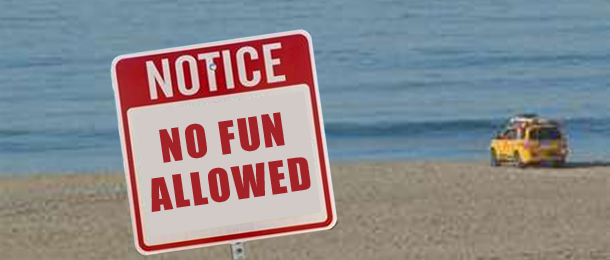
CALIFORNIA HAS been bankrupt for some time now; luckily Los Angeles is here to save the day. As of February 9, 2012 throwing a Frisbee, a football, or even digging a hole deeper than eighteen inches on an L.A. beach could end up costing you up a pretty penny, but thankfully it won’t be a $1000 fine as reported by every news coverage of the new laws. This law is intended to “protect and preserve the peace on public beaches,” as stated in the thirty six page fun killing document.


Throwing a ball of any kind, digging a hole deeper than eighteen inches, disturbing a rock, cussing, producing loud or odd noises, using a tent or structure larger than ten feet by ten feet, holding any group event with more than 50 people without a permit, including a yoga class, and operating a model airplane are all considered a crime on L.A beaches. Luckily these are only considered infractions instead of a misdemeanor. According to the California law, the fine for a first-time infraction will be $100. The second time, it will be $200. And each time after that, the crime of throwing a ball will cost you $500.


Fining people on Los Angeles’ beaches will only be enforced by lifeguards or The Department of Beaches and Harbors’ "peace or code enforcement officers" during the summer season between Memorial Day and Labor Day and will prohibit beach balls, volleyballs, Frisbees, footballs, or in-ocean water polo balls. Only during the off-season are people free to toss, throw, and dig as they please. There is some good news for those who come to the beach looking to do more than just soak up the sun, The Department of Beaches and Harbors will designate special ball-throwing areas or grant permits for a ball game.


This law seems to be a quick and easy way to a lot of money since throwing balls and digging holes are a given at the beach. L.A will make plenty of money from the law, especially when it comes to tourist who may not be aware of the anti-ball throwing and sand digging laws.


This new law is ridiculous. I have been to the beach almost every day for the past twenty years and not once has a football, Frisbee, or a hole deeper than eighteen inches disturbed my time at the beach. This law will change the atmosphere of L.A. beaches from one that is fun, free, and lively. Kids wont be able to try to dig a hole to China or dig a pool big enough for two like I did when I was a kid and adults wont be allowed to do anything other than lay out, swim in the waves, or go surfing or paddle boarding. Adults will however still be allowed to come to the beaches drunk, since that wasn’t added to the list of activities that will disturb the peace on the beach, which makes plenty of sense right? But whatever you do, don't pick up a ball or a shovel on an L.A. beach, or you will not only be committing a crime, you will also apparently disturb the peace.


-Nastassja Habers

Photo Credit: TK

Thursday, February 16, 2012

Street Folk Art


ON MY hour-long commute to my internship on Mondays, I come across an array of different sights, each replacing the next in terms of oddity and shock-value, especially considering the strange juxtaposition of a shop selling alligator meat next to a trendy fitness gym. On La Cienega boulevard, I see advertisements for "freezing the fat," wine companies, and for the annual adult video convention, featuring a girl who looks no older than sixteen in a provocative pose. As I inch along closer to my destination on Wilshire boulevard, the sights become less eccentric and more commercialized--Coffee Beans, Starbucks, chain restaurants, and big corporate buildings line the roads. By the time I reach the iconic light installation at LACMA and see the dozens of food trucks beginning to set up for the rush hour at lunch, things appear fairly "normal." Normal, that is, for L.A.

Less than a minute away from work, there are a few stop lights and lampposts that are decorated in what I can only describe as wool coasters, knitted into colorful and circular designs, and then connected together to encase the lamp posts in some sort of decorative cloak. At first, I thought maybe these were set up by bored locals or maybe were some sort of strange political or artistic statement. My curiosity led me to investigate further. I found that the lamp posts were not the only pieces of everyday city landmarks that we so often use but forget the meaning or significance of that were decorated in the same way. I walked farther along the street and found items even more useful yet ugly than a stop light lamp post, such as a stop sign pole and a water drain, both of which were dressed in the same wool fabric, intricately weaved with designs and different colors. Even a small tree was encased in wool and had little feet, as if it was supposed to be some tree creature with a body but no head. We forget that these items are even there or even what purpose they serve because they have become so commonplace. When you live in a city, or anywhere for that matter, do you ever stop to look at the post attached to the button that you are anxiously pushing to cross the street? I certainly never do. And why would I? But these decorated pieces were so eccentric and beautiful in their own unique way. It's as if someone was trying to appreciate the stop lights and water drains for their practicality by making them more attractive. I had never seen anything like them, and I know that there was a story here.


Anxious to discover the meaning behind these decorated every day objects, I took a second to observe my surroundings and found a Los Angeles Folk Art and Craft store nearby. A quick gaze inside the store, (which was closed on Mondays), confirmed that these coverings were undoubtedly created by its owners, as the inside featured wool trees and hangings in the same style as the lamp post.

For some reason, I was disappointed. I suppose I was hoping for some interesting story to be attached to these decorations, for them to have more meaning than their existence as a way to lure people into a store. Yes, it was a good business tactic and I still think they are enjoyable to look at and appreciate them (and will probably have

to go into the store sometime when it is open), but I was hoping for an interesting anecdote, perhaps one that varied with each nearby store owner that I talked to. I imagined myself going into the store across the street and asking those inside why their lamp posts and stop sign poles were so decorated? What was the story behind that? And they would say something equally vague, mysterious and fascinating like, "I don't know, one day we just came to work and they were decorated," that would send my imagination reeling.

Alas, I have high expectations. I want everything to have a story. And maybe I am being too close-minded. Maybe there is a story there. I suppose the only way to settle this is to come to the shop on a day other than Monday and inquire about their existence. Who knows what kind of answer I will get, but I hope it's an interesting story that tells me something about the history of this unique and busy part of Los Angeles. Whatever the exact story may be, I am happy that these lamp posts, stop sign poles, and city water drains are lucky enough to be adorned with colorful fabric. I hope that other busy Angelenos notice them as I did and question their existence, even if they do not have time to follow up such inquiries with an investigation.


-- Caroline Queen

photo credit: Caroline Queen

Monday, February 6, 2012

Kings of Los Angeles

IN LOS ANGELES, sports teams can make or break our days sometimes. With Dodger disappointments and the Lakers aging faster than ever, some might argue that all attention is pointed towards the Clippers. I would argue that the Los Angeles Kings should get some credit in our city. I have attended three games in the past month and I have been impressed by what I have seen. Specifically, the Kings recently beat the Ottawa Senators 4-1 and upon leaving the game I felt exhausted. From the opening ceremony, which matched the Canadian National Anthem against the U.S. National Anthem, I could tell it would be an entertaining night. As soon as the U.S. National Anthem began, applause filled the air with patriotism. Then the opening puck was dropped and play began. Within minutes there was a fight among players, between breaks in action there was fan engagement and contests, and by halftime the Kings commanded the lead. With a new head coach the Kings have been playing inspired, and attending their games has been something I ignorantly looked beyond when researching games at Staples Center. Don't get me wrong, the Lakers are still my favorite attraction in town, but the Kings have slowly crept to number two on my list.

-- Art Flores

Photo: Los Angeles Kings
Credit:  Art Flores