Showing posts with label Jordan Younger. Show all posts
Wednesday, April 25, 2012
Kombucha: Something was actually made in Los Angeles?
Upon further thought, it was not terribly surprising that something so distinctly L.A. could actually be made in L.A. But that made me think about a whole list of other things that are popular Los Angeles - things you might see a celebrity walking around holding or wearing, and I realized that nearly everything is made somewhere else and imported unless it's made on site and eaten/drank at the particular restaurant where it was made. The brand of Kombucha that is based out of Beverly Hills is called "GT's Kombucha," and upon further investigation I found that they have a user-friendly website that explains their story. One of the creators of the brand started drinking Kombucha in 1993, and when she was diagnosed with cancer two years later she was given one year to live. But a week later when she was tested again, her doctors were shocked to find that her cancerous cells had not metastasized, which she attributes to Kombucha. She drank the drink throughout her chemo and radiation process, and it kept her energized throughout, and today she is cancer-free and still drinking Kombucha.
Their website also ties their home base of Los Angeles to other parts of the world, with a "Did you Know?" box, saying that "Kombucha may be known by many other names in different parts of the world, including Manchurian tea, Manchu Fungus, Tea Kyass, Mo-Gu Fungus japonicus, Kwassan, and many others." I think it's cool that a place like Los Angeles can appreciate the traditions of Eastern medicine and health regimes, and I would have never known if I had not flipped over my Kombucha bottle!
-- Jordan Younger
Monday, April 23, 2012
Coordinates: 1416 La Brea
PULLING UP to 1416 La Brea in Hollywood is not an easy task when you aren’t exactly sure where you are going - so after making U-turns from all four angles at the intersection of La Brea and Sunset, I finally spotted the location. The building has a charming exterior with what appears to be a brick house on the outside with a towering archway overhead that reads “The Jim Henson Company.” I tried to enter the gates beneath the archway, but a security guard kindly informed me that if I wasn’t there to see anyone in particular, I would not be allowed entrance. As I was backing my car back out onto the extremely busy intersection I had been frequenting for the past twenty minutes, I asked him “what is this place, exactly?” He responded like he was talking to someone who was a little looney, and said, “just a bunch of offices, ma’am.”
I took a glance at the plaque on the brick house-looking building before I left, and it read “Historic Charlie Chaplin Studio. Build 1917 Declared 1969.” Immediately I understood what was so charming about the place - it was a cozy studio, the type of establishment that characterizes Hollywood and what it stands for, but tucked away like a delicate gem on the side of one of the busiest intersections in the city. Chaplin, the first actor to appear on the cover of Time Magazine (1925), must have seen the allure as well, because in his autobiography, he described his decision to purchase the studio space by saying, “I decided to buy land in Hollywood and build [a studio]. The site was the corner of Sunset and La Brea and had a very fine ten-room house and five acres of lemon, orange and peach trees. We built a perfect unit, complete with developing plant, cutting room, and offices." No wonder it was so quaint; it had originally been a farmer’s home!
Chaplin purchased the land from a man who had been living on the lot for several years and decided that he would reside there as well in order to be as close to the studio as possible. The creative genius that he was, he had distinct a visual plan for the land. He wanted the six buildings on the property to be “arranged as to give the effect of a picturesque English village street,” which was definitely accomplished and can still be seen today. The cost of carrying out the studio was estimated at nearly $100,000, but when all was said and done Chaplin managed to create the lot he wanted for only $35,000 in just under three years. When it was finished, it was described by one writer as “eccentric Peter Pan architecture.”
There was a bit of trouble getting everything squared with the nearby residents, who complained that the studios were too close to Hollywood High School, but in the end the city was on Chaplin’s side and signed his permit almost unanimously. Not only were his living quarters and studio space incorporated on the property, but there were “stables, a swimming pool and tennis courts” (Wikipedia). The orange orchard that had existed when Chaplin bought the studios became the backlot for filming, where classics like “Modern Times” (1936), “The Great Dictator” (1940) and “Limelight” (1952) were shot.
Chaplin placed his footprints in wet cement outside of the studio, which was perhaps an inspiration for the Chinese Theatre. The studio underwent several changes during Chaplin’s reign, and one particularly notable change on one of the stages because of a fire during the production of the film “The Circus” in 1827. Chaplin enjoyed great company at the studio, including people from Winston Churchill to Helen Keller to Henry Lauder. By 1942, Chaplin sold part of the property (including his persnal residence, the tennis courts, and most of the backlot) to the company Safeway, where they wiped it all out to build a shopping center.
Greta Garbo had her last screen test there in 1949, and by 1953 Chaplin sold the rest of the studio to a real estate agent from New York for $650,000, gaining a hefty profit. Even though the investor was not planning on keeping it as a studio, a television company leased it from him and named itself Kling Studios. Several television series were shot at the studio, and in 1953 the “Adventures of Superman” were shot there was purchased by Red Skleton in 1960. Skelton bought $3.5 million worth of equipment for color television taping, and had a “Skelton Studios” sign put up on La Brea. But his ownership didn’t last long, and he sold the studio to CBS in 1962 where the “Perry Mason” television series was filmed for the next four years.
CBS sold the studio in 1966 to Herb Alpert and Jerry Moss where it then became the headquarters of A&M records. The stages and the swimming pool were transformed into a recording studio, and Alpert and Moss described their transformation by saying, "The old sound stages are in the process of being completely rebuilt into what must be the most luxurious and pleasant recording studios in the world. Chaplin's cement footprints are one of the few reminders of the past." Incredibly successful artists like Michael Jackson, Bob Dylan, Bruce Springsteen and Van Morrison recorded there.
Chaplin returned to the studio in 1972 after 30 years away from it when he came to America to receive an Academy Award, but instead of accepting an event that A&M wanted to throw him, he simply drove by the studio on a weekend day.
Then, in the year 2000, Jim Henson’s children bought the studio for a whopping $12.5 million in order for it to serve as “The Jim Henson Company.” Henson’s daughter Lisa has said that, “The buildings are a lovable hodge-podge of quirky, unusual spaces. There are unexpected elements in some of the offices like original vaults and fish tank-like bathrooms. It's not your typical corporate space, but it's ideal for the Muppets.” Henson’s son Brian said, “When we heard that the Chaplin lot was for sale, we had to have it. It's the perfect home for the Muppets and our particular brand of classy, but eccentric entertainment. When people walk onto our lot, they fall in love with Hollywood again."
And lastly, the designation of the lot as a Los Angeles Historic-Cultural Monument was certainly an important touch. In February 1969, the President of the Los Angeles Vulturual Heritage Board, Carl Dentzel, said that "His studio was one of the first to be established here and by some quirk of fate continuity from the movies' earliest times to today's television and recordings demands has persevered.”
Although the studio is no longer a sprawling 5 acres but rather 2.2, and it is not used for anything as glamorous as Chaplin’s movies or A&M’s “We are the World” recording, it is still a standing piece of Los Angeles history with a great backstory.
-- Jordan Younger
Labels:
Charlie Chaplin,
Coordinates,
hollywood,
Jordan Younger
Thursday, April 19, 2012
Too Complicated for Words
Inspired by J. Michael Walker's literary map of Los Angeles, I decided to compile a handful of my favorite quotes about Los Angeles and make a collage out of them. I wanted to try to represent what Los Angeles means to me using the words of others - from writers like F. Scott Fitzgerald to popular culture celebrities like Mary-Kate Olsen to eccentric authors like Andy Warhol as well as a combination of others - in order to detail its multi-faceted nature. Everyone has a different opinion of Los Angeles, yet anyone who has lived in L.A. can understand how the other feels, no matter how different the attitude. L.A. is a melting pot of opinions, ideals, personalities, types. Some of the quotes are ones I have had written down for a long time while others were discovered on the internet when I decided to expand my idea. I identify with each of them respectively, but only when viewed as a whole do they represent my Los Angeles.
I would like to attribute the quote that is most meaningful to me in the bunch to J. Michael Walker, because if it did not appear on his literary map, I probably would not have stumbled upon it. The quote is from John Fante, and it goes: "Los Angeles, give me some of you! Los Angeles come to me the way I came to you, my feet over your streets, you pretty town I loved you so much, you sad flower in the sand, you pretty town!" I find those words incredibly beautiful and poetic, because to me L.A. is so multifaceted, there are no words to speak of it, but to speak to it is a different story. L.A. is like a person, our own moody little friend that we spend time with day in and day out and aren't ever sure what it will bring. To talk about Los Angeles as a "sad flower in the sand" behind it's back would feel like somewhat of a betrayal to it, it is too delicate even amidst its chaos. Los Angeles is absolutely a "pretty" town, and the word "pretty" can mean so many things. It is "pretty" in the sense that the landscape (in certain areas) is beautiful, it is also "pretty" in the sense that appearance means so much in Los Angeles, the people are "pretty," the trends are "pretty," the glossy magazine photos of stars strutting the streets are "pretty," the idea of chasing one's dreams in the City of Angels is "pretty." Los Angeles is a gem between desert-land in one direction and the cow-land that surrounds it all the way to Northern California. And to ask Los Angeles to "give me some of you" is such a beautiful and interesting thought. Los Angeles is unattainable. It draws people in but gives away none of itself. It is not homey, it is not cozy, it does not lend out its arms in the motherly way that many towns do; yet it is not uninvitingly urban or industrious like New York - it is mysterious. To some, it gives back what it put into it, and to others it gives nothing back to hard work and determination. It depends a lot upon luck, about ties and making the right connections. Ultimately, to many who come to Los Angeles, no matter how "pretty" the town is, it is no more than a "sad flower in the sand." But that is not necessarily a bad thing. In fact, I see it as a beautiful thing. It is dangling there, waiting for people to inhabit it, to make their own land of opportunity.
The John Fante quote is just one of many quotes I drew from in making the collage. I wanted to make sure to represent Los Angeles' beauty, it's zest for life and it's undeniable amount of opportunity. To do that I used several different quotes, one of which being Frank Lloyd Wright's "Tip the world on its side and everything loose will land in Los Angeles." Los Angeles attracts "loose change" type of people, people who don't particularly mind where they will fall, people who are not afraid to leave home and try something different; something new and exciting. Another one I used to capture the enchanting feeling of Los Angeles is a quote by Tom Bradley: “People cut themselves off from their ties of the old life when they come to Los Angeles. They are looking for a place where they can be free, where they can do things they couldn’t do anywhere else.” That is an important thing to recognize, and judging by my experience in Los Angeles and the people I have met here, that seems to be true. Another is a quote by actress Jennifer Love Hewitt, one where she speaks of coming to Los Angeles and finally feeling that she fit in somewhere. "When I came to Los Angeles, it was the first time that I ever felt like I belonged somewhere. Not because I was wacky, but because people here understood what it felt like to perform, and there were other kids my age who wanted to do it. I didn't get looked at as God, you freak." Since the original reason I came to Los Angeles was to act, I very much identify with that quote. People in Los Angeles do know what it feels like to perform. They know the rush of adrenaline that comes with not only being on stage or in front of a camera, but the kind that comes from being motivated to do something you love, to get up in front of people and perform - whether it be in the board room, in their writing, or creating cuisine at a gourmet restaurant. There is an energy about Los Angeles that isn't found quite anywhere else.
And, of course, I had to represent the more negative aspects of Los Angeles. There is the Rona Barrett quote "Pick your enemies carefully or you'll never make it in Los Angeles," which is so true, because even though Los Angeles is large, the circles are small, and to step on someone's toes in the industry you want to go in would be very damaging. I also have a humorous quote from David Letterman poking fun at the city's lack of seasons, “Fall is my favorite season in Los Angeles, watching the birds change color and fall from the trees," among many others.
In short, the collage represents the complexities that make up the way I feel about Los Angeles from the positive aspects that made me fall in love with the city to the very difficult ones that have made me contemplate leaving and returning to Northern California after I graduate. I will end my post with another of my favorite quotes on the collage, one by Miranda Richardson, that sums up how I feel about the city: “You can have a laugh in Los Angeles, or you can weep in Los Angeles, depending on your attitude towards it."
-- Jordan Younger
Wednesday, April 4, 2012
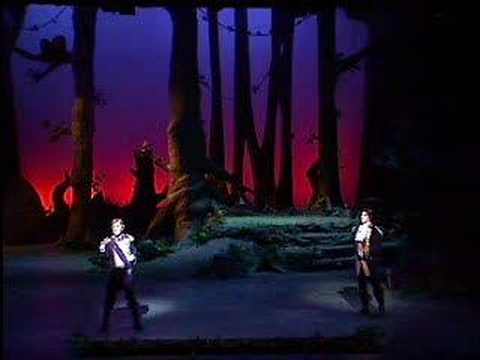
Happily Ever After?: L.A. as Fairy Tale
When I moved to Los Angeles, I had no idea what the difference was between what I wanted out of moving to the city and what I needed out of it. What I wanted was to make new friends, have a fun and enriching college experience and become successful in whatever field I chose to go into. What I needed was to gain independence and become comfortable living on my own - yet since I didn’t understand that, I still relied heavily on my parents and on my friends from home to help me with the transition. I desperately wished to go home as often as a I could to regain comfort, but that hindered me from blossoming on my own and learning to support myself. Los Angeles was a scary place to me when I first moved here, an entirely new environment - I was literally going “into the woods.”
One of the key phrases in the play is “we had to lose a lot to win,” and each of the main characters abide by that phrase. Cinderella’s stepsisters mutilate their feet to try to fit into the glass slipper to be with the prince, which is reminiscent of the plastic surgery and even just the amount of make up that is so prevalent in Hollywood and the belief that morphing your body to fit a certain mold will make you happier. Even though each girl fools the prince for a short time, he soon realizes they have mutilated themselves and aren’t who they claim to be, which can be likened to the shattering of images in Hollywood to reveal who people truly are - images can only fool you for so long. There are a multitude of lies and deceit that come along with wish fulfillment, and the entertainment industry is the ultimate place to try to fulfill far-fetched wishes of fame and fortune.
There are also vicious battles in the play involving romance and fidelity, with men wishing for the most beautiful princesses and once they wed them only wishing for younger and what they perceive to be more beautiful women - essentially, always wishing for what they cannot have, what is beyond their reach. To always wish beyond your means is not a realistic thing to do, but for many in Hollywood, it is a way of life. There is nothing wrong with a little bit of adventure and trying to achieve your highest dreams, but when the risk surpasses the gain is when the adventure loses its worth. “Into the Woods” shows us that there is risk that comes along with adventure - the characters all get what they want but they are still not happy and instead continue to desire more. Perhaps this is because they didn’t understand what they really wanted in the first place, which was to be comforted and content. In the beginning, the characters relied on too many things, and I believe when people first come to Los Angeles they rely too much on their expectations instead of allowing themselves to grow on their own.
“Into the Woods” defies the typical “happily ever after” ending of most fairy tales and has a more realistic ending - a compromised and complicated one, which is the truth of what people will find in Hollywood as well. The characters had to “lose a lot to win,” and the only ones still standing at the end were the characters who had to lose the ones they depending upon in the beginning - the Baker lost his wife, Little Red Riding Hood lost her mother and her grandmother, Jack lost his mother, and Cinderella lost the prince. Only at that point do they realize that what they initially wished for was not what they really wanted at all - they were just wishes beyond their means, but they realize this too late, and the consequences of wishing for too much have already occurred.
I am not saying that people should not expect a happily ever after by moving to Los Angeles - in fact, I think everyone everywhere deserves their own happily ever after, and if they wait out their personal growth instead of forcing things to work out in certain fields, or forcing their bodies to change, or forcing anything for that matter, then they will gain what they truly need. The characters in “Into the Woods” had to lose the people they felt as if they needed in order to grow psychologically, and I think that is also a big part of living in Los Angeles. When I first moved here, I depended very much on my parents and my close friends to comfort me during the tough move. I was reluctant to reach out to new people in this entirely new environment, and if I had given in to my deepest wish to return home to Northern California, I would have done it and I would not have experienced the growth I have after living here for two and a half years. But in order to do that, I needed to trust that I could handle my new surroundings on my own - I needed to grow individually before I was able to experience Los Angeles and the opportunities it had for me, and two and a half years is only the beginning of that growth. And it’s true that adventure has risks, but those risks are necessary in order to progress, as long as you understand what it really is that you’re looking for.
While Hollywood franchises and brands the enchantment of fairy tales, the people living in Los Angeles are dealing with enchantment and wish fulfillment issues of their own, and what people are truly looking for is comfort and contentment in this big city.
-- Jordan Younger
Labels:
fairy tale,
Into the Woods,
Jordan Younger,
March,
theater
Friday, March 23, 2012
Chuck Rosenthal: Surfing the Elusive City
LIKE MANY writers who’ve come to Los Angeles, Chuck Rosenthal was drawn to L.A. because of its elusive quality - but not the typical “elusiveness” of L.A. that comes to mind. Beyond the never ending traffic, the intrigue of celebrity, the variety of neighborhoods, “L.A. has so many facets,” says Rosenthal. “It’s neither male nor female, it’s metrosexual.” And the exploration of that complex place in between has long been an element in Rosenthal's work.
Rosenthal, the author of seven books and a memoir, and a professor of English at Loyola Marymount University, has been a force in both the literary scene and has inspired and influenced students with courses he’s taught which deal directly with the city. Before the university nixed his RoadWrite class because of the higher budget it required, he took students all over Los Angeles and even up to Big Sur for a course inspired by Jack Kerouac’s “On the Road” mentality.
The "metrosexual city" of Los Angeles, so dubbed by Rosenthal because of its eccentricities and materialistic nature, has been his playground ever since he moved here as a young writer in 1986. A native Pennsylvanian, he had high hopes that moving to sunny Los Angeles would fulfill his dreams of learning how to surf and riding his motorcycle every day. He inched his way from the East coast toward California with writing employment at several universities before he wound up in L.A., and aside from steady employment at the same university as his wife, he has remained ever since because he actually enjoys it. What he doesn’t like is the superficiality that L.A. has been branded with. Oh, and the city’s endless need for driving.
But Rosenthal has been able to find inspiration in its superficiality - in fact, L.A.’s superficial nature is a key element in his upcoming book, "West of Eden," that will be released in October. The book is a mixture of fictional stories and snippets from his own life, touching on everything from the entertainment industry to teaching at LMU to his daughter’s kooky decision to change her name to Jesus. “It’s funny,” Rosenthal said in his characteristically matter of fact tone. “I’m funny.”
He came up with the concept for "West of Eden" by pulling stories from his "Last Book of Everything," which was about 900 pages of work that he added to whenever he felt inspired. A few years ago, after he’d written a story chronicling his humorous battle to pawn off a live chicken to his celebrity neighbors - including Sting and Robert Downey Jr. - his wife told him “you love funny stories about L.A., you ought to write a book about it.” With that thought, he realized that there were about 7 or 8 stories woven throughout his Last Book of Everything to draw from.
Because of the interesting way the book came to be, some of its stories are from 10 years ago, but could also be made tomorrow. “If an animal died in 2004, it doesn’t matter if I say it died in 2012,” he said. “Those things don’t matter at all.” As the book is centered around his funny experiences living in Los Angeles, it makes sense that time is irrelevant - he will continue to have these experiences long after the book’s publication.
“You can do anything you want in L.A.,” Rosenthal said. “You just have to drive to do it.” One perk L.A. has on the literary front that other cities do not is the influence of the entertainment world. Although most writers in L.A. are screenwriters, the people Rosenthal hangs out with are some of the few that are not interested in writing for the movies. In fact, when HBO approached him about writing the screenplay for his memoir "Never Let Me Go," which deals with his six-year sexual abuse from a grade school coach, he told them to have someone else write it.
“It’s not like I’m not good at it,” he explained. “I just wasn’t interested.” Truth be told, a screenplay Rosenthal wrote several years ago was nominated for the Sundance Film Festival. But screenwriting is not where his heart lies, and as a result, he does not feel influenced by Hollywood like he believes many of the writers in L.A. do. He also believes there is a pressure on L.A. writers from the big rig publishers in New York to conform to the expectations of the noir, mystery and Hollywood genres that often sell.
But don’t expect Rosenthal to conform any time soon. Even though the majority of the literary world is centered around New York City, Rosenthal is happy to be in Los Angeles. For one of his current projects he is taking lines from old sci-fi poems, mixing them up in a hat, and making poetry out of them. “I like to mix genres,” he said. With this defiance against what typically “sells,” Rosenthal displays his capability to live in a city like Los Angeles while still holding on to his own voice.
He spent his early years in L.A.'s Venice Beach where he did surf every day, but these days he and his wife reside of Topanga, where he has replaced daily surfing with riding his beloved horse, Nikki. There are aspects about city life - like being able to “pick up wine, a baguette and fish for dinner; bring it anywhere and call it a meal” - that he knows he is lacking by living in an L.A. surburb, but the pros of Los Angeles outweigh the cons. The city entertains him, and his work has been successful.
Rosenthal thinks maybe he will stay in L.A. forever, depending on whether he can afford to live in Topanga or to get a loft downtown once he retires. He wouldn’t mind remaining here, although if L.A. were a person, he probably would not like to be its friend. L.A. is “superficial - self consciously invested of the presentation of itself. Always on display. A fashion model,” he said. Maybe its because of the amusement he gets as a writer out of observing people, but within that superficial fashion model likes a city Rosenthal calls home.
-- Jordan Younger
(image via lmu library's webpage)
Labels:
Chuck Rosenthal,
Jordan Younger,
The Profile
Thursday, March 22, 2012
LA's Friendliness (Or Lack Thereof)
LOS ANGELES - the land of milk and honey. The city of opportunity, great weather, the entertainment industry, and... unfriendly people? Say what you will about all of the wonderfully personable people you know in Los Angeles, it is likely that for every one of them there are two Angelenos that are simply too busy to bother with friendliness. In Travel and Leisure Magazine’s “America’s Favorite Cities Survey” of 2010, L.A. was ranked the 35th city on the friendliness scale. That doesn’t seem so bad, right? The thing is, there were 35 cities in the article.
A close friend of mine, Heather, from Indianapolis, Indiana, visited here last week. While I was in class she was tanning on my roof, and called out a friendly “Hello!” to a neighbor walking his dog. Instead of the civil acknowledgement she expected in return, he said “Where are you from, young lady? There is no way you are from Los Angeles.” Initially she was confused at his question, but he went on to explain that no one in Los Angeles waves hello to people they don’t know.
They struck up a friendly conversation and it came up that she was looking for work in Los Angeles for the summer. The man was so refreshed by her amiability that he offered her an interview at the talent agency his daughter owns, and called his daughter on the spot to make sure she would make an opening for Heather while she was still in town. She interviewed the next day and is currently waiting to hear back from the company.
In this case, and I would say in most, it pays to be friendly. Some of the best conversations I’ve had have been with strangers on a plane or on the bus, and if not for the sake of making connections people should be friendly to improve their quality of life. Aristotle’s definition of happiness includes being friendly as “a mean between the excess of being ingratiating and the deficiency of being surly.”
Los Angeles should take a lesson from the Ancient Greeks, or even from the midwest, when it comes to this important feature.
-- Jordan Younger
image via Flickr
Tuesday, March 6, 2012
In Los Angeles, You Can Reach for the Moon
HOT AIR ballooning in Napa Valley? Very Californian. Lifting a house up into the sky via balloons? Very Angeleno. Anyone who has seen the Disney/Pixar animated film "Up," in which a house is triumphantly launched into the sky by the protagonist, will appreciate this accomplishment, which was performed last March by a team of "scientists, engineers and two world class balloon pilots" according to design-dautore.com. The extravaganza took place for a National Geographic special titled "How Hard Can it Be?" that will air later this year.
It is very telling that this accomplishment took place at a private site slightly east of Los Angeles, because Los Angeles is a haven for those who want to reach for more. In Los Angeles, the average person can reach for the moon, and in this case, they can reach for the moon from their very own living room.
I knew I had to blog about this photo because when I came across it on a friend's Facebook page, I thought to myself, not knowing where the flight took place, "that's something that would happen in Los Angeles."As I read the caption beneath it I came to realize that although it occurred slightly outside of Los Angeles, there were Angelenos behind the project that brought it to a workable base (after all, something this whimsical would be impossible to pull off in the city).
Los Angeles is a town that makes dreams come true, whether you go right back to Disney making dreams come true in "Up" - and, of course, Los Angeles is the home of Disneyland - or take a glimpse of Angelenos strolling down the street. People come to Los Angeles to follow their heart, no matter how big their dreams are. When I first came to L.A. I quickly ran the gamut of "dream following" careers from actress to screenwriter to film director to photographer to author before settling on the notion that here, as long as I continue with my education, I can do any of those things.
Lifting a house into the sky with a group of balloons is a testament to how important it is to push yourself to your limits in a city like Los Angeles. If you don't, you might get lost in the shuffle. It might sound a little Disney, but this photo reminded me that if you follow heart, your dreams will come true.
photo credit: Design-dautore.com
Thursday, March 1, 2012
Let's Get Lost - Corner of 2nd & Wilshire
Fig Tree at the Fairmont Miramar Hotel
photo credit: Google Images
As I sit here today and take in the beach covered in mid afternoon mist, I can't help but smile. My brother once deemed Santa Monica a magical place in that "people are fun enough to party all night but active enough to be up for their morning jog," which is a description that rings true in this moment. There is always activity in Santa Monica, and from my perch on 2nd and Wilshire I can observe that activity and relish it for what it is - the type of area people dream about when they envision Los Angeles.
The corner has a neon brightness from the white light of the sun compared to the dimmer streets perpendicular to it, and maintains a peaceful air while it's 3rd street counterpart is packed with shops and popular eateries. This corner is quiet, boasting a hair salon and a dog groomer as well as smaller cafes and doctors' offices.
The aspect of this corner that makes it feel like a slice of home to me is the Fairmont Miramar hotel that spans the area between the corner and the beach. It is the hotel I stayed at with my parents the night before I started college, and it is the place that they stay each time they come and visit - which is twice as often as most of my classmates' parents! Any time I have taken a friend to the hotel to hang out with my parents, they comment on the gargantuan fig tree that sits in the middle of the sprawling entrance. Someone once told me that they purposely built around it to garner a homey feel.
And, at the end of the day, of course there is the beach. If you walk less than a mile into the bright sun you will reach Santa Monica Pier, with its gorgeous view and infamous rides.
Santa Monica is one of my favorite places to explore in Los Angeles, and the corner of 2nd and Wilshire is just one of the many spots I hope to find during my time living here.
-- Jordan Younger
Tuesday, February 14, 2012
My L.A.: Life on the Perch
PEOPLE WHO come to Los Angeles claim to be “searching for themselves” or “trying to experience personal growth,” but the truth is, there is no solitary experience to be had in L.A. With over 12 million residents and a population density of 8169 people per square mile, Los Angeles doesn’t cry out independence - but people continue to seek refuge in moving to L.A. to have their L.A. experience. There are not, generally speaking, quaint coffee shops walking distance from your home where you can write in your journal after a long day on the movie set. Your life in L.A. will typically be as it was anywhere else, because you are still going to be the same person. The trick is to find those places that make Los Angeles unique to you, and once you find them, keep them close. It’s easy to disregard a place you love because you don’t have time for it, especially if you’ve been sitting on the 405 for two hours.
From my balcony you can see into people’s backyards; people’s lives. And that’s really what L.A. is - you’re alone but you’re never alone. You might be having what feels like an individual experience and then come to realize that people can see you from their very bedroom. The streets of L.A. are no different - your phone conversation with your mother is a passerby’s entertainment. What you choose to wear and how you choose to act will be noticed by everyone you encounter and will, in most cases, be used as an instrument to put you into the box of a certain stereotype. People in Los Angeles are both nosy and keenly observant.
It is a city, but, well put by American poet Dorothy Parker, “Los Angeles is seventy-two suburbs in search of a city.” Within these suburbs lives hundreds of thousands of people trying to make L.A. their own. I live on the second story of a five-bedroom home in Westchester, and, yes, that means I live with six other college students - that doesn’t allow much time for me to reflect on just about anything. But my balcony is a haven for me. It is the first place in the house that the sun hits in the morning, striping my walls with its gauzy salmon zest and welcoming me in its whimsical way to another full day. There is something tranquil about going out there, taking a breath, and seeing nothing for miles but rooftops.
Many a morning on my balcony I can get lost in my head, zone out, and just be. If the houses weren’t there, I would be able to see straight into the beach, but the beauty of L.A. is that there are houses there with people in them looking for the same things we are. The Plain White T’s have a song called “Meet me in California,” where they sing “Meet me in California, I’ll be there waiting for your call / ‘Cause you know in California there’s something better for us all.” If I want Los Angeles to be a place that holds my brighter future, I have to hold on to the few places where I am able to unwind. In L.A. we are alone but we’re never alone, because we’re all here, right now, experiencing our own Los Angeles.
-- Jordan Younger
Photo Credit: Jordan Younger's iPhone
Thursday, February 2, 2012
Iconic LA: Flower District
THIS is place that is both overwhelming and enchanting; captivating of the hustle and bustle of Los Angeles yet also stands still in time because of its non-renovated facade and its old-school charm. It opens at 3:00 in the morning, is closed for the day by mid-afternoon, and is visited by top executives, event planners, teenagers gearing up for their first date, business men remembering their anniversary at the last minute, and homeless people hoping for the daily turnover that they can sell on the streets. It is the embodiment of chaos with a purpose.
Upon approach, the Flower District is not an alluring area. Get off at San Pedro, keep left at the fork and merge onto East 16th, turn back onto San Pedro, turn left on East 8th, and take the 2nd right onto Wall St. First of all, how typical L.A. are those directions? It is almost impossible not to get turned around, especially because many of the streets downtown are one-ways with yielded turns. Once you get off the freeway, the store fronts are shabby and unkempt, and the further into the neighborhood you get, the less English signs you will see, and it can likely be guaranteed that you will not recognize a store in sight. But by the time you turn onto 8th street, your nose is filled with the aroma of fresh flowers. Everywhere.
The shops range from small mom and pop vendors to corporate sized warehouses with thousands of employees. There are splashes of graffiti on the outer walls, and workers out front bargaining with hopeful young sweethearts in search of the perfect bouquet. Banners that promise “The cheapest roses in town” and “The widest selection of sunflowers in Southern California,” all the while homeless men and women are wandering the sidewalks begging for change. Employees run after impatient event planners to place crates upon crates of the latest flower craze into the trunks their glossy Jettas. Free spirits who need a pick me up in the middle of their day saunter out of a shop with a single daisy or a decorative orchid.
I entered the flower district for my first time last week. A young blonde girl
with a long list of specifics about flowers to buy for an event – you would think if I was
noticed at all amidst the commotion it would have been in attempt to rip me off, but
instead I was greeted with remarkable help and friendliness from each individual vendor.
If they knew I could get a flower from someone else for a cheaper price, they would send
me in that direction. And if they knew I could not, they bet me with a smile on their face
that I wasn’t going to find a better offer.
No matter how high tech our country - and our beloved city - gets, there are certain attractions that have not lost their appeal and remain transfixed in time even in the depths of economic crisis. Endless traffic may have replaced horse-drawn wagons, and e-cards may have become a semi-acceptable substitute to the endearing anniversary bouquet, but it is satisfying to know that there is still an area of Los Angeles where people, literally, take their time to stop and smell the roses.
-- Jordan Younger
photo credit: Jordan Younger
Labels:
flower district,
iconic l.a.,
Jordan Younger
Subscribe to:
Comments (Atom)