Showing posts with label Wilshire. Show all posts

Monday, April 30, 2012

Coordinates: 6067 Wilshire


Photo Credit: Myself

The Miracle Mile District is bordered by the Fairfax District, Hancock Park, Mid-City, West Pico, and Carthay. I never even knew that it existed, yet I have been down the Wilshire Stretch of the district many times. Wilshire Boulevard, west of Western Avenue, used to be a farm road, before becoming a part of the Pacific Electric Railroad System. But developer A.W. Ross saw its potential and set out on a journey to make it a commercial district that would cater to automobile traffic, rather than foot traffic. Many retailers and department stores were built, in a fashion so as to attract the most attention from cars, on this strip of Wilshire. Among them was the May Company, a department store chain that went out of business in 1993. Many of its stores were turned into Macy’s.
But not the May Company Building on Wilshire. This building, easily recognizable by the gold cylinder on its front, was acquired by LACMA and sits on the western end of Museum Row. It is now known as LACMA West. It is an impressive building, one that I have seen before but never paid much attention to because there are many other things to look at. It was built in 1939 and LACMA bought it in 1994 and moved some of their staff into it. While you can not go inside the building (yet), LACMA’s blog has some wonderful photos of what the portions that have not converted look like now. There is an outstanding employees Walk of Fame, a space for candy refrigeration, and a grid through which employees would look to make sure no one was shoplifting (before security cameras). The building was featured in many old movies, such as “Volcano” and “The Star.” The outside of the building looks virtually unchanged, except the giant letters spelling out MAY CO. have been taken off but not replaced with anything yet.
Photo Credit: taken from the LACMA blog
The building in 1976. Photo credit: found online on University of Washington's Digital Collection
Last year, there were talks of converting the space into a motion picture museum. LACMA and The Academy of Motion Picture Arts and Sciences teamed up to put this together, however they are still working on fundraising and picking out an architect. 

-- Allie Flinn

Thursday, March 22, 2012

Coordinates: 3400 Wilshire Boulveard

Way Back When: 3400 Wilshire Boulevard


BACK IN the 90s, if you motored along the easterly stretches of the Wilshire corridor, at its 3400 address, you would happen upon a uniquely L.A. curiosity. Pushed back dramatically from the noisy boulevard, the remains of an expansive terracotta-roofed building had the distinct feel of a  suddenly abandoned story, or more precisely -- a vast encyclopedia of them.

 Even if you knew nothing about the building's past, its many former lives, just the expanse of the lot, the formal elegance of what remained of the structure, you knew there was a reason it stood there so long -- waiting.  For what? It wasn't certain at first. 

Another piece of L.A. history on the guillotine. I'd grown up seeing this cycle time and again; the past leveled, turned to sand, a new future imagined in its spot.  This one felt different though.

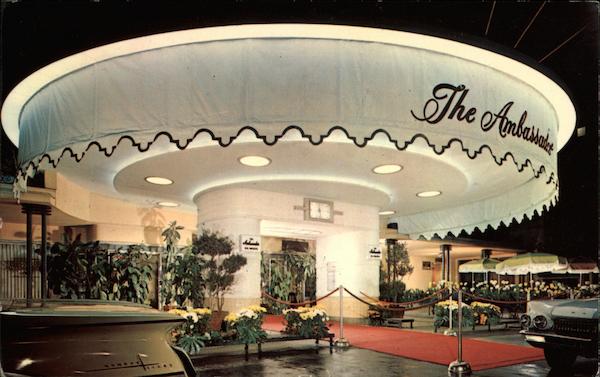
The Ambassador Hotel, which once stood imposingly at 3400 Wilshire Boulevard, was built in 1921  designed by Pasadena architect Myron Hunt, and owned and operated by the Schine family for 50 years. The architect, Paul Revere Williams, made the 1949 additions to the property which included renovations to the interior, adjacent private bungalows and a facelift for the famous hotspot, the nightclub known as the Cocoanut Grove.


 The hotel attracted dignitaries from around the world, royalty, businessmen, film stars, presidents. It its heyday, it was glamourous and looked something like this:


But by the early 70s, the hotel had become an anachronism, and even more complicated, an end-of-the-golden dream symbol. Los Angeles' "center" -- always a point of debate -- had been pressing westward for sometime. What cast the most pernicious shadow, however, was that the hotel was the site of then Attorney General Robert F. Kennedy's 1968 assassination. From that moment on the Ambassador would not ever shake the taint.  The hotel eventually closed in 1989 and was vacant until demolished in 2006.

In the hotel's waning years, as a kid, I would find myself on occasion sitting at vast, ciruclar banquet tables at the Ambassador, attending  my mother's various "club" luncheons -- fashion shows, educators' meetings and the like. At first I wasn't interested. At all.  Listless, I'd tune in and out of the  program of speeches and presentations (there was even a woman who would "preform" bird calls) and eat dainty finger sandwiches and sip Shirley Temples. What I most remember is staring at the designs in the ornate ballroom carpet and getting lost in them like a maze.

It wasn't until much later that I began to appreciate the history, the layers of history whispering around me on those Saturday afternoons. I was a voracious reader and on the latter-end of those journeys to the hotel had discovered F. Scott Fitzgerald and was particularly fascinated with his difficult Los Angeles years -- when he'd arrived in Los Angeles to work, not so happily, as a screenwriter.  According to lore, Fitzgerald and his wife Zelda stayed for a bit  at the Ambassador in one of those Williams designed bungalows.  During their stay, the couple met a young actress named Lois Moran.  Zelda was miffed at the attention her husband beamed upon the young woman, apparently so enraged after their quarrel that she threw her own clothes into bungalow bathtub and lit them on fire.

By the 80s, the Ambassador resembled  something that had been put into storage for too long. In the closed-off floors and rooms,  it gave off that odor too.  It had also acquired a deeper patina of sadness. Strangely though, my high school prom was held here, at the Grove, that by this time had been renovated once more and had a strange sort of disco-70s-glass-and-mylar-red-carpet feel to it. It was like a variety show set, you expected to see entertainers of that vintage, say Cher or Sammy Davis Jr., walk out on stage. For a time,  they did.  I opted out of going and instead wandered out with a tribe of friends to the beach that night -- a sort of anti-prom nonevent. It was a choice I didn't regret for years, until it looked as if the down-at-the-heels building would come down for sure.   

During the early 90s, the owners opened the grounds and invited  visitors to come in and pay their last respects. Although, the property had been used for movie and television shoots, the general public hadn't been allowed on the grounds for years. By this time, I was working as a journalist, so I, along with a photographer friend of mine, descended on the property to take photos and interview  people who lingered in the musty hallways or had a grilled cheese at the soon-to-be-shuttered coffee shop. Some of the visitors had married there, some had honeymooned, others, like me, had spent Saturdays with their moms at long Saturday luncheons.  After awhile, the stories began to feel like one large public collage, linking together the hotel's story past and present. In a few more months, a public sale of the contents was held: I purchased salad plates and a sliver casserole dish even stationery and cocktail napkins embossed with the Ambassador logo.

 After a decades-long,  bitter fight between residents, conservationists and the school board, the Los Angeles Unified School District erected a state of the art educational complex  on the old site. As a tribute to the fallen politician, it's been named,  The Robert F. Kennedy Community Schools. 

In recent years, I haven't been able to drive past the building -- or where the building should be.  Even growing up where I know things very seldom stay the same, I knew seeing this huge block of memory vanished would break my heart.

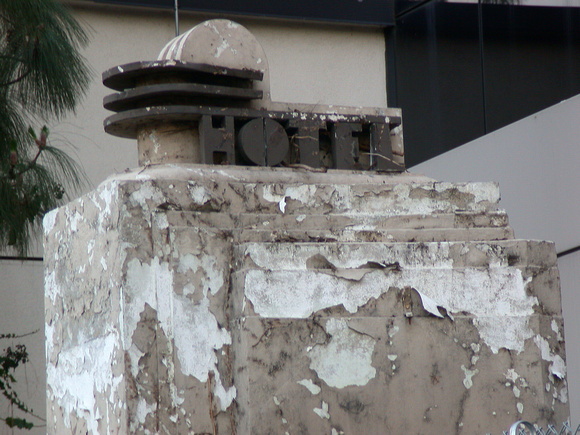
One of the last evenings I set foot inside the hotel, when it was still a going concern, some other reporter friends of mine decided to meet up after work.  We were looking for a place that wasn't a scene. The Ambassador hadn't fit that description for more than four decades. Even still, there was an elegant lounge off the lobby, that opened out into a vibrant rose garden; The Palm Bar, it was called. By then,  the mix of clientele reflected the neighborhood's evolved new mix --  Korean businessmen, Silver Lake night crawlers and of course, some remnants from the old days -- couples who used to live just down the street in one of the high rise hotels topped with those elegant  signs that, after dusk, spelled out each building's name in cool neon script. They ordered their Manhattans and Martinis.  On demand, they happily regaled us with stories about the Academy Award events once held at the Grove, the dignitaries who once stayed there, and too, their memories of RFK's last night on the campaign trail.

I sat with my friends, near open doors that framed the fragrant garden and for once, instead of  trying to time-travel, instead of chasing antique ghosts, I made note of the soon-to-be vanished details before us -- the image of us arranged in those high-backed chairs, the rise and fall of excited voices telling and listening to Los Angeles stories, the sharp scent of the night-blooms on a eve-of-Spring night, I was aware that I would be both making and  then embroidering memory. I knew, this little moment too would be gone soon enough -- and yet until all of us ourselves were ghosts --  not the memory of it.


(For an detailed visual past to present timeline of the site in recent years you can click here.)

Today: 3400 Wilshire Blvd: Robert F. Kennedy Community Schools

-- L.G

Thursday, February 16, 2012

Street Folk Art


ON MY hour-long commute to my internship on Mondays, I come across an array of different sights, each replacing the next in terms of oddity and shock-value, especially considering the strange juxtaposition of a shop selling alligator meat next to a trendy fitness gym. On La Cienega boulevard, I see advertisements for "freezing the fat," wine companies, and for the annual adult video convention, featuring a girl who looks no older than sixteen in a provocative pose. As I inch along closer to my destination on Wilshire boulevard, the sights become less eccentric and more commercialized--Coffee Beans, Starbucks, chain restaurants, and big corporate buildings line the roads. By the time I reach the iconic light installation at LACMA and see the dozens of food trucks beginning to set up for the rush hour at lunch, things appear fairly "normal." Normal, that is, for L.A.

Less than a minute away from work, there are a few stop lights and lampposts that are decorated in what I can only describe as wool coasters, knitted into colorful and circular designs, and then connected together to encase the lamp posts in some sort of decorative cloak. At first, I thought maybe these were set up by bored locals or maybe were some sort of strange political or artistic statement. My curiosity led me to investigate further. I found that the lamp posts were not the only pieces of everyday city landmarks that we so often use but forget the meaning or significance of that were decorated in the same way. I walked farther along the street and found items even more useful yet ugly than a stop light lamp post, such as a stop sign pole and a water drain, both of which were dressed in the same wool fabric, intricately weaved with designs and different colors. Even a small tree was encased in wool and had little feet, as if it was supposed to be some tree creature with a body but no head. We forget that these items are even there or even what purpose they serve because they have become so commonplace. When you live in a city, or anywhere for that matter, do you ever stop to look at the post attached to the button that you are anxiously pushing to cross the street? I certainly never do. And why would I? But these decorated pieces were so eccentric and beautiful in their own unique way. It's as if someone was trying to appreciate the stop lights and water drains for their practicality by making them more attractive. I had never seen anything like them, and I know that there was a story here.


Anxious to discover the meaning behind these decorated every day objects, I took a second to observe my surroundings and found a Los Angeles Folk Art and Craft store nearby. A quick gaze inside the store, (which was closed on Mondays), confirmed that these coverings were undoubtedly created by its owners, as the inside featured wool trees and hangings in the same style as the lamp post.

For some reason, I was disappointed. I suppose I was hoping for some interesting story to be attached to these decorations, for them to have more meaning than their existence as a way to lure people into a store. Yes, it was a good business tactic and I still think they are enjoyable to look at and appreciate them (and will probably have

to go into the store sometime when it is open), but I was hoping for an interesting anecdote, perhaps one that varied with each nearby store owner that I talked to. I imagined myself going into the store across the street and asking those inside why their lamp posts and stop sign poles were so decorated? What was the story behind that? And they would say something equally vague, mysterious and fascinating like, "I don't know, one day we just came to work and they were decorated," that would send my imagination reeling.

Alas, I have high expectations. I want everything to have a story. And maybe I am being too close-minded. Maybe there is a story there. I suppose the only way to settle this is to come to the shop on a day other than Monday and inquire about their existence. Who knows what kind of answer I will get, but I hope it's an interesting story that tells me something about the history of this unique and busy part of Los Angeles. Whatever the exact story may be, I am happy that these lamp posts, stop sign poles, and city water drains are lucky enough to be adorned with colorful fabric. I hope that other busy Angelenos notice them as I did and question their existence, even if they do not have time to follow up such inquiries with an investigation.


-- Caroline Queen

photo credit: Caroline Queen

Wednesday, February 1, 2012

"Iconic L.A.": 5700 Wilshire


 "You will always be my friend no matter what. And if you go to Cali dreams of going to college in L.A. and writing for a magazine, I will come visit you and be a nanny there and we can live together."


 THOSE words have stayed with me ever since they were written in bubbly letters on a neon pink going away card from my friend Michelle before I left for school at LMU in 2008, terrified yet thrilled. Maybe that’s why, when I walked up to the corner of Wilshire Boulevard in Beverly Hills, California, I stopped in the middle of the twin office buildings and did a complete turn all the way around, taking in every sight. After painstaking college essays, SAT re-takes, ACT study sessions, and the gut-wrenching anxiety that I would not get into LMU, or any college for that matter, (fueled in part by my mother, who told me condescendingly yet with caring undertones to “not get my hopes up”) I was here, in downtown Los Angeles. When I stood there in the courtyard, shaking and sweating before my interview at Us Weekly, an interview which I thought at the time would make or break my future, would change my life completely, for better or for worse, would propel me into my editorial dreams or send me plummeting regretfully down a new path, I thought, “This is the L.A. I envisioned. This is what I wanted to be apart of."

I should explain that when I first landed at LAX and headed down Lincoln Boulevard, I felt a wave of disappointment and fear because this loud, traffic-infested street was the complete antithesis of the glamorous Los Angeles I envisioned. Where were the palm trees lining the sides of the road, and where were the teenagers driving around in their jeeps listening to music with the top down? Where was this gorgeous school with a bluff overlooking Los Angeles and white letters proudly boasting “LMU” on the side? Luckily, when I arrived at LMU, this fear diminished because I realized that our school is in its own separate world, in the quiet neighborhood of Westchester, separated from the busy streets and loud noises of Los Angeles. However, every time I left LMU to frequent other areas of Los Angeles, I always felt a twinge of disappointment, that this was not the “real” Los Angeles that I had seen in movies, television shows, and magazines. I always felt as though there was something missing or something that I was not seeing.

5700 Wilshire Boulevard feels like that kind of "real" Los Angeles to me. If you were to view it from above, you would see huge office buildings enclosing a little cluster of restaurants that almost seem as though they shouldn’t be there, as if maybe they were there before the big corporate buildings were and refuse to move. Office buildings surround these eateries, including the one that contains Wenner Media, where I work for Us Weekly. To the right and high above all else is a building called Museum Square, which proudly boasts “Screen Actors Guild Awards” towards it’s sky-high top. There is a fountain to the left of Museum Square that would put the LMU fountain, as it almost doubles it in size and in the magnitude of water it constantly produces. These buildings stand overlooking a cluster of restaurants, including Marie Callender’s, The Counter Burger, Baja Fresh, Mix’t Greens, and of course, Starbucks. Almost every day of the week, I could have a different choice of food, from home-cooked, to hamburgers, to Mexican, to vegetarian. However, in between all of these varying places, the Starbucks remains, a daily reminder of the need for Angelenos to get their coffee fix. Starbucks is the consistent factor within this little hub of eateries. Busy corporate CEOS, producers, writers, and interns hoping to climb the ladder, like myself, start their day the same, with an often thirty minute wait for Starbucks, but choose which cuisine to lunch on when the time comes for them to break away from their offices.


The people on this corner are always busy. There are no leisurely lunch breaks, no cigarette bonding sessions outside, and no walking slowly across the street. I find myself hurriedly walking alongside the businessmen and women attached to their cell phones with their big bags and laptop cases because I feel as though walking slow means I am not worthy to be in such a busy world. These people are walking fast because they do not have a second in their day to stop or slow down. The fact that I might be taking my time crossing the street, sipping my coffee slowly, or sloshing my “mix’t greens” around in a vat of fat free dressing with a lazy smile seems almost inappropriate. Don’t I have anywhere else to be? The corner of 5700 Wilshire holds special meaning for me personally because of the memories I associate with it, as well as that epiphanic first experience, but I think that anyone else could appreciate it for the variety of venues it possesses, from small restaurants to huge office buildings, and hurried, posh, “I have somewhere else to be right this second” lifestyle that feels intrinsically L.A.


-- Caroline Queen 

photo: 5700 Wilshire
credit: Caroline Queen