Showing posts with label My L.A.. Show all posts

Thursday, March 22, 2012

A Trip to The Mansion

                THERE IS  a distinct microcosm of L.A. where poverty is feigned rather than realized, where misfortune is fabricated rather than experienced.  Here lies a counterculture where the residents may resist, but certainly don’t deny the luxuries granted by a state of privilege.  Here, money is rarely tight and the living is rarely anything but easy.  Still, there is an unspoken resistance to the ideals promoted by those who typically find themselves in this privileged state of circumstance.  This strange, paradoxical microcosm is known by the simple moniker, 'The Mansion', and serves as an eccentric home to spoiled hippies.


The Mansion looms over a neighborhood of reasonably sized houses.  It was lavishly remodeled by a man who quickly learned he could not afford the lifestyle the house demanded.  This is how eight college students belonging to the liberal youth were granted access to a house that they so clearly were not meant to belong in.  At The Mansion, all are welcome and the door is always left unlocked.
Anyone who enters the premises realizes they must abandon whatever assumptions they might have had about the house when judging it by its exterior.  As said by housemate Jared Egusa, "I think we're doing our best to respect it, but we certainly aren't limiting ourselves in what we want to do in it."  Beer cans litter the granite counters, trash is ever-present, pop art shrouds the walls.  Though furnished minimally, the clutter fills out the space and breathes livelihood into what would otherwise appear as a sterile and sparse environment.

The housemates willfully avoided the tendency to succumb to demands of ornate furnishing that a house with this level of architectural sophistication asks for.  Rather, it is representative of the lawless, liberal youth of L.A.  When housemate John Puppo had a chance to respond to how he felt about the home that he helped create, he quipped, "So it's beautiful, right, on the outside.  And on the inside it's been torn up and turned into something totally different.  We function opposite, in that a bunch of us look really ridiculous on the outside and on inside are pretty well put together."

           The Great Room is the first room seen upon entering The Mansion.  This sunken cabinet features a fireplace that only burns when intellectuals choose to sit down for an occasional game of chess.  A couple flowered couches decorate the barren room and literary anthologies are carelessly scattered on the floor.  The Great Room is a thinking room.
The next room in in the house is The Room of Chairs.  Largely unoccupied, the room once served as a dining room to the previous owner.  When eight college students moved in, practicality was superseded by experimentation and the room now serves stranger purposes.  One can understand the charm of the house if they are willing to enter a world that operates under its own terms, and as put by James Eckstrom, "part of it is a mentality of openness."  The Room of Chairs arose from the scouring of free furniture posted on craigslist, which gives all the sofas and chairs an appearance of aged wisdom.  What once was a refined dining table has been replaced with a massage table center-piece, still sporting the tape that appeared on it the day it was found on a poverty-stricken street of L.A.  Seven chairs and sofas surround the table, the walls are barren, and an American flag hangs dutifully from the chandelier.

Those who have fallen victim to the charm of The Mansion understand it for what it has come to represent to those who inhabit the space.  The house is constructed under the pretense of what  Jared Egusa comes to describe as a "bohemian paradise."  It's primary purpose is certainly not to eat and sleep, but rather to foster creativity in a unique atmosphere that always encourages before it condemns.  As James Eckstrom meditated on his experience living with seven other people, he said, "I think every good creative environment, at its core, needs a certain level of uncomfortability and a lot of different perspectives because if you get similar minded people, you're going to get strife and argument."  Though all the members of the house certainly embrace alternative lifestyles, their different creative pursuits allow for free-thinking and collaboration.
As might be expected, the majority of the living is done in the Living Room.  The large, open area is fused with an extensive kitchen where the sink is ornamented with foot pedals, just in case it turning the water on manually seems overwhelming.  It is a room where you’d like to offer your guest a place to sit, but the guitars, banjos, ukuleles, and bongos have already taken up all the chairs.  The florescent lights have been replaced with neon colors that give the space an after-hours feeling.  Most any night, people stand around the pool table for a end-of-the-day game of billiards.

The kitchen opens up to a back patio that is referred to as the Garden of Sounds.  There isn’t much space to walk around, seeing that most of the space is covered with water.  From the fountain against a cement fence that isolates The Mansion from the world at large, water pours into the Jacuzzi, which in turn, flows into our liver-shaped infinity pool.


It is hard to not be half appalled and half mesmerized by the lifestyle promoted by The Mansion.  It comes with all of the plagues and praises of the LA youth.  Ultimately, it is a place of unrestricted freedom because of the distinct vision of the eight individuals who invaded and transformed the space.  As Jared Egusa said, "I think we have done a fairly good job at inhabiting this mansion and filling it with out own, unique personal style.  Turning something that was very regal and untouched and then imbuing it with our craziness, our bohemian tendencies.  It's rather conducive to doing, really, whatever your heart desires."  At the Mansion, there is an undeniable sense that the house deserves better, but maybe it doesn’t.  Maybe the Mansion has finally been given the breadth of liveliness that it deserves.  Before the ranks of youth stormed this castle, it served as an unused fortress to an older couple.  Now, the space is both used and abused.  The luxuries are marveled at and thoroughly enjoyed by the unique group that transformed it.


-- Carey Uhl


All photos taken by Benjamin Magrdichian of Boijon Media

Wednesday, February 22, 2012

My La, My Home: Celaya Bakery


LOS ANGELES  is an intricate maze of freeways and streets that wind through skyscrapers, businesses, and back alleys, and it is a land where the speech of its people has become laid back while their actions and motivations are fast paced. For me, the flurry that Los Angeles emits is home. Home, for a lot of people, comes with traditions and values that we grow up around. No event comes with more tradition for my family than Christmas. And when Christmas comes, so do the pile of tamales.


            Located off Sunset Blvd and Echo Park Ave., Celaya Bakery is a hole in the wall if you ever saw one. If you aren’t looking for the bakery, you may miss it. Celaya is one of only a cluster of stores and shops squeezed together on a city block. The owners tease the public by proudly displaying their freshly baked bolios (fresh baked Mexican bread) in their giant bay windows, drawing in customers of all kinds at all times of the days. The crisp bread that is taken from the oven and transported to the display case produces a symphony of sounds when an individual rips off a piece and hears the rhythmic crackle released by tiny breadcrumbs. On several other shelves line the sweet pan dulce, sugar coated with every color on the pastel rainbow. Wandering around the floors of Celaya Bakery is like wandering around the aisles of a candy factory. There is a surprise in every corner.
For my family, going to Celaya Bakery is a tradition every Christmas holiday. My mother went to grammar and middle school with the owner’s daughter and my mother tells me that little has changed to the bakery after forty years.  "Not much has changed over the years other than a few re-paintings here and there," Martha Flores, 50, proud mother of this here author, states. "My parents used to own a restaurant and Celaya was our provider [for bread]. It wasn't until seventh grade when I found out I went to school with the owners' daughter." 
Christmas is Celaya’s busiest time of the year and their reputation of flawless tamales precedes them. My mother places her nine dozen-tamale order three weeks in advance: three-dozen pork, three-dozen chickens and chili, and three-dozen cheese. For those arriving to the bakery days before Christmas are turned down because the demand for these delicious treats is through the roof.  Taking a bite into any flavor will send your taste buds into frenzy, dancing wildly over the kick of spices found within the recipe.  The sugary sweetness of candied bread combined with the perfect fluff of their bolios leaves your mouth wanting more. The bread can be nicely washed down with a glass of milk or better yet, their homemade champurrado (Mexican hot chocolate). The goal of the bakers is to leave their customer’s mouth watering and it is a goal they achieve every day.
We then package these tamales into separate gift baskets to give to friends and family, a tradition we’ve done for years. Our family has become affiliated with tamales during the winter and with every delivery to a friend or relative comes the opportunity to reconnect with those we love and haven’t seen.
For my family, bringing these tamales isn’t done for the purpose of delivering a delicious delicacy. For my family, delivering the tamales is like delivering a slice of home and for those familiar with Hispanic traditions; opening up our home is common. During the holidays, we wish to bring the warm feelings of home to those we cherish deeply. "Celaya Bakery has been run and operated by the same family for years and you really feel like you're apart of that atmosphere when you walk in," Martha Flores explains. Home is where the heart is and my heart belongs to Los Angeles. It is small businesses like Celaya Bakery that have occupied the city for half a century and continue to please its customers daily that I am proud to call myself a native.
-- Michael Flores
photo credit: James H., Yelp

My LA: Conflicted


AFTER SITTING on a long flight the plane finally begins its descent into the Los Angeles International Airport. Depending on the time of day, I look out the window to get a bird’s eye view of a cluster of lights overwhelming the smog of a night sky or a bright sun softened by smog but still able to reflect the houses stacked upon houses in between the interwoven freeways transporting a never ending amount of shiny cars against the backdrop of the Santa Monica mountains. Once upon a time either sight filled me with the joy, and maybe even relief, that I was nearly home. The feeling I get when I look out my window and see Los Angeles below me has changed. The joy is gone. I am not relieved. What I see in these iconic views of LA now is a question – What the heck am I doing back here?
Since the age of fifteen I have been conflicted about Los Angeles. Before all of Los Angeles’ clichés and smog began to taint my love for L.A. the sight of Los Angeles from the air gave me warm butterflies. The city was welcoming me home with open arms. It always felt like I left my heart in Los Angeles, and the instant I looked down from the airplane’s small window, my heart and I were reunited. The terminal had just the right amount of chaos and my home was just around the corner. When I finally made my way outside, the polluted air filled my nose with happiness and good memories. The slight breeze was cooling on my sun kissed skin.
And yet… every year, Angelenos seemed to become more fake and superficial, and more orange from their spray tans. The air seemed to increasingly thicken and the car population must have tripled. I began to think that earthquakes, Santa Ana winds, and fires overshadowed the mild climate. Perhaps the outdoor focus of the beaches, skateboarding, and hanging out was not the height of modern civilization. I became increasingly sure that maturing required experiences beyond Disneyland and In-n-Out. So when I finally turned eighteen, I packed my bags quickly, and the time came for me to break up with Los Angeles and find true love with New York City.
I lasted in New York for a year. I left L.A. to escape the suffocating smog, to never have to sit in traffic again, and to grow as a person without the influence of the bubble which seems to surround, shelter, and protect certain parts of the L.A. scene, and keeps those trapped inside the bubble ignorant and stuck, especially where I grew up in the South Bay. Much to my surprise, after six months had passed I had a longing for Los Angeles, even with all the negativity I attached to the words Los Angeles.
I didn’t even know it was possible to be twenty degrees for six months straight. Whenever I would walk out onto the cold streets of New York, my face immediately hurt. My nose, ears and cheeks felt like they were about to fall off and smash into tiny ice cubes on the dirty ground. I could not keep my body from shivering, even when I would receive strange looks from people passing by. New York’s cold winter weather made me cold towards New York.
The subway system made me miss sitting in traffic because if my commute was going to be stressful and I was going to be late, I’d rather it be my fault, and enjoy the cleanness and privacy of my car, and not because the trains were stopped for twenty minutes with people’s arms and bodies a few inches from my face. New York even had its own layer of smog. New York was grey and gloomy, but when I thought of Los Angeles all I could picture was a warm orange hazy sun shinning over the city.
New Yorkers did not seem any different from those living in Los Angeles, except they had much paler skin and more natural hair, which seemed to make them blander than those in Los Angeles. Also the people in New York could not seem to wrap their heads around my L.A. style and slang. Black was not only the new black it was the only color anybody ever wore, which clashed with my colorful Californian wardrobe. I spoke slower and used words I don’t think they thought people actually used in real conversation. When describing how bomb cupcakes tasted, instead of agreement, the three faces in front of me looked at me in confusion and entertainment, as if I said something hilarious. Then one finally said, “Bomb? As in ‘Da Bomb?’ That’s so 90’s!”
The things I happily left behind in Los Angeles were the things I began to miss the most. I missed my car. I missed the warm sand on the beach and the smell of the Pacific Ocean. I began counting down the days until I would see my friends and family, wear a bikini and sandals, and buy everything at a cheaper price. I was ready to leave New York and get back to where my heart seemed to be, in Los Angeles, so I hoped on a plane headed back to where I came from.
Arriving in Los Angeles from New York, I looked out of my airplane window to see tiny cars driving on the streets and freeways and hundreds of houses surrounding the tall buildings of the city. I felt like I was home again. I felt nostalgic, warm, and appreciative to call Los Angeles my home. This was the last time my bird’s eye view of Los Angeles gave me those feelings.
Los Angeles is the most populated city in California, and the second most populated city in the States under New York City. Over the years there has been a rising trend of people leaving Los Angeles for a place with more opportunities and more to offer. According the California Census Reports of 2008, more than 135,173 people migrated out of California and Los Angeles, however the population remains high due to births and non-Angeleno’s moving to Los Angeles hoping their dreams will come true. However, it seems as if L.A.’s natives are no longer hypnotized by the false promises L.A. continually offers
Eventually Los Angeles began to disappoint me yet again. Living in New York was not all bad, but the growing up in L.A. does not prepare someone for the fact that you can’t have it all. So, L.A. is the city I hate to love. I love it because it is my home, and my style and lingo doesn’t stick out like a sore thumb, but I hate it because it can’t keep me satisfied. I continue to look for a new place to call home, but Los Angeles keeps a firm grip on me. Every time I think I found a new place to go, Los Angeles calls me back, telling me “I am your home. This is where you belong.” Now whenever I fly back to Los Angeles and see the city outside the plane’s window, I am saddened with disappointment and a desire for a home that can offer me more than perfect weather, tanned bodies, and celebrity sightings. Instead of seeing beauty below me, I see too much pollution, too many cars, and too much concrete. I am just not sure if that overpowers my love for my home. I guess it’s true that Los Angeles is synonymous with love and disappointment at the same time.
-Nastassja Habers
- Photo credit: Steve Perrin

Saturday, February 18, 2012

My L.A.: A City and Its Secrets


AFTER QUICKLY exiting the freeway, and a turn on Gless Street, I’m transported to another world. I step onto the sidewalks of Boyle Heights, pressing the pavement down. I round the corner to reach the school’s parking lot, which serves as the children’s playground after school during recess on Friday afternoons. From where I stand on the concrete playground, I see the freeway overhead in the distance and the tall pillars of downtown, so close that the buildings feel within my grasp. The church and school are painted in an off-white, warm color that absorbs the drowning sunlight of the afternoon. 

Every week, I find myself here, at Dolores Mission Elementary. It’s just for a few hours every Friday, but each visit is a brief release from the pressures of my own world. I am able to experience another part of town, escaping my own. I’d never have found this place without finding LMU first – two communities so different and yet, connected.

We play tag, we play patty-cake. The girls like to hold my hands and skip while the boys toss a basketball around their court. We encircle each other, surrounded by blurred cars on the overpass in sight, but we’re covered more so by the scarce trees in bloom. In our games of tag, the children run in a chaotic mess. I’m always “it”, and I don’t mind, even if I’m never quite able to catch anyone else. I’m continually unable to catch up to their pace. 
Their concept of normal has been so different from my own. Throughout their young lives they have known Dolores Mission Elementary School, their memories shaped inside its cement walls. They tell me of their joys – a present from the tooth fairy, or a story about their favorite movie. They tell me of their troubles – the Boogey man, and how together, we can ward him off. Diana, keychain in hand, twirls around as we sneak through the hallways. It’s all nonsensical, childish whims and worries, but somehow, these moments bring the most clarity. The children, without knowledge of their surroundings, are still children. 
I have come to Dolores Mission much like them. Raised in Michigan, I’d arrived with no knowledge of Boyle Heights and its history. It was not until later that I discovered its historical transformations, and its notoriety for gang violence. It is home to more than more than 20 gangs, and according to the Huffington Post, it is ranked 50th out of 272 Los Angeles neighborhoods in violent crime.

While I have never experienced firsthand any occurrences to support this data, it is impossible to forget the surrounding environment. It lingers in the air, heavy, without ever being seen. I imagine that one day I may be able to press my feet to the concrete and melt the cracks and crevices together to create one smooth surface, impenetrable to those who walk upon it.

Part of what makes Los Angeles the city that it is, is its ability to reveal its secrets to you subtly. A forgotten unknown location can become a home away from home. Maybe part of the beauty of this city is its slow reveal of the majestic. It keeps us waiting until, unexpectedly, we’ve learned to find magic in the ordinary.


 Photo Credit: Jennifer Pellerito

Thursday, February 16, 2012

My LA: A Convenient Escape


IN MANHATTAN BEACH, California, about five minutes from the actual ocean waves, over-priced boutiques (My friend Remington works at a particularly pricey one and often comes home bragging about the "great deal" she got on a $300 dress because it was on sale), and toddlers with their nannies and bellies full of ice cream and candy from the local candy shop, there is a trail known as Veteran's Parkway. I have been familiar with this trail for some time, as I have been babysitting two boys in the area for three years now, and I regularly walk their gray Labrador, Mika, on the trail. Walking down Veteran's Parkway, or Manhattan Parkway as it was called until changed somewhat recently to Veteran's, has always been a relaxing and peaceful experience for me, despite the hyper-activity of the dog to my side. When I see another dog approaching, I prepare myself. It requires control and awareness, and I am lucky if I see another dog before Mika does. I wrap the leash around my wrist three times, so if somehow she jerks away too quickly in excitement, at least my arm will come out of its socket before I loose her to the 21 acre long trail. I move her to the opposite side of the approaching dogs in order to avoid a miniature riot on an otherwise peaceful trail. As I do so, I usually smile at the dog walkers. I'm from Texas, and we smile at everyone, say thank you no matter what, hold open doors, and call people "sir" and "ma'am" even if they insist that we don't because it makes them feel old. But the people on the trail usually do not acknowledge my friendly greeting. Maybe they are too rushed and are afraid I will try to start a conversation, or maybe they just do not care. Either way, having a "moment" of genuine and casually friendly human interaction on the trail is rare. Somehow, though, that is okay and neither a good nor a bad thing.

Despite the somewhat hectic and busy nature of Manhattan Beach, there is something tranquil about Veteran's Parkway. Instead of being twenty minutes from civilization or existing as a place that you have to drive to in order to reach, this trail cuts right through an entire road in a neighborhood right off of Sepulveda Boulevard, creating plateau of saw dust, flowers, grass, trees, and the occasional palm trees. Drinking fountains, "for dogs and their human companions" are ubiquitous, probably due to the fact that this is the only park in the city where leashed dogs are allowed. But that doesn't stop there from being signs stating that all dogs must be leashed according to Manhattan beach law accompanying the water fountains and dense foliage. The air smells of saw dust and if you accidentally stumble on your way, you will kick up a cloud of dust that disappears into the air like mist. Even on days when it's cold, the sun always shines on Veteran's Parkway, and it somehow becomes impossible to be cold. I consistently begin my walk with a sweatshirt or jacket of some kind, and end up shedding it in frustration halfway through as the warm California sun engulfs the trail in a lazy, relaxing heat.

The people that I have seen on the trail are not what one would expect. I've seen an old man walking with a cane, jogging housewives, young girls walking with their iPods, elementary school children on a run for P.E., and, most commonly, the dog walkers. The dog walkers travel with up to six dogs of all different sizes on leashes of different lengths, somehow managing to keep the dogs from nipping each other or getting tangled up in a heap of fur and paws. The dogs are not concerned with the joggers that pass by as Mika is. Maybe they are desensitized to seeing other humans because they are walked everyday on the same trail by the same person, or maybe they are more concerned with each other. Either way, just as I don't interact with the joggers and passers by, neither do the dog walkers with their army of dogs.


I see this trail as a convenient escape. It's not an experience of complete isolation in nature, wherein one packs up a picnic basket and a days worth of water to escape the mundane and routine frequencies of life, and it does not pose as such. It's right in the middle of the city and it is not trying to be anywhere else. The green, thick leaves that line the sides do not hide the fact that there are speeding cars on either side the trail, crossing guards at the corner where the street cuts through it, or houses with their balconies and busy gardeners overlooking it. Instead, the trail is apart of the neighborhood as anything else, and although I have only walked Mika for about an hour, in that time I can make my way from the edge of Sepulveda to the downtown skate park adjacent to a McDonald's and within a visible distance from the beach.


I have grown up familiar with cities such as Austin, Texas where everything is spread out and not as easily accessible at once. I don't think that many other cities besides Los Angeles can boast about being within walking distance of so may different venues, eateries, and opportunities for activities. For me, Los Angeles has been an escape from a place where not much happens to a place where everything seems to happen all at once. Compared to other parts of Texas, Austin is arguably very hip and not the image of cows and barren land that comes to mind of non-Texans when they picture it, but it is still nothing like Los Angeles. I like to be in the center of everything, where all of the action, fun, and opportunities for such are. Veteran's Parkway is almost like a walking tour of those aspects of this part of L.A.--I walk from the edge of the highway to the skate park, passing beautiful beach adjacent houses, boutiques, and an array of citizens. I do not necessarily have a destination. I am just cutting through this part of everyday Los Angeles life that might seem commonplace to some, but that is fascinating and full of action to me.


-- Caroline Queen
photo credit: Caroline Queen

My LA: Manhattan Beach


MANHATTAN BEACH reflects L.A.’s coastal attraction without telling you all about it. With that said, I am going to tell you a little about it. Originally owned by George Peck, this area was called “Shores Acres.” In 1901, John Merrill bought the south portion and hoped to name it after his old home in New York City—Manhattan. However, Peck was not in favor of Merrill’s suggestion, so the two maturely decided to flip a coin to decide on the name.
Whether heads or tails determined Manhattan Beach is up for debate, but my first tale from Manhattan Beach came by means of surfing. Local surfer Ryan Miller, who grew up surfing in San Diego, described surfing the beach’s El Porto break by saying, “the water is barely blue anymore because of the pollution and urban runoff, and the waves are nothing special.” Despite the water’s pollution, it continues to attract local surfers that are experienced enough to tackle big waves elsewhere, but settle for its close proximity. It also attracts inexperienced surfers that are looking for a place to get started. I viewed myself in this latter category the first time I got in the water. I was nervous and terrified. All I could see were waves crashing and surfers nearly crashing into one another. It seemed like driving through traffic without brakes. With all this in mind, I chose the most undesirable surf break, and left the best spots for those willing to rub surf wax with one another. After only days of surfing I soon learned that El Porto provided me with an opportunity to be comfortable in my own wetsuit and enjoy the waist to shoulder high, and occasionally overhead, waves it had to offer.
Since learning to surf I have had many more opportunities to enjoy what Manhattan Beach has to offer. For instance, while parking blocks inland from the beach to avoid overly priced quarter-per-ten minute parking I stumbled upon its residential neighborhoods. Even blocks from the sand many homes reflected the city’s beach theme. Three-story, light blue and white homes were piled among one another. One home had a large wooden sign in its front yard with arrows indicating the directions of the beach and work. In these areas, despite the lack of any view of the beach you can still smell a healthy dose of salt water, and the homes are tightly packed amongst one another as they would appear on the Stand. Speaking of the Stand, these homes sit with their feet buried in the sand reflecting various architecture and age, but all have one common denominator; the homes found here rival Bel-Air in terms of half-acre real estate by $15 million. Clearly, Manhattan Beach can be home to many walks of life. From professional athletes like Blake Griffin to everyday beach goers it offers a taste of L.A. without compromising its beachfront property.
As I have frequented Manhattan Beach for non-surf related reasons I have continued to enjoy what I have found. The Village offers commercial shopping and dining experiences with its mall and chain restaurants. While the shops restaurants between the beach and Sepulveda offer unique experiences, such as Uncle Bill’s Pancake House and The Kettle. As a college student it as has been a nice outlet at any time of day or night. With all these attractions in mind, it is no wonder that modern television utilized Manhattan Beach’s local high school and beach as a fictional representation of Orange County in Fox Television’s hit show The O.C.
--Art Flores
Caption: The Strand
Photo Credits: Mike Dunitz, beach-broker.com

STOP: My LA


THIS IS a busy city. LA is like the 405 within that short half hour in the afternoon when there is no traffic.  People have no idea what to do so they just drive and swerve from lane to lane, cutting you off in an attempt to get to their destination as fast as they can before the next wave of break lights begin to form in the distance.  LA is the fast cars and fast people, zipping in and out of your memory, cutting of any sort of the thought you may have.  For a city known iconically by its red brake lights that so many people despise, they can however, be the one thing they need; a break, to just stop and think.  Although a foreign idea to me, I would like to think that there is a place where you can just stop.  
            Then you do.  Break lights form as you turn the corner.  You stop—finally, you have stopped.  Instead of getting frazzled by the fact that there is nowhere to move, these break lights have actually come as a relief.  LA traffic is the only time when the city isn’t moving. As you slowly inch forward, working your way deeper into, what writer Louie Adamic refers to as, “the jungle.” Grey skyscrapers enclose around you as you become trapped between the broken white lines beneath the blue and gray painted ceiling.  Through the glass of your windshield, you finally see LA for what it is: red brake lights glaring through sunlit smog and people finally moving with one another toward entirely separate destinations. 
            Freeways define the city. They are complicated mazes that connect the beach with downtown and the suburbs. In 1996, Los Angeles was ranked 44th out of the largest 57 urban areas according to Federal Highway Administration Data.  According to writer and researcher Wendell Cox, Los Angeles has the nations worst traffic congestion because is has less freeway space per capita in most urban areas. This urban city continues to grow and it has become filled to the brim with all types of people, from all types of places, that all have one thing in common, the freeways they take.  The freeways doesn’t just connect places, it connects people, families.  They establish relationships, for they make it possible for the grandmother living in the Valley to see her grandchildren in Marina Del Rey and her older sister in Echo Park. 
            When the red break lights hit, you may be alone in your car, but you are surrounded by the congestion of thousands of people.  Through the windows, you can see into the lives of Angelos that you have never met.  The mother in the white Sequoia who laughs and sings along to the radio with her teenage daughters who, for that very moment, are not growing up; the high powered man who, for this moment, can sit in his black Mercedes and doesn’t have to pretend that he likes his job or that he really wants to get to where he is going; the a hopeful twenty-something, who sits in her beat up ford that is plastered with colorful bumper stickers and pauses from memorizing the script for her audition to actually look at the world outside of her duck taped window.  LA is a snapshot and the shots, that define LA, can only be taken through the horizon of red brake lights.
Photo credit: Elise Fornaca
“Why are we stopped?  We all have somewhere to go,” my friend, Andrew Pardo,  a Northern California native and now LA resident recently exclaimed as he sat in stand-still traffic. We've all been there.
  Yes, we all have somewhere different to go; yet we are all moving together.  In traffic, time freezes.  It is in these moments that you need to take in the world around you, because once the traffic picks up again, LA will flash before your eyes.   

Wednesday, February 15, 2012

My LA: Eclectic Avenues

 WALKING THROUGH downtown Santa Monica this past weekend was a stark reminder of the eclecticism that is Los Angeles. A man with no shoes, dressed in rags, sits on the floor alongside a couple of businessmen, sitting at a patio table of an upscale restaurant.  The pattern continued as the journey progressed, outdoor patios with carefree patrons, and the homeless, sitting on the floor next to them, with signs of desperation.
            Street performers and nonprofit workers filled the sidewalks.  Attempting to get donations and per chance get their name out there, or the organization they represent, these people put passion into their work, hoping that people would contribute to their cause.  I decided to stop and ask one person in particular about her situation, as she was asking for donations for her cats.  It turns out she was a part of a non-profit organization that helped rescue stray cats, and she herself had adopted all of the cats that she had with her, which amounted to about 15.  When I asked her why she decided to adopt all of these cats, instead of just drop them off at an animal shelter, she looked me directly in the eyes and passionately said, “Because if I wanted them to die, I would have left them where they were”. I felt embarrassed for asking and decided to donate to her cause, realizing that she was doing what she felt was the right thing.
            Most believe in the myth of Santa Monica. They see Santa Monica as a predominately upper- class area, with upscale shopping malls and five star restaurants to boot.  Most come to shop and perhaps visit the pier, and enjoy the beautiful ocean and view that it encompasses. The truth is there’s much more than that.  There are the people that inhabit it that make it a truly diverse community.  Whether it’s a beachfront property, or a park bench with nothing to comfort you but your guitar, these people are simply looking to make it in this city, no matter the age.
            I saw a little boy, no older than ten, walking by himself down the promenade, sporting bright red DJ style headphones covering his ears and bopping to the music. He was dressed in a plain black tee and brown skinny jeans, looking like the direct descendent of a “hipster” family, with high top Chuck Taylors to match.  This image made me realize just how eclectic this city is, and how my interpretation of reality and what is supposed to happen and how people are supposed to act, is really something only I’ve created.

--Julian Portera
Photo Credit: Myself

My LA: Bon Appetit

DON'T ASK me what their names are. Honestly, I can only remember a few - the standouts, fresh in my mind either by blowing me away or being much less than satisfactory. What they look like is an even more difficult question to answer. Most are just a blur of dim lighting and soft candles.

This is my Los Angeles.

Every Friday night, a new restaurant.

14,706 businesses have been reviewed on Yelp under the search terms “restaurants in Los Angeles.” How do you pick a place out of so many options? What draws me to a particular restaurant could be anything ranging from a celebrity sighting, to hearing about it on the Food Network, to driving past it on the way to a different restaurant and making a voice memo to remember it (I haven’t forgotten you, restaurant with the twinkly lights on Robertson who’s name is written in such a fancy font that I can not decipher it).

The timing for going out on a Friday has to be fine tuned to minimize the amount of traffic hit on the freeway. There are few things more frustrating than being forced to sit in a car for an undetermined amount of time when you are starving. This means leaving late, but does not guarantee the absence of traffic once off the freeway. The brake lights remind you at every pulse that if you were in practically any other city, you would be eating right at that very moment.

A new place almost every week necessarily calls for new directions. Looking out the car window, you are on the prowl for any indication of the restaurant, as well as for a place to park. The sky is dark and peppered with the lights of tall buildings and flashing signs; these are illuminated with the oncoming rush of headlights.

My Los Angeles is the knowledge that, no matter how wonderful the food is at a particular restaurant, there are so many other places to try that you will probably never be back.

The upside is that if the food is terrible, the same rule applies.

Part of me wants to settle down, the other part enjoys the thrill of not knowing exactly what the food put in front of you will taste like; whether or not you will like it.


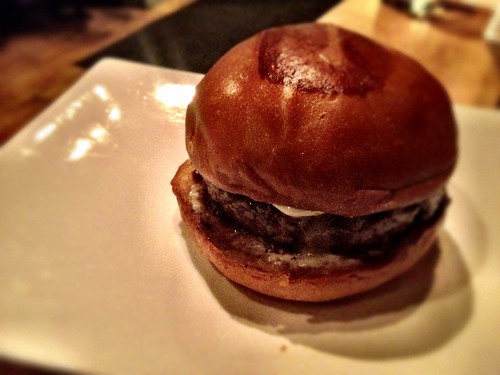
When I order fries with five unique flavors of ketchup from Ketchup or the Truffle Burger from Umami or even something from a food truck, I am transformed. I’m not the same girl who’s favorite restaurant was Papa’s Pizza back in Bend, Oregon and who would have regular orders at the four places I regularly frequented. I am now someone different, someone adventurous. Someone who can order an item with ingredients that they don’t recognize, and be willing to try it. Each meal is a new sensation; the taste, smell and feel all combining to create something compelling but often times replaceable by the next week’s choice.


It is the ordinary items that are hard to come by. I once made the rookie mistake of asking for an italian soda at Little Dom’s in Los Feliz. They had no idea what I was talking about, but someone at my table did get a fried oyster sandwich with crispy speck (still no idea what that is), arugula, and hot sauce mayo. This sandwich is hailed as “the best oyster po’ boy in Los Angeles” by “LA Weekly.”


Each meal ends with the inevitable question - would you like dessert? The answer is no every time. There’s always somewhere else to be.

-- Allie Flinn
Photo: Umami Truffle Burger, Joanne Wan via Flickr Creative Commons


Tuesday, February 14, 2012

My L.A.: Life on the Perch


PEOPLE WHO come to Los Angeles claim to be “searching for themselves” or “trying to experience personal growth,” but the truth is, there is no solitary experience to be had in L.A. With over 12 million residents and a population density of 8169 people per square mile, Los Angeles doesn’t cry out independence - but people continue to seek refuge in moving to L.A. to have their L.A. experience. There are not, generally speaking, quaint coffee shops walking distance from your home where you can write in your journal after a long day on the movie set. Your life in L.A. will typically be as it was anywhere else, because you are still going to be the same person. The trick is to find those places that make Los Angeles unique to you, and once you find them, keep them close. It’s easy to disregard a place you love because you don’t have time for it, especially if you’ve been sitting on the 405 for two hours.

From my balcony you can see into people’s backyards; people’s lives. And that’s really what L.A. is - you’re alone but you’re never alone. You might be having what feels like an individual experience and then come to realize that people can see you from their very bedroom. The streets of L.A. are no different - your phone conversation with your mother is a passerby’s entertainment. What you choose to wear and how you choose to act will be noticed by everyone you encounter and will, in most cases, be used as an instrument to put you into the box of a certain stereotype. People in Los Angeles are both nosy and keenly observant.


It is a city, but, well put by American poet Dorothy Parker, “Los Angeles is seventy-two suburbs in search of a city.” Within these suburbs lives hundreds of thousands of people trying to make L.A. their own. I live on the second story of a five-bedroom home in Westchester, and, yes, that means I live with six other college students - that doesn’t allow much time for me to reflect on just about anything. But my balcony is a haven for me. It is the first place in the house that the sun hits in the morning, striping my walls with its gauzy salmon zest and welcoming me in its whimsical way to another full day. There is something tranquil about going out there, taking a breath, and seeing nothing for miles but rooftops.


Many a morning on my balcony I can get lost in my head, zone out, and just be. If the houses weren’t there, I would be able to see straight into the beach, but the beauty of L.A. is that there are houses there with people in them looking for the same things we are. The Plain White T’s have a song called “Meet me in California,” where they sing “Meet me in California, I’ll be there waiting for your call / ‘Cause you know in California there’s something better for us all.” If I want Los Angeles to be a place that holds my brighter future, I have to hold on to the few places where I am able to unwind. In L.A. we are alone but we’re never alone, because we’re all here, right now, experiencing our own Los Angeles.

-- Jordan Younger
Photo Credit: Jordan Younger's iPhone