SINCE WE talked about our favorite writers and their unique voices, as well as what we specifically enjoy about their particular style of writing, I decided to share a passage from Mildred Pierce by James M. Cain. I have been reading this book per suggestion of Professor George in class in the attempt to expand my literary knowledge beyond my somewhat embarrassing and "guilty-pleasure" book choices which I will not name here. While I had some trouble deciphering and pinpointing what exactly I loved about "City of Thieves," my book selection for last class, I realize that in this case, it's Cain's attention to detail and ability to describe things in such rich color without being overpowering that I enjoy. This is illustrated in the following passage from the very beginning of the book, where he is describing the Pierce home:
" The living room he stepped into corresponded to the lawn he left. It was indeed the standard living room sent out by department stores as suitable for a Spanish bungalow, and consisted of a crimson velvet coat of arms, displayed against the wall; crimson velvet drapes, hung on iron spears; a crimson rug, with figured border; a settee in front of the fireplaece, flanked by two chairs, all of these having straight backs and beaded seats; a long oak table holding a lamp with stained-glass shade, two floor lamps of iron, to match the overhead spears, and having crimson silk shades; one table, in a corner, in the Grand Rapids style, and one radio, on this table, in the Bakelite style. On the tinted walls, in addition to the coat of arms, were three paintings: one of a butte at sunset, with cow skeletons in the foregound; one of a cowboy, herding cattle through snow, and one of a covered wagon-train, plodding through an alkali flat. On the long table was one book, called Cyclopedia of Useful Knowledge, stamped in gilt and placed on an interesting diagonal. One might object that this living room achieved the remarkable feat of being cold and at the same time stuffy, and that it would be quite oppressive to live in. But the man was vaguely roud of it, especially the pictures, which he had convinced himself were "pretty good." As for living in it, it had never once occurred to him." --James M. Cain, Mildred Pierce.
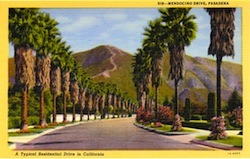
The amount of information that this entire paragraph provides without, to me at least, seeming like a rambling run-on sentence is astonishing. Also, I think this description helps the reader envision Glendale, California in the 1930s, which is where and when the book is set. The descriptions of the pictures on the wall were interesting to me as well because when I think of cow skeletons and cowboys, it's usually my hometown of Texas or some other Southern state that comes to mind before California does. A description of California to me now might be a palm tree, the beach, sandy shores, polluted air, or traffic, as cliche as that might sound. But I am forgetting, of course, the large Spanish population and influence that California has today as well as back then. As "The White Spot" reading taught us, Los Angeles was a settlement first founded in 1781 as a spanish pueblo. Only later was it reenvisioned as "the white spot of America," and so these descriptions make sense more sense with that in mind.
While I enjoy our class readings about the history of California, often a very informative way to learn about the history of a place is by reading a novel that is set in a certain time and attempts to capture this time through the plot and characters. I look forward to continue reading this book and pulling out more descriptive paragraphs such as this one, as well as learning about the history of California through its descriptions.
--Also, apparently it's also an HBO mini series starring Kate Winslet and others? Interesting. But my rule is to always try to read the book before seeing the movie!
-- Caroline Queen
-- Caroline Queen