Showing posts with label Vanished L.A.. Show all posts

Sunday, April 22, 2012

From Shepherd's Pie to "Sexy Tuesdays" and Back Again: Life at the Cock n' Bull Pub


WHEN DRIVING  by the Cock n’ Bull pub, the only thing that makes it stand out from the many other businesses on that stretch of Lincoln Boulevard is the big red British phone booth. The building is a bit old and faded, the door is wide open allowing you a glimpse of the patrons inside, and occasionally a person or two stand outside with plumes of smoke trailing out of their cigarettes. You might pass it by. Los Angeles is a made place furthered by establishments that run on gimmicks instead of authenticity. The Cock n Bull, a rare unpretentious establishment, could have been one of those places.
Julie Bray, who moved to Los Angeles 20 years ago, remembers a time when the only patrons at the Cock n Bull pub were elderly British gentlemen. Bray and her friends had a penchant for dive bars, and when they found the pub in 2001 it seemed like perfection - authentic, with excellent Shepherd’s Pie, and decidedly not crowded. “The average number of patrons even on a Friday or Saturday night was about 10,” says Bray, a welcome escape from the popular sweaty crowded dive bars or, perhaps worse, the uncrowded dive bars that were that way for a reason. The Cock n Bull had no reason not to be crowded, and Bray and her friends were not going to be the only ones to discover that.  
In the four years they frequented the pub, at any given time, Bray and her friends were the only women in the pub. This earned them the nickname “the girls” from the bartender. “We’d walk in and Dave, one of the bartenders and half owner of the bar, would call out ‘the girls are here,’” Bray says, though the only people there to hear him were the 70-80 year old men who, no matter the time of day, had been drinking for hours.
Given the limited conversation options, Bray spent a lot of time talking to Dave. “He even gave me a ton of barware to use on the tiki bar at my apartment,” says Bray. For her, with its dim lights and unique clientele, it was a haven away from the busy city.
That all changed the day the Cock n Bull was listed on one of the local TV stations as the best sport’s bar in LA, because it would open up at two in the morning every Saturday and Sunday to televise soccer games live from the UK. 
“After the television story it became really popular,” recalls Bray, “and it was crowded every night with up and coming hipsters.” Aside from the change in population, the bar’s appearance also took on a new vibe. The beloved Shepherd’s Pie was taken off the menu because it required so much time to prepare, and the bar, once lovingly dim, became more heavily lit. “No dive bar looks better with the lights on,” says Bray. Even the die hard, elderly British men were driven out of their spots. 
Before then, the only time the faded walls of the bar had been filled side-to-side was on the night of the Australian Rules Grand Final, an event Bray describes as “the Australian version of the Super Bowl.” Bray only attended one more Grand Final after the television story ran, because though she was used to the crowd on game night, that time she recalls, “The crowd was much different than before. A little edgier, a little angrier. So it was hot, annoying, and a little scary.”
As far as entertainment goes, Bray and her friends did just fine with the televisions, dartboards, and ratty pool tables. Now the pub offers theme nights like Thursday night trivia and “sexy” Tuesday salsa lessons. 
Sexy is the last word that comes to mind when picturing the pub. The lights are far too harsh and flickering to be sexy, and so are the clientele. On a recent Friday night, on the far side of the bar, tucked away in a corner a little darker than the rest of the room, are the remnants of the hipsters who came because of the television show. They sit and watch the door, looking each person who comes in up and down, as if they were the ones who discovered the place. Tight pants and beanies, with dyed hair and too cool glances, they thrive in the dark corner like unwelcoming moss.
Another group sits near the door and the dartboard, laughing and talking in voices tinged with British accents. They sit as if they are regulars, and unlike the posing group in the corner, greet visitors with friendly looks. The long bar with it’s tall seats, at first only punctuated with the occasional person, begins to fill up and fill in as the night goes on. Only one bartender works this Friday night. He is Dave, and he recommends the Carlsberg beer and speaks in a soft voice with a heavy accent.
It is the kind of place where you fear to use the ketchup bottles. A modern jukebox, mounted on the wall, is a jarring juxtaposition from the clear, shiny, faded, old beer signs that hang framed on the walls, along with a dartboard and a row of old guns that are lined up on a rafter near the ceiling. Behind that rafter are the pool tables, and a game is going on between a group of men who look like they go to a lot of dive bars. Though more people come in the later it gets, it only hints at the fickle crowds that used to come. Perhaps on game days it picks up. 
A mural of John Lennon provides a backdrop for a small raised platform that functions as a stage on live music nights.
The lights are too bright. An elderly British man sits at the bar, eyes glued to the TV, speaking only to dispute football (English, not American) with Dave. He stays there through all of the comings and goings that Friday night, on a stool that wasn’t chosen at random.
And the Shepherd’s Pie is back on the menu.

Photo via Cock n' Bull's Facebook page

Thursday, March 29, 2012

Vanished L.A.: The Exiles


This is the trailer from, The Exiles, the film by Kent Mackenzie, I was telling you all about last night. This is the larger project that came out of his time on Bunker Hill. If you can get a chance to see it you should. Another look at a vanished Los Angeles. This is why we need archivists who are really storytellers.

L.G. 

Friday, March 9, 2012

Coordinates: 3722 Crenshaw Boulevard

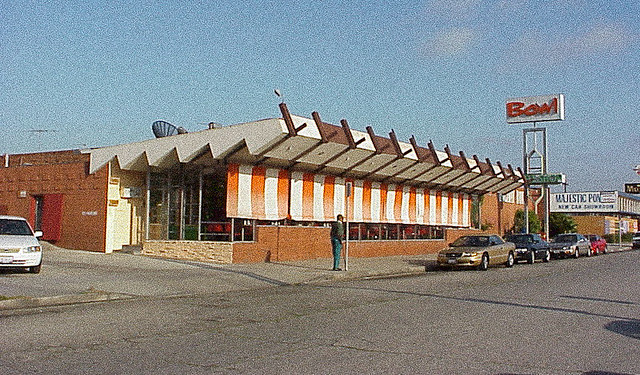
Then: The Holiday Bowl just before it's shuttering in the late 90s.

I REMEMBER the exact day my second novel, Southland, was born. It was the day in 1996 when I first went to the Holiday Bowl, a bowling alley and coffee shop in L.A.’s Crenshaw district. The coffee shop was full at that breakfast hour, the tables occupied by black and Japanese customers, mostly elderly, all eating together. A Japanese waitress in her sixties handed me a menu. They had hot links— and sushi, and red beans and rice, noodles, and of course, jambalaya.

At the next table sat a pair of elderly men, one Japanese, and one black. They were arguing about the Dodgers—the 1964 Dodgers—and it was clear this was a debate they’d been having for decades. Watching them, and all the people there, I thought I’d stumbled into heaven. Those Dodger fans reminded me of my own group of peers -- the black, Latino, and Asian kids who all hung out together, and whose friendships befuddled our less racially accepting parents. We’d had no models among our parents of such cross-racial ties, and so the older folks at the Holiday were a revelation. Sitting in the middle of that mixed-race crowd, it was as if I’d found my long-lost family.

The next week, I started researching the Crenshaw district. I learned that Crenshaw -- along the heart of L.A.’s black community—had once had a significant Japanese population. When Japanese-Americans were sent off to internment camps during World War II, their black neighbors watched over their houses. When African-Americans were speaking out during the civil rights movement, their Japanese friends stood beside them.

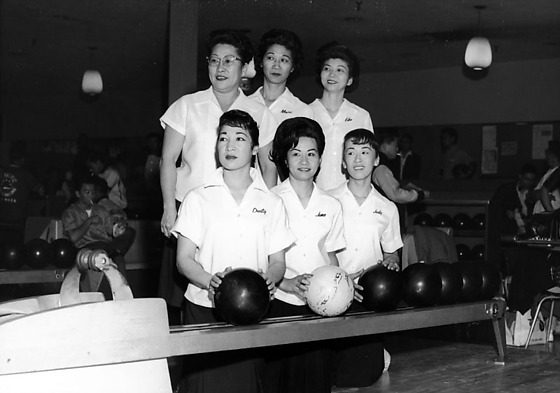
Holiday Bowl team, via Japanese Heritage Museum
That first visit to the Holiday Bowl lit my imagination, and I started writing my book a few months later. I took an idea that had been incubating for years—the rumor of an unsolved multiple murder during the Watts Riots—and set it in the Crenshaw district. My main characters were a Japanese-American shopkeeper and the black friends who spent time in his store. Several critical scenes took place in my version of the Holiday Bowl.

Two years ago, the Holiday was closed. It was purchased by real estate developers who want to demolish the old building and replace it with yet another strip mall. Now, while the city’s Cultural Heritage Commission is debating its fate, the Holiday stands empty, boarded up, and covered with graffiti.

Because my novel was just published this spring, I’ve been able to add my voice to all of the others who are trying to save the Holiday Bowl. But what I feel goes beyond my civic regret that a community institution may be destroyed. What I feel is personal. It’s as if the grandfather on whose knee I heard so many stories has slipped into a coma. And his condition, the imminent loss, makes me even more aware of my debt. Because the Holiday didn’t just give me a book—it gave me a history, a place to belong.
via synthetrix.com

I’m not vain enough to think that if the Holiday Bowl is destroyed, it will live on only in my novel. But I’m still struck by the sense that I captured something just before it was lost forever. And I think that other people are, too. I recently gave a reading here in L.A., and many of the people in the audience had some tie to the Crenshaw district, and those who did knew the Holiday Bowl. “My father bowled there after work,” one black woman told me. And a Japanese man had this response, which meant as much to me as any review: “You got it right,” he said, “Thank you. That’s just how I remember it."

 - Nina Revoyr

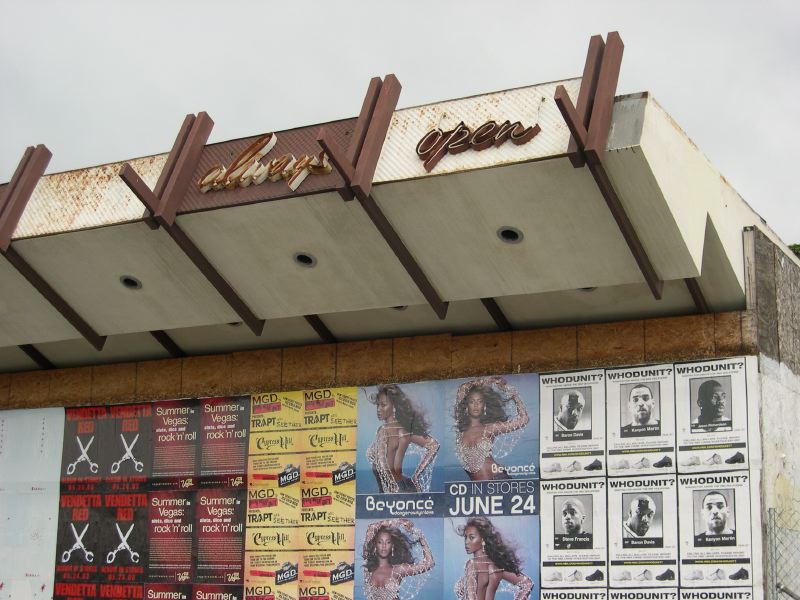
(Editor's Postscript: After a long, emotional fight, the Holiday Bowl building was saved and protected by  the Los Angeles Cultural Heritage Commission. The lanes and cafe are long gone -- replaced by a Walgreen's and Starbucks, but as you see below the architectural notes remain -- a reminder of mid-century intersections and  optimism.)

Now

Check out this site regarding the Holiday Bowl Project: http://holidaybowlcrenshaw.com/index.htm

Tuesday, March 6, 2012

Coordinates: Unearthing Vanished L.A.


SURFING THE internet a couple weeks back, I happened upon a website selling handmade trinkets -- mostly charms for bracelets, unusual earrings or cufflinks. They were conversation pieces; items that  commemorated buildings, streetcars, supermarkets, bakeries and beer-brands that hailed from New Orleans,  Louisiana  yet were physically no longer in existence. The webmaster had titled the page  -- "Ain't There No More" -- and I could hear that sentence delivered rapid-fire in one of my friend's or relative's idiosyncratic Louisiana Creole accents.

I have to say though, I thought, immediately, that the other L.A. -- our Los Angeles -- could have not occupied just a page, but an entire other city dedicated to what isn't here any longer.

Often, you'll hear Angelenos dolling out directions by referencing markers that were once in its place. It's a strange way to live in the present.  Our memories are cluttered with such locations. Some addresses have had multiple identities and lives within one building -- like a brick-and-mortar nesting doll;  others sites continue to be razed entirely and built up over and over again and so often, Angelenos really have to force  the recollection, because even the landmarks nearby have been "updated," "renovated," "retrofitted."

We live in a place filled with the promise of new beginnings and the impatient expectation of them. We want Los Angeles to be "the fix," the geographical solution to our problems. That's a lot to heap on a city's shoulders.

Above, you'll see a charming building, one that when I look at it conjures F. Scott Fitzgerald short stories or the beautiful black-and-white movies I would stay up at night to bathe in the blue glow of   on the old Channel 11-KTTV (decades before it was known as Fox). This was once the old  Hollywood Hotel and it stood  at the corner of Hollywood and Highland, which many of you know now looks - sigh -- like this below. 


As if we needed another mall, really.

In the next few weeks under the tag  "Coordinates" you'll be reading  posts from a couple of guest bloggers weighing in on various spots on L.A.'s vast grid  --   former empty lots, college hangouts, late-night watering holes,  down-at-the-heels  hotels  -- now turned into McMansions or coffee chains or any number of   mixed-use playgrounds.  What sort of memories and histories do these re-imagined spots hold or trigger? What old boundary lines did they once draw? What community did they once host?   

The above images come from the wonderful Facebook page, Vintage Los Angeles. Check it out for a mind-blowing compare and contrast of then-and-now L.A.

And below, check out the trailer for the film "Hollywood Hotel" in its black and white glory.


-- L.G.