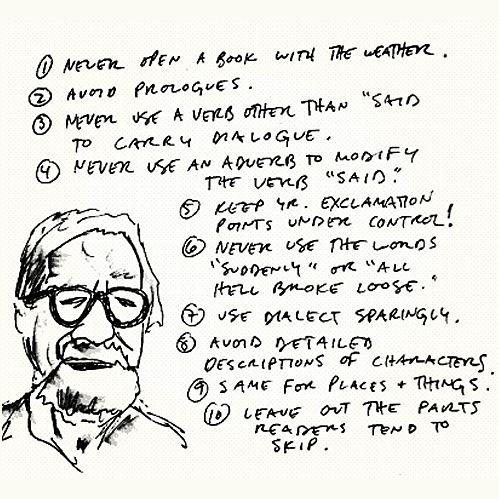
Pay attention in particular to #s 1, 3, 4 6 and 8. Well...that is just about all of them!
L.G.

"By comparing writing and psychoanalysis, I'm implying that finding your own voice as a writer is in some ways like the tricky business of becoming an adult. For a writer, it's also a basic instinct like a bird marking its territory, though not straightforward or so musical. So how do you do it? First, you do what all young people do: you try on different personalities for size and you fall in love. Young writers, in fact, are a peculiarly promiscuous lot . . . . First the writer's voice dazzles you and you read everything you can lay your hands on. If that doesn't cure you, the sickness goes critical and you become obsessed with the beloved's whole take on life: what he did, where he went, even the kind of people he slept with. You don't want to be like him, you want to be him. In retrospect, infatuation is as embarrassing as promiscuity, but for the writer it is a necessary part of the weary process of growing up."
"Nothing should be easier than talking about ways in which I write about myself, but I find it isn’t at all easy. Indeed, in writing about myself I encounter a problem that engages me even as I write this sentence. The problem is how not to write merely about myself. I think the problem is endemic among writers whether or not they are aware of it. The basic elements of writing—diction, grammar, tone, imagery, the patterns of sound made by your sentences—say a good deal about you, so that it is possible for you to be writing about yourself before you even know you are writing about yourself. Regardless of your subject, the basic elements, as well as countless and immeasurable qualities of mind, are at play in your writing and will make your presence felt to a reader as palpably as your handwriting. You virtually write your name, as it were, before you literally sign your name, every time you write.”— Leonard Michaels, “Writing About Myself” (via fsgbooks)

