Showing posts with label iconic l.a.. Show all posts

Monday, March 26, 2012

We Tell Stories: Jean Baudrillard

WE'VE ALL SEEN it from above but what do you see when you look down at the maze of light?

"There is nothing to match flying over Los Angeles by night. A sort of luminous, geometric, incandescent immensity, stretching as far as the eye can see, bursting out from the cracks of the clouds. Only Hieronymus Bosch's hell can match this inferno effect. The muted fluorescent of all the diagonals: Wilshire, Lincoln, Sunset, Santa Monica. Already, flying over San Fernando Valley, you come upon the horizontal infinite in every direction. But, once you are beyond the mountain, a city ten times larger hits you. You will never have encountered anything that stretches as far as this before. Even the sea cannot match it, since it is not divided up geometrically . . . . Mulholland Drive by night is an extraterrestrials vantage point on earth, or conversely, an earth dweller's vantage point on the galactic metropolis."

-- Jean Baudrillard

What do you see when you gaze down at Los Angeles?

(photo: los angeles at night; credit, b.mune flickr creative commons)

Thursday, February 9, 2012

Iconic LA: California Dreamin'


THERE ARE few places in L.A. as iconic of our city's spirit as the image of the Disneyland Castle.  To outsiders, L.A.'s mission statement is not so far from Disneyland's.  It is the place where dreams come true.  There is no better person to examine as a prime example of the materialization of dreams than Walt Disney.  Though he was born in Chicago, he fled to L.A. in pursuit of a career as an animator.  The indomitable Disney Co. makes it easy to imagine Walt Disney solely as an advocate of capitalism, but he really was a dreamer more than anything.  The reality of life was far less entertaining than what he could stir up with his imagination, so he found a way to re-imagine reality.  His work allowed viewers to slip out of the grim truths cast by the world around them, even if momentarily.
Disneyland is the prime example of a materialization of Disney's dream.  It was as if the magical world provided in his films was not enough, so Disney bought a huge sum of land and created a physical place where dreams could come true.There isn't a trouble in the world when you are at Disneyland.  Paradoxically, he created a magical reality, a real place where real problems didn't exist.

To many, the dream of coming to L.A. involves similar sentiments.  People don't come to Los Angeles to learn the disconcerting truth that they just aren't good enough to be an Oscar winning film director or a Hall of Fame musician, they come here to be realized for all the greatness they are.  If these beliefs are on part inspired, they also are one part delusional.  It propagates disappointment in the dreamers that flock to L.A. for fame, magic, resolution, and wealth.

An idea projected by Disney's enterprise is the thought that if you can imagine it, you can achieve it.  People come to L.A. to imagine and achieve wild dreams.  California dreamers have never been pragmatic folk.  Those with ordinary dreams can live in ordinary places, but those with extraordinary dreams live in L.A.

Growing up in LA, a city bursting with new ideas and creativity, has undeniably affected how my interests have developed.  It's impossible to be untouched by the California dream because LA is ornamented with places like Disneyland, where a magical Castle soars in the sky.  When it takes just a short haul to make it to "the happiest place on earth".   As a child, I remember getting lost in Disney's wonderland of magic.   There was a certain naivety to my marvel at the castle as a young child, much like a farmer in Kansas might have distorted perceptions of what LA is.  Last time I revisited the famed Castle to top off my evening with a bout of fireworks, I thought about Disney's dream and it was more than magic.  I saw vision, aestheticism, capitalism, all bundled up in a fantastical display.  As I thought about how the castle had come to mean much more to me as my city smartened me up, I remembered the famous words of Arthur C. Clarke, "Any sufficiently advanced technology is indistinguishable from magic".  As I enjoyed the visual display, I realized that the magic had not been lost, it was just better understood.

The ornate castle that serves as the center of action in Disneyland is a sublime symbolization and materialization of this dream.  The castle is primarily a pink-purple, clad in gold to defeat any remaining sense of subtlety it might have had.  The castle at night has perhaps an even more romanticized flare to it.  Purple lights allow the castle to glow as a shining emblem of the L.A. dream in the night sky.  As if this isn't picturesque enough, fireworks explode into the sky every single night that Disneyland is open. Since Disneyland is one of the first locations that your average tourist to California will visit, imagine this dream being imprinted in the minds of all visitors to our city.  After seeing the fireworks light up the night sky behind Disney's majestic castle, how could you not believe that L.A. is the place where dreams come true?

--Carey Uhl
Photo Credit: Lauren Nemec

Monday, February 6, 2012

Iconic L.A.: Flower and 5th Street


AS I sat in front of the Citi Bank building, passively waiting for my father to come down from his office to have lunch, I looked around and realized just how contrary everyone was to me. I felt out of place, like a child in an office building, surrounded by all these grown ups in suits and ties, holding briefcases and Venti Starbucks coffees. I waited at an empty bench that looked like it had hardly been sat on, directly in front of the 48-story tower, and watched businessmen and women shuffle in and out of the building. Oddly enough, there were about ten palm trees that surrounded me, in this concrete jungle, with not other trace of plant life around. I wondered to myself where each person was going, and even tried to guess. One man had a silver snake skin suit and a metallic briefcase, with grey hair and beard to match. He had a hurried and deliberate pace, as if he knew exactly where he was going and what he planned to do when he got there. I then saw a woman, dressed in a black skirt suit, frantically typing away on her blackberry as she sped walked out towards the city, seemingly entranced by the glowing screen. Everyone I made eye contact with seemed concerned or preoccupied with the next task at hand, and not a single smile was returned.


Downtown Los Angeles has always intimidated me, even going back to when my father used to take me to work with him as a child. Perhaps it was from being surrounded by these behemoth buildings, seemingly blocking out the sun and sky that created such a feeling. Even as I grew older, and would go to Lakers’ games, I still felt that if I were to wander around Downtown Los Angeles alone, I’d get chewed up and spit out. Just driving there and finding parking was a feat in and of itself, and there’s good reason for that, it was deliberate. Before the 1984 Olympics, the streets were normal, not a bunch of convoluted one-way streets and cramped driving lanes. The goal was to alleviate traffic and congestion that was anticipated with the coming of the Olympics, but it didn’t quite turn out that way, and today’s streets are the end result.


A city still trying to find its identity to this day has worked at expanding and making its name known, sans city promoters of the early 20th century. I saw these buildings as a sign of progress, and over the years I have seen the city grow exponentially, building magnificent cathedrals and music halls along the way. Downtown Los Angeles is a thriving city with thriving people in it, but they must remember not to get completely consumed by the city and their endless tasks, because it will chew you up and spit you out.


--Julian Portera
Photo Credit: Myself

Friday, February 3, 2012

Iconic LA: What Makes Los Angeles Los Angeles


DRIVING AROUND the city of Los Angeles makes you wonder about the identity behind all of the traffic signals and brake lights. What really give Los Angeles its character are those individuals who are not from LA. The adults with childish eyes who wake up every morning in their small town with open ended dreams of becoming famous, of Hollywood. The movies have given LA a leading role in a multitude of films that have changed the lives of many stargazed dreamers forever. Being one of these dreamers myself, I only thought of LA in terms of the movies, celebrities and the magic that consumes Los Angeles.

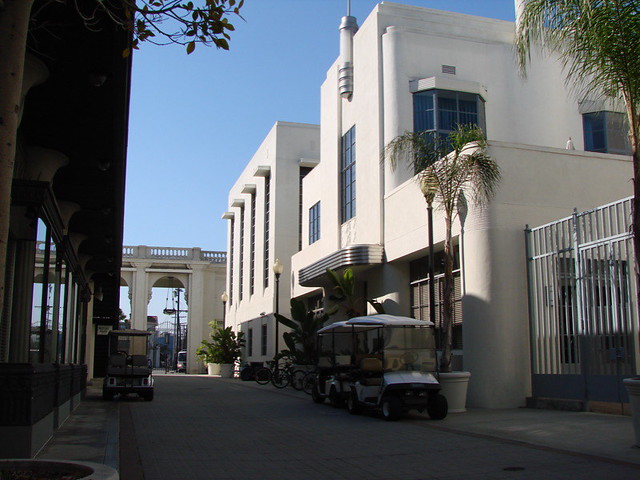
Sony Pictures is, for many, a place where magic happens, magic of the movies, where imagination and stories come to life. I remember the first time I walked down the Main Street of Sony. Small fifties style shops with old Hollywood style costumes fill the walkway with posters of the latest films, even a gift shop or two, line each side of the street in an attempt to keep the authenticity of the true movie industry alive, while still incorporating some of the more recent necessities like Yogurt Land and Coffee Bean. People bustle along each side of the street as the magic that once was Hollywood encapsulates every being. You can feel the glitter in the air as you glance around trying to take all the magic in. As you come to the end of Main Street, a skyline of sound stages enclose you away from the rest of the crazed world outside.

A city within a city, Sony Pictures resides at 10202 West Washington Boulevard and has been there since 1915 when, according to Sony Studios Tours, Hary Culver, the founding father of Culver City moved his own production studio to this legendary place. Although that is where the history began, it continued in the name of MGM Studios starting in 1924. The Golden Age of Hollywood thrived within the realm of the sound stages on Washington Boulevard, as MGM was responsible for some of the greatest films like Gone With the Wind, Ben-Hur, and The Wizard of OZ. Films like these and many more changed the lives of Americans just as they forever changed the industry. The sparkles that twinkle in the wind between every alleyway throughout the lot are there because of those who brought their talents together and brought the Oscars, the imagination, and the glitter to the street of Sony Pictures. The origin of the magic resides within in every nook and cranny of this cramped little town.

As you continue to walk through the lot, through the history, the sound stages begin to enter into the background, while before you stand an army of trailers, withholding some brilliant and some not so brilliant actors of our time. Behind you, you hear a booming voice say, “Quiet on the set.” And you turn around to watch, star struck, as a stunt double scales down flights of stairs on a fake New York apartment building set. The camera crew, lifted by crane fifty feet in the air, captures the scene through their viewfinder. Similarly, you capture the enchantment through your own eyes.

While you walk through the lot, you are forced to look up at the booming stages and only come back to reality as a golf cart zooms past nearly clipping your leg. Men in jeans and construction boots ride their bicycles back and forth gathering all the equipment in order to build the imagination that comes to life within the realm of the plain warehouse. While walking through the maze of buildings, golf carts, bicycles and construction equipment, you finally realize that you can be anywhere you want right now. You look into a sound stage and are transported to another world, a doctor’s office, a hotel room in Maui, or even a million dollar mansion. You can be anything or anywhere you want to be and you can feel the laugher of those that have come before us. You feel the present as a creation of the past.

Behind all of the technical equipment, contracts and business, at the end of the day, this is what so many hope-to-be-Angelos dream to experience. This is the character that LA has become and she has fantastically held the leading role in so many of the histories most memorable scenes. She is the giver of dreams to so many hopeless romantics.

She is Los Angeles.

-- Elise Fornaca

photo: backlot at sony pictures, culver city
credit: puck90 via flickr creative commons

Iconic LA: "An Ocean View"


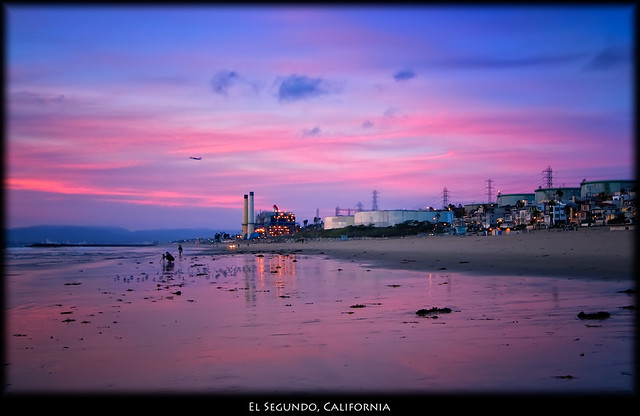
DRIVING WEST on Grande Avenue in El Segundo, CA is nothing really special. It could be any street in almost any part of the country. People running and walking their dogs, down the street lined with normal looking houses and apartments. Once your car gets past all of the houses, the sidewalk is now lined with tall trees, unsuccessfully covering tall fences on either side of the street. You follow the curve of the road and as you come around the turn you are smacked in the face with the endless, peaceful ocean. The ocean itself is a huge landscape of Los Angeles and yet the waves alone are not what make this scene distinct to Los Angeles.


Your perfect view is interrupted by the oil tanker sitting in the middle of your peaceful horizon. Your nostrils begin to fill with the fumes of rotten sewage and the ocean in front of you seems miles away. What would normally be the scent of refreshing seawater, perhaps littered with a whiff or two of ocean dwelling fish is now completely overcome with a smell worse than fish. As someone who absolutely despises the smell of fish this is huge to say. The rank odor of cleaning rotten water makes you feel as if you are underground, desperately trying to find a manhole somewhere to escape through. Unfortunately, the drive to get past the smell is over a mile long. The cause of this smell is the Hyperion water purifying plant to your right, and even with your windows closed the putrid smell starts to fill your car, overpowering any hope to smell the salty air the sea brings. One cannot help but chuckle at the line of palm trees that surround the entrance to the water plant, unfortunately palm trees do not have an odor that would mask the smell.


What makes this drive iconic of Los Angeles is the clear intertwining of the natural setting Los Angeles provides, such as the ocean, and then polluting it with factories and treatment plants. Utopia meeting arcadia is a theme seen all around Los Angeles even in the quaint little town of El Segundo. El Segundo tries so hard to be distinct from Los Angeles and yet that ocean drive would never be seen anywhere else. When you drive along the ocean going up to northern California, there are houses, little beach front towns and boardwalks galore, but no where else have I ever seen an ocean view paired with a Oil refinery and water treatment plant. Perhaps it is the adding of palm trees next to these unnatural existences that bring out the irony even more. The ocean will always be beautiful but the El Segundo beach may not be the beach people expect when they think of Los Angeles, but being disappointed is also something that is iconic of Los Angeles.


--Mickala Jauregui
photo: hyperion water treatment plant, el segundo
credit: szeke via flickr creative commons

Iconic LA: Chateau Marmont


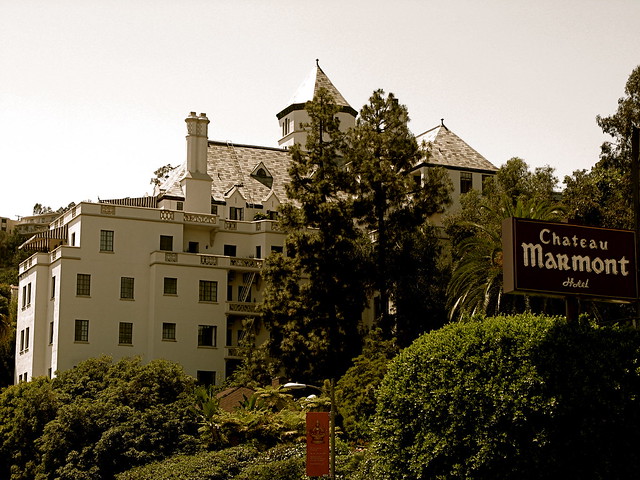
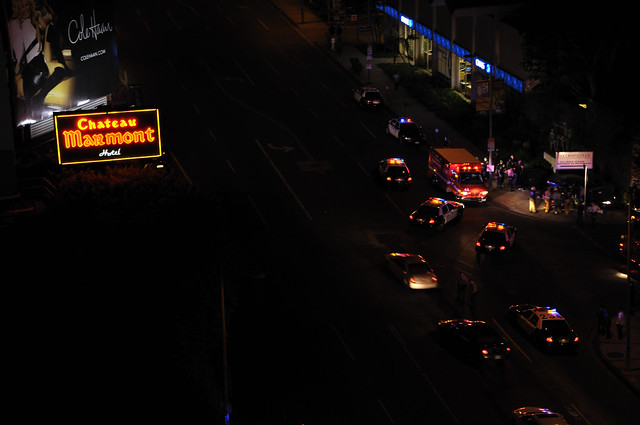
THE WORDS "Chateau Marmont" are synonymous with old glamour and luxury. The name alone conjures up pictures of stony castle walls and a high, imposing tower rising above Sunset Boulevard, appearing as a beacon to celebrities. The words, written on a lightly faded brown sign in lightly faded white letters, rise above the foliage that surrounds the hotel and glow softly in the nighttime. This stands in stark contrast to the other sign nearby - the one that glows brightly and draws people in with the promise of one thing: Liquor. Though the hotel is modeled after a royal residence in France, the scenery surrounding it couldn’t be any further from that depiction. Across the street, a strip mall complete with a McDonald’s shines in the darkness. Head lights and tail lights rush past. Everyone has somewhere to be.

Go there and the probability of running into a celebrity is high. The probability of getting in to the restaurant, as I understand, is substantially lower unless a reservation has been made far in advance, or you enjoy a certain “status.” It is a miniature castle peering out over the palm trees and billboards. The hotel is surrounded by bushy vibrant shrubbery which partly obscure it and add a barrier to keep out the rest of the boulevard.

At night the driveway to valet for the bar is usually softly lit, but drive by after a big event and it will be punctuated by the flashing bulbs of the paparazzi clamoring to take the best picture of the most important celebrities in attendance.

Chateau Marmont is a promise of old glamour, different from the promises of newer, modern hotels like The Standard which feature sleek lines and colorful lights. The stony hallways of the Chateau are filled with stories; legends of celebrities who have lived there, who have died there, and who have partied there.

Every time I drive by, I want to go in. Every time, there is an excuse. What if it doesn’t live up to my expectations? Worse, what if it does and I only get a moment there? I am not going to be a regular there, but there is that clinging hope that that’s only temporary. That one day, at some point, I will be a part of the mystery. Not just an outsider trying to look in.

The Chateau remains elevated and imposing, enveloped in its own mythic splendor, and this is the very reason it stands out from the rest of the street. Even the nature is excessive. Where else on a busy Los Angeles street could so much foliage be found? The Chateau has managed to create its own little world; an escape protected by castle walls and hazy glamour.

--Allie Flinn
photo credit: Keturah Stickann via flickr creative commons

Thursday, February 2, 2012

Iconic LA: Platform for Freedom

LOS ANGELES is the freeway: crisscrossing structures of concrete and steel, twisting into the transitory bliss of a momentary open road. The winding roads lead in and out of the many segregated parts of the city, connecting each through a rushing river of automobiles. Pavement cracks under the friction of mankind’s spinning wheel.                 

I could find no single part of the city that could encompass my conceptualization of Los Angeles. I racked my mind: Venice, with its murals painted across stone, Downtown’s historic core filled with fainted memories, Beverly Hills and all its glamour, Hollywood, with a star-studded walkway of the more or less famous, and East Los Angeles, a collage of tiny shops and, of course, the beloved taco stands. Undoubtedly, there is yet more for me to discover in the endless, sprawling city. In this way, the many distinct parts of Los Angeles combine to create one identity. To pick one place to represent the entire city would be impossible, for each is all too separate to describe another.
Yet despite the segregation of these areas, the layers of the city connect through the highways that run through them. From the overarching highway, my eyes capture the sight of the city’s sprawl encircled by distant mountaintops. To me, in all ways, Los Angeles is the road that is continually paved and repaved. It crumbles, and is renewed. It can be either a path to a dream fulfilled, or a road with a dead end. The life it sustains rushes and slows, whether it holds its citizens captive, or serves as their liberator.

People migrate to Los Angeles to escape and chase their dreams, seeking the opportunities unavailable anywhere else, simply because, well, it’s the City of the Stars. An open road awaits—most often at night—for the dreamers. Others, though, break against the pristine surface, victims to the daily grind, which is a continual beat upon pavement that shatters a glass-like illusion of perfection. They are stuck in a no man’s land, the road jammed between the forces of other citizens that together all say move forward.  
The highway brings the people of Los Angeles together in one circuit of flowing motion. The road may not always provide the mobility as originally imagined, much like the city’s sparkling, glamorous, but false illusion perpetuated by popular culture. The highway, much like the city itself, can be a platform for freedom, or for disappointment. There is no other place that I can imagine that might represent Los Angeles better than the roads that intertwine among such a diverse city. The city can be a morning sitting in traffic, trapped and frustrated, or it can be a night driving an exhilarating 70 MPH on an empty 405-freeway. Continually a conflict of capture and release, this is Los Angeles.
-- Jennifer Pellarito 

photos:  bossco via flickr creative commons (top), jennifer pellarito (bottom)

Iconic LA: Flower District


THIS is place that is both overwhelming and enchanting; captivating of the hustle and bustle of Los Angeles yet also stands still in time because of its non-renovated facade and its old-school charm. It opens at 3:00 in the morning, is closed for the day by mid-afternoon, and is visited by top executives, event planners, teenagers gearing up for their first date, business men remembering their anniversary at the last minute, and homeless people hoping for the daily turnover that they can sell on the streets. It is the embodiment of chaos with a purpose.


You can tell when you enter the flower district in downtown Los Angeles that you are entering into something distinctly urban; distinctly L.A. In the early 1900s, flower farmers came into the city by horse-drawn wagon to sell their flowers to the produce market downtown. There is something about the area that has not lost that agricultural magnetism – maybe it’s the idea that the simplicity of flowers are still salient enough to our senses that business is booming even in an economy like ours.


Upon approach, the Flower District is not an alluring area. Get off at San Pedro, keep left at the fork and merge onto East 16th, turn back onto San Pedro, turn left on East 8th, and take the 2nd right onto Wall St. First of all, how typical L.A. are those directions? It is almost impossible not to get turned around, especially because many of the streets downtown are one-ways with yielded turns. Once you get off the freeway, the store fronts are shabby and unkempt, and the further into the neighborhood you get, the less English signs you will see, and it can likely be guaranteed that you will not recognize a store in sight. But by the time you turn onto 8th street, your nose is filled with the aroma of fresh flowers. Everywhere.


The shops range from small mom and pop vendors to corporate sized warehouses with thousands of employees. There are splashes of graffiti on the outer walls, and workers out front bargaining with hopeful young sweethearts in search of the perfect bouquet. Banners that promise “The cheapest roses in town” and “The widest selection of sunflowers in Southern California,” all the while homeless men and women are wandering the sidewalks begging for change. Employees run after impatient event planners to place crates upon crates of the latest flower craze into the trunks their glossy Jettas. Free spirits who need a pick me up in the middle of their day saunter out of a shop with a single daisy or a decorative orchid.


I entered the flower district for my first time last week. A young blonde girl
with a long list of specifics about flowers to buy for an event – you would think if I was
noticed at all amidst the commotion it would have been in attempt to rip me off, but
instead I was greeted with remarkable help and friendliness from each individual vendor.
If they knew I could get a flower from someone else for a cheaper price, they would send
me in that direction. And if they knew I could not, they bet me with a smile on their face
that I wasn’t going to find a better offer.


No matter how high tech our country - and our beloved city - gets, there are certain attractions that have not lost their appeal and remain transfixed in time even in the depths of economic crisis. Endless traffic may have replaced horse-drawn wagons, and e-cards may have become a semi-acceptable substitute to the endearing anniversary bouquet, but it is satisfying to know that there is still an area of Los Angeles where people, literally, take their time to stop and smell the roses.
-- Jordan Younger

photo credit: Jordan Younger


Iconic L.A: Seeing Double-Double


LAST WEEK  I found myself dining double-double.

Our student government brought In-N-Out to campus to encourage students to vote for Homecoming court, and as our President I was sure to get my hands on some free In-N-Out. However, I also found myself driving back to In-N-out for dinner. As I arrived at the In-N-Out on Sepulveda Boulevard, adjacent to Los Angeles International Airport (LAX), I sympathized with anyone who might be unfamiliar with its parking. If you pull in to any of the two entrances you’ll soon learn that it’s your only option. This particular In-N-Out forces you to either get your food through their drive-thru or dine in depending on which entrance you enter. It screams, “Duh” to anyone who angrily is unaware of the parking lot’s diva division.

In addition to parking confusion this In-N-Out attracts an eclectic audience. It attracts the perennial travelers who fly into LA with In-N-Out in mind. These travelers will rent cars, and even walk through frigid fifty degree weather, to taste In-N-Out’s fresh version of fast-food. There are also the travelers from out of state that come into In-N-Out ready to test its tastes against their hometown burger joints. With the wait at In-N-Out it is always a pleasure to listen while you wait to eat. I commonly listen to the patrons around me as they discuss where they came from and where they are going. In addition, I listen to the LMU drama that unfolds within the booths as if they are somehow private spaces. I myself am guilty of this. I have ended casual relationships, consulted friends during hardship, and much more at this very In-N-Out. While the food is great, In-N-Out provides many with a casual place to celebrate and confide in others, because odds are that those around you are just one flight away from taking any secrets you have with them.

Speaking of secrets, we are all familiar with the traditional Double-Double, fries, and a milkshake combination defining In-N-Out’s success. It offers us the option of eating fast-food without fasting afterward. It’s “protein style” option allows us to substitute the bun for a large amount of lettuce to wrap your burger within. While this should really be called a “low carb style,” we never seem to question its healthiness. However, beneath their traditional menu lies a Secret Menu. A menu that allows you to order 4x4s, animal styles fries, a “Flying Dutchman”, well-done fries, cheese fries, and more. These secret items reveal that even In-N-Out is not as healthy as it has made itself out to be. However, In-N-Out now acknowledges their secret menu to a certain extend without physically advertising it. Whether it be L.A.’s obsession with simplicity or secrecy, it is evident that even In-N-Out has something to hide.

Last semester during finals week my roommate and I dashed to In-N-Out just before 1AM hoping to grab a midnight feast. Unfortunately, as we arrived at the door the clock struck 1AM and the location’s perennial security guard locked us out. Many times before this I made it right on time to be greeted by their overtly friendly and over-worked employees, but not tonight. As I stood outside I realized just how lonely the airport was without a Double-Double, fries, and a milkshake.

-- Art Flores

(photo credit: Dave77459 via flickr creative commons)

Andy Grammer: the Los Angeles musician


IT USED to be that when I saw musicians singing on sidewalks lining busy L.A. streets, I wouldn’t give them much thought. I’d make a sad attempt at polite with a “No, thank you” to the demo CD they offer me, or I’d walk by their penny-filled guitar case without even considering reaching into my wallet for a monetary acknowledgement of their (and their music’s) existence. Now I give these busking musicians a second thought, and for every occasional dollar bill I drop in a fedora or violin case, these musicians have Andy Grammer to thank for it.

Los Angeles – home to movie studios and record labels – is a city full of musicians, actors and filmmakers trying to “make it.” Many don’t find success. Some do. It’s hard to know just which of those lining the streets will make the transition to venues like the House of Blues and big stadiums. It’s hard to know what I would have thought of Andy Grammer’s music had I first heard it on a Santa Monica street instead of at a small show on LMU’s campus. But I do know that he is part of a lucky minority of singer/songwriters who have “made it,” and he’s a musician who strikes me as having a very L.A. story.

Grammer – born in L.A., raised in New York before moving back to L.A. at age 20 – got into the business with a combination of the quintessential ways to “make it”: have a family member in music, and play your heart out busking on the streets and performing small shows. His father is a singer-songwriter of children’s songs. But Grammer also performed for years on Third Street Promenade in Santa Monica, selling demo CDs to pay the rent before moving on to performing small shows at colleges around California then around the country.

Now he is headlining his own tour, and those college crowds have turned into a devoted following. And the other artists and performers who lined the Santa Monica street in his busking days? Grammer stays close to them and even invites them out on stage during his shows.

Most of his songs are ones you’d expect to come from spending so much time performing in sunny Santa Monica and to energetic, free-spirited college students: His music is uplifting and optimistic, calling for his listeners to “keep your head up” in his single of the same name.

When I interviewed him for The Hollywood Reporter last summer, I asked him if he sets out to be uplifting with his music. He responded, “My ultimate goal is to try to be real. It just so happens that I’m usually more happy than sad when I’m writing.”

His songs always do seem to succeed in tapping into those real experiences you have but may never admit to – in “Numbers” he puts into lyrics that thing we all have done at some point in our lives: assign numbers rating the hotness level of people we see out and about. He admits to feeling like “a 5 on a good day” and that “just one time I wish I could have a 9” while sending an anti-superficiality message, singing, “The value of personality seems to be dead. / We’re all walking around numbered with halos on our heads.”

But not everything that is real and authentic is all sunshine and rainbows in Grammer’s music. Perhaps no song of his has resonated more with me – truly struck at real emotion, the heart of what I’m feeling and what frame of mind I’m often in these days as a college senior going through ups and downs and freaking out about whether I’m going to have a job come graduation time – no song any more than “The Heavy and the Slow.” He sings, “If there’s anything to learn on Earth, / I’m certain it’s the heavy and the slow” and “Bruise me life. / Confuse me life. / Bring on the rain.” It’s a song about embracing the hardships and the sorrows that actually brought tears to my eyes when I saw him sing it at one of his shows, closing his eyes, swaying with the strumming of his guitar, getting more into the music than I ever had seen him be.

That performance of “The Heavy and the Slow” also was a tear-jerker for me because of how he introduced it, giving a shout-out to his mom, who died a few years back, leaving that Earth Andy sings about before he got his success and found his way in the music industry.

Just as Andy’s life is a mix of the joyful – like getting a record deal and starting his first headlining tour – and the “heavy and the slow” – like losing his mom too soon – L.A. is a blend of the two. It’s not all sunny Arcadia as it’s represented to be, just as New York most certainly isn’t all black clothing and gloomy weather as it’s often depicted. L.A. has the sunny weather and the smog, and even some rain. It’s a city where so much is fake and contrived – reality shows, anyone? – but right next to the phony there’s plenty that’s authentic and real, and that’s where artists like Andy Grammer come in.

Photo: Andy Grammer performing at the Anaheim House of Blues on Jan. 14, 2012. Credit: Emily Rome, courtesy of my oh-so-high-tech camera phone  

An L.A. Iconic Beach Town and the Sunsets


LOS ANGELES is an iconic city from the Hollywood sign to the pillar of lights at the Los Angeles International Airport. Wilshire boulevard and the Sunset Strip also make Los Angeles an iconic city. However these treasures do not tell me that I am in Los Angeles.

Hermosa Beach is my Los Angeles. It is fifteen minutes south of LAX and is only one mile wide and one mile long. The town has never received the same attention as the towns and beaches of Santa Monica, Venice or Malibu and remains a hidden gem. However as Hermosa Beach evolved over the years it has attracted more and more tourists, typically from surrounding Los Angeles areas.


I grew up in Hermosa and may be a little prejudiced, but the area where Pier Avenue meets the Strand is the center of an iconic beach town. The pier and the strand separate the town from the beach. Walkers, runners, bikers, surfers, skaters, and dogs, can be seen on either the pier, the strand, or the beach, and they are all as friendly as the California Tourist Board says they are. Hermosa embodies the ideal beach lifestyle. The atmosphere of Hermosa Beach is more relaxed and humbled compared to the glitz and glam our associated with the city of Los Angeles. The locals all know each other, including the homeless living under the pier, and people are dressed in Vans, bathing suits, and shirts made by locals.

Like Los Angeles, Hermosa Beach has evolved and morphed over the years. When I was growing up the people of Hermosa Beach took a lot of pride in being local. However, as more outsiders began visiting Hermosa and as my generation of locals grew up, the local pride began to decline, although it can still be seen. Although Hermosa Beach has always been a beach town that loves to party, it has evolved from a more relaxed beach town to a town dedicated to catering to entertainment needs. Local restaurants have closed down as more nightclubs cropped up. Pier Avenue was built for fun and entertainment. There is something going on in Hermosa almost every night, whether it’s going to a bar or a nightclub on the pier or catching a local band or a comedy show at the Comedy and Magic Club on Hermosa Avenue, adjacent to the pier.

For me Hermosa Beach is an escape from the stresses that are interlocked with Los Angeles. It is a much slower lifestyle with the tranquility of the crashing of the waves and the sea air. However, if I were to say that Hermosa is an escape from the notorious L.A. traffic, my neighbor would point out that the limited parking and the city’s propensity for issuing parking tickets any chance they get is a very good substitute. Parking in Hermosa can drive you as crazy as any 405 commute.

L.A. sunsets are iconic and they are breathtaking to watch from the beach with the sound and smell of the ocean. I love walking west on Pier Avenue and onto the beach when the sun is low in the sky and getting ready to fall behind the ocean. The low L.A. sun shines a beautiful orange light on everything and time and problems seem to fade away.


At this time I begin to appreciate the Los Angeles smog as it contributes to make the colors change in the sky. The sunset’s soft pinks are streaked across the clouds, vibrant reds and oranges paint the clear blue sky, and then finally the sky is dark with a handful of stars and airplanes that are mistaken for stars coming in and out of LAX. The sunsets in Los Angeles, especially when by the beach, makes me more appreciative of the natural beauty that can be found, but often goes unnoticed in the large city of Los Angeles. Nothing smooths my day more like my hometown Hermosa Beach and the beautiful sunsets I see everyday there.


-Nastassja Habers

Photo: Hermosa Beach 
Credit: Nastassja Habers

Wednesday, February 1, 2012

"Iconic L.A.": 5700 Wilshire


 "You will always be my friend no matter what. And if you go to Cali dreams of going to college in L.A. and writing for a magazine, I will come visit you and be a nanny there and we can live together."


 THOSE words have stayed with me ever since they were written in bubbly letters on a neon pink going away card from my friend Michelle before I left for school at LMU in 2008, terrified yet thrilled. Maybe that’s why, when I walked up to the corner of Wilshire Boulevard in Beverly Hills, California, I stopped in the middle of the twin office buildings and did a complete turn all the way around, taking in every sight. After painstaking college essays, SAT re-takes, ACT study sessions, and the gut-wrenching anxiety that I would not get into LMU, or any college for that matter, (fueled in part by my mother, who told me condescendingly yet with caring undertones to “not get my hopes up”) I was here, in downtown Los Angeles. When I stood there in the courtyard, shaking and sweating before my interview at Us Weekly, an interview which I thought at the time would make or break my future, would change my life completely, for better or for worse, would propel me into my editorial dreams or send me plummeting regretfully down a new path, I thought, “This is the L.A. I envisioned. This is what I wanted to be apart of."

I should explain that when I first landed at LAX and headed down Lincoln Boulevard, I felt a wave of disappointment and fear because this loud, traffic-infested street was the complete antithesis of the glamorous Los Angeles I envisioned. Where were the palm trees lining the sides of the road, and where were the teenagers driving around in their jeeps listening to music with the top down? Where was this gorgeous school with a bluff overlooking Los Angeles and white letters proudly boasting “LMU” on the side? Luckily, when I arrived at LMU, this fear diminished because I realized that our school is in its own separate world, in the quiet neighborhood of Westchester, separated from the busy streets and loud noises of Los Angeles. However, every time I left LMU to frequent other areas of Los Angeles, I always felt a twinge of disappointment, that this was not the “real” Los Angeles that I had seen in movies, television shows, and magazines. I always felt as though there was something missing or something that I was not seeing.

5700 Wilshire Boulevard feels like that kind of "real" Los Angeles to me. If you were to view it from above, you would see huge office buildings enclosing a little cluster of restaurants that almost seem as though they shouldn’t be there, as if maybe they were there before the big corporate buildings were and refuse to move. Office buildings surround these eateries, including the one that contains Wenner Media, where I work for Us Weekly. To the right and high above all else is a building called Museum Square, which proudly boasts “Screen Actors Guild Awards” towards it’s sky-high top. There is a fountain to the left of Museum Square that would put the LMU fountain, as it almost doubles it in size and in the magnitude of water it constantly produces. These buildings stand overlooking a cluster of restaurants, including Marie Callender’s, The Counter Burger, Baja Fresh, Mix’t Greens, and of course, Starbucks. Almost every day of the week, I could have a different choice of food, from home-cooked, to hamburgers, to Mexican, to vegetarian. However, in between all of these varying places, the Starbucks remains, a daily reminder of the need for Angelenos to get their coffee fix. Starbucks is the consistent factor within this little hub of eateries. Busy corporate CEOS, producers, writers, and interns hoping to climb the ladder, like myself, start their day the same, with an often thirty minute wait for Starbucks, but choose which cuisine to lunch on when the time comes for them to break away from their offices.


The people on this corner are always busy. There are no leisurely lunch breaks, no cigarette bonding sessions outside, and no walking slowly across the street. I find myself hurriedly walking alongside the businessmen and women attached to their cell phones with their big bags and laptop cases because I feel as though walking slow means I am not worthy to be in such a busy world. These people are walking fast because they do not have a second in their day to stop or slow down. The fact that I might be taking my time crossing the street, sipping my coffee slowly, or sloshing my “mix’t greens” around in a vat of fat free dressing with a lazy smile seems almost inappropriate. Don’t I have anywhere else to be? The corner of 5700 Wilshire holds special meaning for me personally because of the memories I associate with it, as well as that epiphanic first experience, but I think that anyone else could appreciate it for the variety of venues it possesses, from small restaurants to huge office buildings, and hurried, posh, “I have somewhere else to be right this second” lifestyle that feels intrinsically L.A.


-- Caroline Queen 

photo: 5700 Wilshire
credit: Caroline Queen

Monday, January 30, 2012

Iconic L.A.: "The Chateau"


THE SUNSET STRIP is an open wound, twinkling bacteria and brilliant billboards in shades of lime and tangerine and cherry litter the sidewalk. 

 The yellow train-car, rusted and repainted, a piece broken off from the forties, has been converted into a very narrow diner and complains lazily that LA has been written about and re-written about; seems to complain that everything in LA has been done. 
Beyond the train-diner are tufts of slender trees that play with the light and rise up into a microcosm of forest and a brief suggestion of wilderness.  Through the trees, a series of pale stone towers emerge, pointed and withered and majestic.  White cloth blows gently in the wind, stripped with tenuous gold. 


The grey shackled roof flickers light and dark swallowing up slits in increments, rows and rows of windows, no two the same size.  One tall, slender shrub juts up the front of the building, trying, unsuccessfully to penetrate.  Where the smooth, cream façade bends into an L, a light spray of bare, bony branches erupt over the outer wall.  They seem to shiver.  Palm trees and telephone wires collide amicably, making room for each other; they share rust, becoming one.  I am potently aware of my exclusion from their tight bond.

Directly in front of hotel stands a larger-than-life bottle-shaped advertisement for Absoulut Vodka, that can be recognized even from behind, a network of iron rails, also bottle-shaped.  Everything glows and blurs together as if I’ve consumed the entire bottle.
The Chateau Marmot on Sunset is a real place.  At sunset, when you have only heard the name in movies and internal monologue fantasy sequences, it doesn’t appear to be so.  It is more like a palace of mesh and lace, a mirage rising up from the burnt nothingness of Los Angeles terrain.  An apparition, most definitely, it has to be.  But it isn’t.  It is a real place (whatever that means), and real people eat and drink and smoke there.  Some of those people are even regulars.  But tonight may be my only night at the Chateau: the vodka mojitos we order are eighteen dollars each.  And it is things like this that expose it as a real place: the glossy red, white and black woven chairs, the charmingly uneven marble mosaic walls and tables, the touches of gleaming brass on knobs and handles, the cold and cruel smell of various liquors, mixing and chilling in the air like gaseous metal.  It is a real place that wants to be a fantastic mirage, most likely for business purposes, or something bigger, like our fear of being average pushes us to strive for the whimsical.  I am calmed, then excited, by the dream that I could vanish here behind these fantastic, phantasmagoric walls, never to face the outside world again.

The Chateau Marmot is built on an incline, into the base of the Hollywood hills.  It is modeled after a French-Normandy villa, intentionally crumbled and covered entirely in ivy, made to look delicate as table doilies.  Everything is tinged with nostalgia for the 1920s with classic art deco designs woven into the makeup of the building.  The elevator we ride up to the exposed courtyard is plated in gold leaf with intentionally scuffed up patches that give the narrow box a soft, cinematic glow.

-- Zahra Lipson


(image: robertjasoncross via flickr creative commons)

Thursday, January 26, 2012

Let's Get Lost: The Serendipity of Reporting

REPORTING, as we will discuss next week, is an open-ended journey. Sometimes you'll be assigned to go out into the world and "bring back" a very particular story,  a slant or an angle on a particular event or a shift in the culture.

The best stories, however, sometimes bloom out of not the story you went out the report, but the story that you didn't expect to find. In certain ways it's about taking a side road instead of the main road and being open to what you'll find.

Your blog post assignment for January will play on this idea of serendipity. What I'd like you to do is take a "side road" and "get lost" on purpose. That is, throw a figurative dart at a map and go down a street, into a neighborhood to an event, that you wouldn't ordinarily explore. Be a visitor.  Describe what you see using as many of your senses as you can. However, instead of summing things up, make sure your language is vivid, take us along with you. Be a camera.  Then, tell us what your impressions are: What surprised you? What put you off? What entranced you? What did you learn about this segment of Los Angeles? How does looking at L.A. from this perspective change your impression of L.A. as a whole?  You can add voices to your piece. You might meet up with someone who can tell you more about where you are, the history or the concerns, the secrets or the joy of this spot/street/outpost/intersection you've landed in quite by happy accident.

-- L.G.

Photo: The Reporter's Notebook
Credit: L.G.

Wednesday, January 25, 2012

Behind the Scenes of "The Sign"

THE VERY top of the iconic Hollywood sign. More than just nine letters spelling out a city's name, it is one of the world's most illustrious symbols.

A note: I did this hike two weeks ago. Sadly, you are unable to sit on the letters like they do in the movies.

-- Michael Flores

credit: michael flores