Thursday, February 16, 2012

My LA: Manhattan Beach


MANHATTAN BEACH reflects L.A.’s coastal attraction without telling you all about it. With that said, I am going to tell you a little about it. Originally owned by George Peck, this area was called “Shores Acres.” In 1901, John Merrill bought the south portion and hoped to name it after his old home in New York City—Manhattan. However, Peck was not in favor of Merrill’s suggestion, so the two maturely decided to flip a coin to decide on the name.
Whether heads or tails determined Manhattan Beach is up for debate, but my first tale from Manhattan Beach came by means of surfing. Local surfer Ryan Miller, who grew up surfing in San Diego, described surfing the beach’s El Porto break by saying, “the water is barely blue anymore because of the pollution and urban runoff, and the waves are nothing special.” Despite the water’s pollution, it continues to attract local surfers that are experienced enough to tackle big waves elsewhere, but settle for its close proximity. It also attracts inexperienced surfers that are looking for a place to get started. I viewed myself in this latter category the first time I got in the water. I was nervous and terrified. All I could see were waves crashing and surfers nearly crashing into one another. It seemed like driving through traffic without brakes. With all this in mind, I chose the most undesirable surf break, and left the best spots for those willing to rub surf wax with one another. After only days of surfing I soon learned that El Porto provided me with an opportunity to be comfortable in my own wetsuit and enjoy the waist to shoulder high, and occasionally overhead, waves it had to offer.
Since learning to surf I have had many more opportunities to enjoy what Manhattan Beach has to offer. For instance, while parking blocks inland from the beach to avoid overly priced quarter-per-ten minute parking I stumbled upon its residential neighborhoods. Even blocks from the sand many homes reflected the city’s beach theme. Three-story, light blue and white homes were piled among one another. One home had a large wooden sign in its front yard with arrows indicating the directions of the beach and work. In these areas, despite the lack of any view of the beach you can still smell a healthy dose of salt water, and the homes are tightly packed amongst one another as they would appear on the Stand. Speaking of the Stand, these homes sit with their feet buried in the sand reflecting various architecture and age, but all have one common denominator; the homes found here rival Bel-Air in terms of half-acre real estate by $15 million. Clearly, Manhattan Beach can be home to many walks of life. From professional athletes like Blake Griffin to everyday beach goers it offers a taste of L.A. without compromising its beachfront property.
As I have frequented Manhattan Beach for non-surf related reasons I have continued to enjoy what I have found. The Village offers commercial shopping and dining experiences with its mall and chain restaurants. While the shops restaurants between the beach and Sepulveda offer unique experiences, such as Uncle Bill’s Pancake House and The Kettle. As a college student it as has been a nice outlet at any time of day or night. With all these attractions in mind, it is no wonder that modern television utilized Manhattan Beach’s local high school and beach as a fictional representation of Orange County in Fox Television’s hit show The O.C.
--Art Flores
Caption: The Strand
Photo Credits: Mike Dunitz, beach-broker.com

STOP: My LA


THIS IS a busy city. LA is like the 405 within that short half hour in the afternoon when there is no traffic.  People have no idea what to do so they just drive and swerve from lane to lane, cutting you off in an attempt to get to their destination as fast as they can before the next wave of break lights begin to form in the distance.  LA is the fast cars and fast people, zipping in and out of your memory, cutting of any sort of the thought you may have.  For a city known iconically by its red brake lights that so many people despise, they can however, be the one thing they need; a break, to just stop and think.  Although a foreign idea to me, I would like to think that there is a place where you can just stop.  
            Then you do.  Break lights form as you turn the corner.  You stop—finally, you have stopped.  Instead of getting frazzled by the fact that there is nowhere to move, these break lights have actually come as a relief.  LA traffic is the only time when the city isn’t moving. As you slowly inch forward, working your way deeper into, what writer Louie Adamic refers to as, “the jungle.” Grey skyscrapers enclose around you as you become trapped between the broken white lines beneath the blue and gray painted ceiling.  Through the glass of your windshield, you finally see LA for what it is: red brake lights glaring through sunlit smog and people finally moving with one another toward entirely separate destinations. 
            Freeways define the city. They are complicated mazes that connect the beach with downtown and the suburbs. In 1996, Los Angeles was ranked 44th out of the largest 57 urban areas according to Federal Highway Administration Data.  According to writer and researcher Wendell Cox, Los Angeles has the nations worst traffic congestion because is has less freeway space per capita in most urban areas. This urban city continues to grow and it has become filled to the brim with all types of people, from all types of places, that all have one thing in common, the freeways they take.  The freeways doesn’t just connect places, it connects people, families.  They establish relationships, for they make it possible for the grandmother living in the Valley to see her grandchildren in Marina Del Rey and her older sister in Echo Park. 
            When the red break lights hit, you may be alone in your car, but you are surrounded by the congestion of thousands of people.  Through the windows, you can see into the lives of Angelos that you have never met.  The mother in the white Sequoia who laughs and sings along to the radio with her teenage daughters who, for that very moment, are not growing up; the high powered man who, for this moment, can sit in his black Mercedes and doesn’t have to pretend that he likes his job or that he really wants to get to where he is going; the a hopeful twenty-something, who sits in her beat up ford that is plastered with colorful bumper stickers and pauses from memorizing the script for her audition to actually look at the world outside of her duck taped window.  LA is a snapshot and the shots, that define LA, can only be taken through the horizon of red brake lights.
Photo credit: Elise Fornaca
“Why are we stopped?  We all have somewhere to go,” my friend, Andrew Pardo,  a Northern California native and now LA resident recently exclaimed as he sat in stand-still traffic. We've all been there.
  Yes, we all have somewhere different to go; yet we are all moving together.  In traffic, time freezes.  It is in these moments that you need to take in the world around you, because once the traffic picks up again, LA will flash before your eyes.   

Wednesday, February 15, 2012

My LA: Eclectic Avenues

 WALKING THROUGH downtown Santa Monica this past weekend was a stark reminder of the eclecticism that is Los Angeles. A man with no shoes, dressed in rags, sits on the floor alongside a couple of businessmen, sitting at a patio table of an upscale restaurant.  The pattern continued as the journey progressed, outdoor patios with carefree patrons, and the homeless, sitting on the floor next to them, with signs of desperation.
            Street performers and nonprofit workers filled the sidewalks.  Attempting to get donations and per chance get their name out there, or the organization they represent, these people put passion into their work, hoping that people would contribute to their cause.  I decided to stop and ask one person in particular about her situation, as she was asking for donations for her cats.  It turns out she was a part of a non-profit organization that helped rescue stray cats, and she herself had adopted all of the cats that she had with her, which amounted to about 15.  When I asked her why she decided to adopt all of these cats, instead of just drop them off at an animal shelter, she looked me directly in the eyes and passionately said, “Because if I wanted them to die, I would have left them where they were”. I felt embarrassed for asking and decided to donate to her cause, realizing that she was doing what she felt was the right thing.
            Most believe in the myth of Santa Monica. They see Santa Monica as a predominately upper- class area, with upscale shopping malls and five star restaurants to boot.  Most come to shop and perhaps visit the pier, and enjoy the beautiful ocean and view that it encompasses. The truth is there’s much more than that.  There are the people that inhabit it that make it a truly diverse community.  Whether it’s a beachfront property, or a park bench with nothing to comfort you but your guitar, these people are simply looking to make it in this city, no matter the age.
            I saw a little boy, no older than ten, walking by himself down the promenade, sporting bright red DJ style headphones covering his ears and bopping to the music. He was dressed in a plain black tee and brown skinny jeans, looking like the direct descendent of a “hipster” family, with high top Chuck Taylors to match.  This image made me realize just how eclectic this city is, and how my interpretation of reality and what is supposed to happen and how people are supposed to act, is really something only I’ve created.

--Julian Portera
Photo Credit: Myself

On Voice

"Nothing should be easier than talking about ways in which I write about myself, but I find it isn’t at all easy. Indeed, in writing about myself I encounter a problem that engages me even as I write this sentence. The problem is how not to write merely about myself. I think the problem is endemic among writers whether or not they are aware of it. The basic elements of writing—diction, grammar, tone, imagery, the patterns of sound made by your sentences—say a good deal about you, so that it is possible for you to be writing about yourself before you even know you are writing about yourself. Regardless of your subject, the basic elements, as well as countless and immeasurable qualities of mind, are at play in your writing and will make your presence felt to a reader as palpably as your handwriting. You virtually write your name, as it were, before you literally sign your name, every time you write.”
—     Leonard Michaels, “Writing About Myself” (via fsgbooks)

My LA: Bon Appetit

DON'T ASK me what their names are. Honestly, I can only remember a few - the standouts, fresh in my mind either by blowing me away or being much less than satisfactory. What they look like is an even more difficult question to answer. Most are just a blur of dim lighting and soft candles.

This is my Los Angeles.

Every Friday night, a new restaurant.

14,706 businesses have been reviewed on Yelp under the search terms “restaurants in Los Angeles.” How do you pick a place out of so many options? What draws me to a particular restaurant could be anything ranging from a celebrity sighting, to hearing about it on the Food Network, to driving past it on the way to a different restaurant and making a voice memo to remember it (I haven’t forgotten you, restaurant with the twinkly lights on Robertson who’s name is written in such a fancy font that I can not decipher it).

The timing for going out on a Friday has to be fine tuned to minimize the amount of traffic hit on the freeway. There are few things more frustrating than being forced to sit in a car for an undetermined amount of time when you are starving. This means leaving late, but does not guarantee the absence of traffic once off the freeway. The brake lights remind you at every pulse that if you were in practically any other city, you would be eating right at that very moment.

A new place almost every week necessarily calls for new directions. Looking out the car window, you are on the prowl for any indication of the restaurant, as well as for a place to park. The sky is dark and peppered with the lights of tall buildings and flashing signs; these are illuminated with the oncoming rush of headlights.

My Los Angeles is the knowledge that, no matter how wonderful the food is at a particular restaurant, there are so many other places to try that you will probably never be back.

The upside is that if the food is terrible, the same rule applies.

Part of me wants to settle down, the other part enjoys the thrill of not knowing exactly what the food put in front of you will taste like; whether or not you will like it.


When I order fries with five unique flavors of ketchup from Ketchup or the Truffle Burger from Umami or even something from a food truck, I am transformed. I’m not the same girl who’s favorite restaurant was Papa’s Pizza back in Bend, Oregon and who would have regular orders at the four places I regularly frequented. I am now someone different, someone adventurous. Someone who can order an item with ingredients that they don’t recognize, and be willing to try it. Each meal is a new sensation; the taste, smell and feel all combining to create something compelling but often times replaceable by the next week’s choice.


It is the ordinary items that are hard to come by. I once made the rookie mistake of asking for an italian soda at Little Dom’s in Los Feliz. They had no idea what I was talking about, but someone at my table did get a fried oyster sandwich with crispy speck (still no idea what that is), arugula, and hot sauce mayo. This sandwich is hailed as “the best oyster po’ boy in Los Angeles” by “LA Weekly.”


Each meal ends with the inevitable question - would you like dessert? The answer is no every time. There’s always somewhere else to be.

-- Allie Flinn
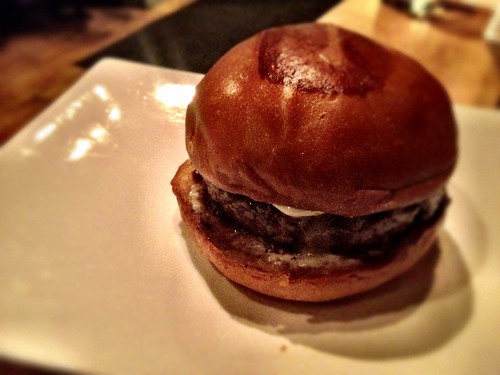
Photo: Umami Truffle Burger, Joanne Wan via Flickr Creative Commons


Tuesday, February 14, 2012

My L.A.: Life on the Perch


PEOPLE WHO come to Los Angeles claim to be “searching for themselves” or “trying to experience personal growth,” but the truth is, there is no solitary experience to be had in L.A. With over 12 million residents and a population density of 8169 people per square mile, Los Angeles doesn’t cry out independence - but people continue to seek refuge in moving to L.A. to have their L.A. experience. There are not, generally speaking, quaint coffee shops walking distance from your home where you can write in your journal after a long day on the movie set. Your life in L.A. will typically be as it was anywhere else, because you are still going to be the same person. The trick is to find those places that make Los Angeles unique to you, and once you find them, keep them close. It’s easy to disregard a place you love because you don’t have time for it, especially if you’ve been sitting on the 405 for two hours.

From my balcony you can see into people’s backyards; people’s lives. And that’s really what L.A. is - you’re alone but you’re never alone. You might be having what feels like an individual experience and then come to realize that people can see you from their very bedroom. The streets of L.A. are no different - your phone conversation with your mother is a passerby’s entertainment. What you choose to wear and how you choose to act will be noticed by everyone you encounter and will, in most cases, be used as an instrument to put you into the box of a certain stereotype. People in Los Angeles are both nosy and keenly observant.


It is a city, but, well put by American poet Dorothy Parker, “Los Angeles is seventy-two suburbs in search of a city.” Within these suburbs lives hundreds of thousands of people trying to make L.A. their own. I live on the second story of a five-bedroom home in Westchester, and, yes, that means I live with six other college students - that doesn’t allow much time for me to reflect on just about anything. But my balcony is a haven for me. It is the first place in the house that the sun hits in the morning, striping my walls with its gauzy salmon zest and welcoming me in its whimsical way to another full day. There is something tranquil about going out there, taking a breath, and seeing nothing for miles but rooftops.


Many a morning on my balcony I can get lost in my head, zone out, and just be. If the houses weren’t there, I would be able to see straight into the beach, but the beauty of L.A. is that there are houses there with people in them looking for the same things we are. The Plain White T’s have a song called “Meet me in California,” where they sing “Meet me in California, I’ll be there waiting for your call / ‘Cause you know in California there’s something better for us all.” If I want Los Angeles to be a place that holds my brighter future, I have to hold on to the few places where I am able to unwind. In L.A. we are alone but we’re never alone, because we’re all here, right now, experiencing our own Los Angeles.

-- Jordan Younger
Photo Credit: Jordan Younger's iPhone

Friday, February 10, 2012

In Response to Lautner: Ice Cube on Eames


WE SPOKE  a little bit about Pacific Standard Time: Art in L.A. 1945-1980, the sprawling art exhibition that stretches across the basin, finally joining L.A.'s art institutions like sturdy links on a chain (More on that later).  Part of the exhibition, however, includes this video of rapepr/actor Ice Cube musing on his city.


He is echoing many of the observations, concerns we've been discussing thus far and he's doing more than a bit of myth busting himself -- but as a booster in the very sense you all will be talking and writing about -- someone who lives, works and understands L.A. and its all its complexity.

This from L.A.-ist:
"so what" to people deeming L.A. "eyesore after eyesore," claiming, "They don't know the L.A. I know. The good, the bad and the ugly about L.A." His main stop is the Eames House in the Pacific Palisades, where he reveals his solid knowledge of architecture and design.

Check out the rest of the L.A.ist post here.

Now, I'm off to "go get lost"
-- L.G.